
Alex the parrot was no ordinary bird.
Alex was no ordinary bird. He was an African grey parrot who stunned the world by learning more than 100 words, understanding numbers, colors, shapes, and even abstract concepts—something scientists once believed animals were incapable of doing.
Alex was part of a decades-long research project led by Irene Pepperberg, who worked with him for over 30 years. Unlike parrots that simply mimic sounds, Alex demonstrated true comprehension. He could identify objects, count up to six, recognize zero, distinguish between materials like wood and metal, and correctly answer questions such as “What color?” or “How many?” His intelligence fundamentally changed how scientists understand animal cognition.
But Alex’s most powerful moment didn’t come in a lab—it came at the end of his life.
In 2007, the night before he died unexpectedly at the age of 31, Alex spoke to Pepperberg as he always did at the end of the day. His final words were not a trained response or a scientific prompt. They were words of connection:
“You be good. See you tomorrow. I love you.”
The next morning, Alex was gone.
Those final words left scientists, animal lovers, and researchers around the world deeply moved. Whether or not Alex fully understood the emotional weight of what he said, the moment highlighted something undeniable: the bond between humans and animals can transcend what science alone can measure.
Pepperberg later said those words haunted and comforted her at the same time. Alex had been her colleague, her student, and her companion for more than three decades. His death marked not just the loss of a research subject, but of a relationship built on trust, routine, and mutual recognition.
Alex’s legacy lives on in modern animal cognition research. He helped prove that intelligence, emotion, and communication are not uniquely human traits—and that other species may understand far more than we once allowed ourselves to believe.
For many, Alex’s final words weren’t just remarkable for a parrot.
They were a reminder that love and connection can exist across species—and sometimes, they speak back.
Source: Pepperberg, I. (2008). Alex & Me; National Geographic; Harvard University animal cognition research archives
:Hawaii’s rare happy face spider is real, found only there, naturally pigmented, and every individual looks different

Hawaii’s happy face spider is one of nature’s most delightful surprises, small, rare, and so visually striking that it looks almost unreal. Officially known as Theridion grallator, this tiny spider is found only in Hawaii and nowhere else on Earth, making it an extraordinary example of island endemism. What sets it apart is the vivid, smiley-face-like pattern on its abdomen, a marking that has fascinated scientists, photographers, and nature lovers for decades.
Despite its cheerful nickname, the happy face spider isn’t a single, uniform design. In fact, no two individuals look exactly the same. Some display bright yellow abdomens with bold red, black, or white markings that resemble smiling faces, abstract masks, or cartoon-like expressions. Others are paler or more subtly patterned. These variations are naturally pigmented, not the result of environment or diet, and are controlled by complex genetic mechanisms that scientists are still studying.
The spider is incredibly small, usually just a few millimeters long and lives primarily on the undersides of leaves in Hawaii’s native forests. It belongs to the cobweb spider family and builds small, irregular webs close to vegetation. Because of its size and habitat, it’s easy to miss unless you know exactly what you’re looking for.
One of the most fascinating aspects of the happy face spider is how quickly it evolved. Genetic research suggests that it descended from a single ancestral species that colonized the Hawaiian Islands millions of years ago. Isolated by geography and shaped by unique ecological pressures, the species diversified rapidly. The dramatic color variation is thought to be an evolutionary strategy, possibly helping the spiders avoid predators by confusing them or mimicking toxic insects though this is still debated.
Importantly, the happy face spider is harmless to humans. It does not bite unless severely provoked, and even then, its venom poses no danger. Its role in the ecosystem is beneficial, helping control populations of small insects.
However, like many native Hawaiian species, the happy face spider faces serious threats. Habitat loss due to urban development, invasive species, and climate change has reduced the availability of native forests where it thrives. Because it exists only in a limited geographic range, even small environmental changes can have outsized effects on its survival.
Scientists consider the happy face spider a powerful symbol of Hawaii’s fragile biodiversity. Its existence highlights both the wonder of evolution and the vulnerability of isolated ecosystems. Protecting native habitats doesn’t just preserve landscapes, it safeguards countless unique species that exist nowhere else.
In a world where so much wildlife is disappearing before it’s even documented, the happy face spider feels almost magical: a tiny creature with a painted smile, reminding us that nature still has surprises left if we choose to protect them.
Source: University of Hawaii – Department of Entomology
A French firefighter rescued a tiny kitten, adopted him, and now the cat happily lives at the fire station.
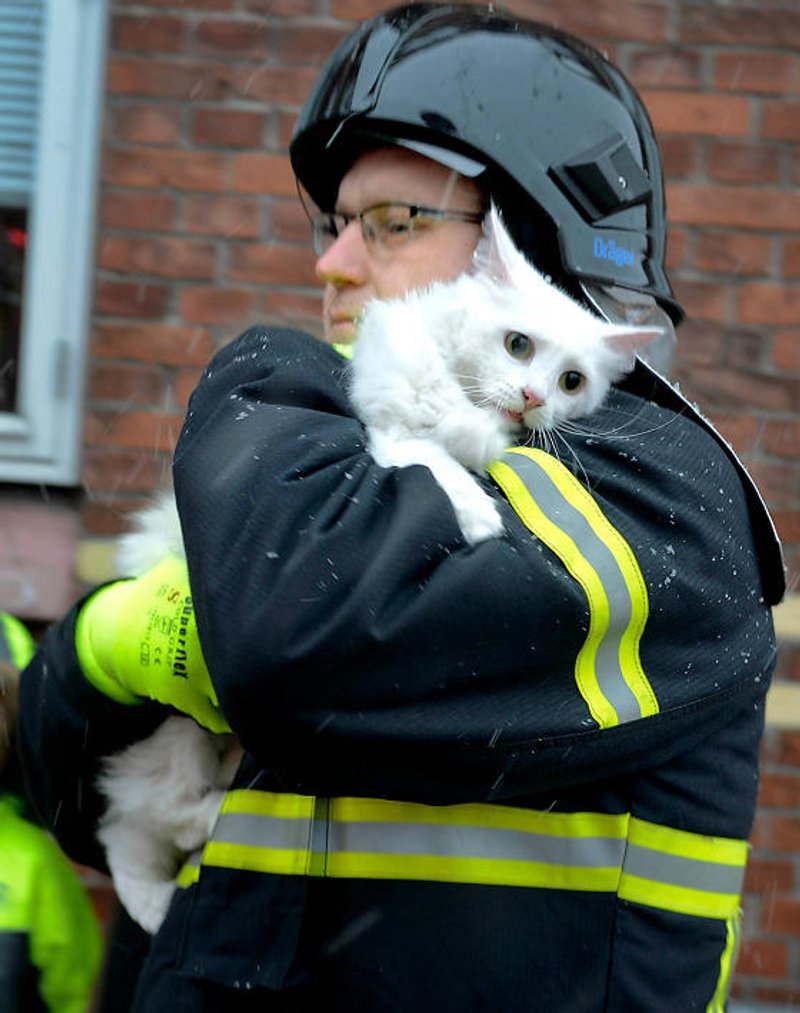
A heartwarming story from France has captured attention after a firefighter rescued a tiny, stranded kitten then decided he couldn’t let him go. Instead of taking the kitten to a shelter, the firefighter adopted him, and the little cat now lives happily at the fire station, where he’s become an unofficial mascot.
The rescue reportedly happened during a routine call, when firefighters heard faint cries coming from a hard-to-reach area. Tucked away and clearly frightened, the kitten was cold, underweight, and alone. One firefighter gently brought him to safety, initially intending only to make sure he was cared for and checked by a vet.
But sometimes rescues turn into something more.
After ensuring the kitten was healthy, the firefighter chose to adopt him and with permission from colleagues, brought him back to the station. There, the kitten quickly settled in, trading fear for comfort among sirens, boots, and turnout gear. Far from being stressed by the environment, he adapted with surprising ease, curling up on chairs, greeting firefighters after calls, and soaking up attention during downtime.
Photos of the kitten lounging around the station quickly spread online, melting hearts. Viewers loved seeing the contrast between tough emergency responders and a tiny cat who now rules the place. Firefighters joked that morale has never been higher and that the kitten takes his “station security” duties very seriously.
Station cats aren’t unheard of, but this one’s origin story struck a chord. Many commenters praised the firefighter for not only saving a life, but committing to it long-term. Others noted how animals often thrive in communal spaces where they’re surrounded by care and routine.
The kitten now has food, warmth, medical care, and what might be the safest home imaginable. In return, he offers companionship, stress relief, and a daily reminder of why firefighters do what they do: protect life, no matter how small.
Aloka, a rescued dog, walks with Buddhist monks, spreading peace and kindness across thousands of miles worldwide.
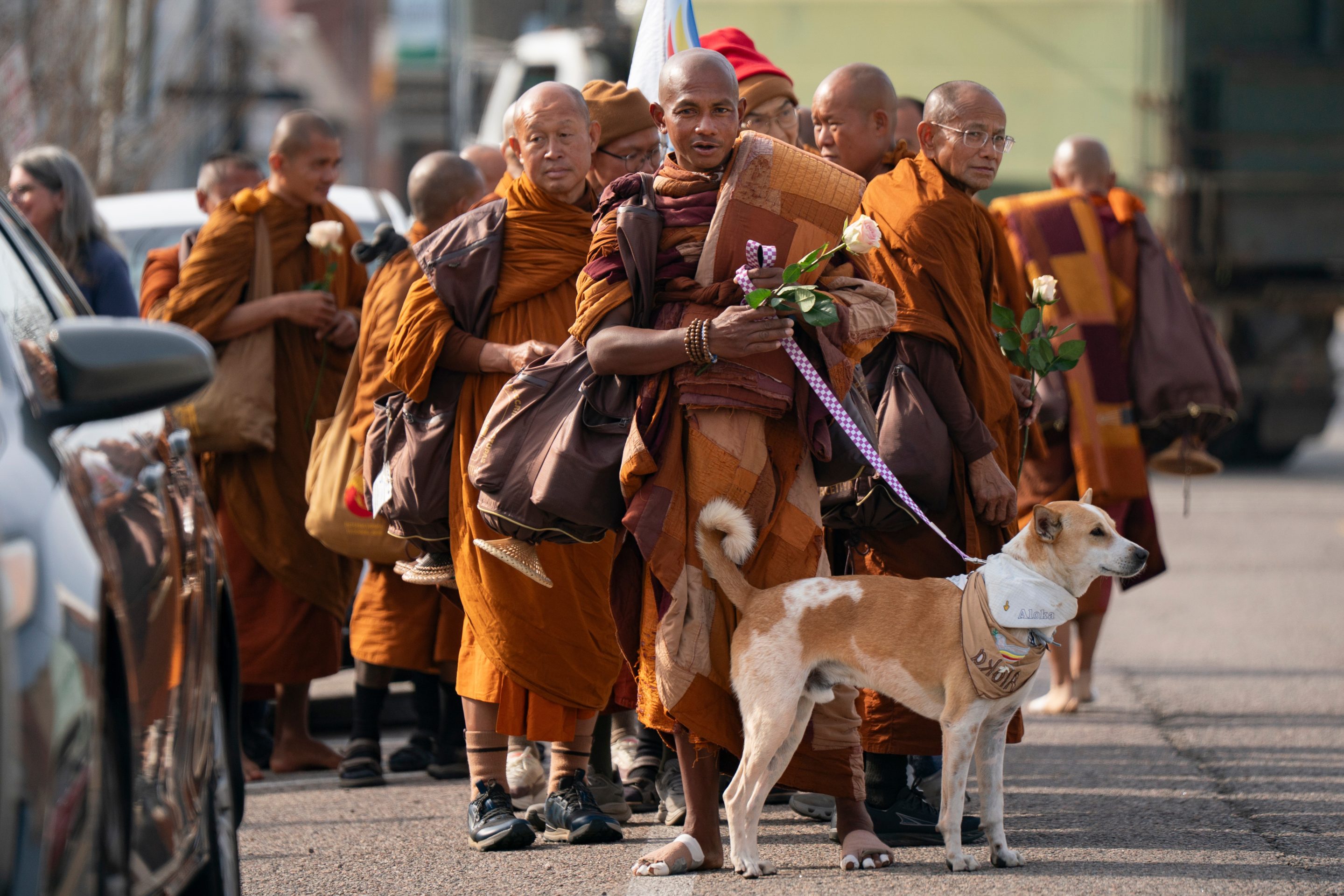
Aloka is not just a rescued dog he is a quiet symbol of compassion, resilience, and the unexpected ways kindness can travel the world. Once abandoned and vulnerable, Aloka’s life changed when he crossed paths with Buddhist monks who chose not only to save him, but to walk beside him literally across thousands of miles, spreading a message of peace wherever they go.
The monks, who follow the teachings of Buddhism, live a life rooted in non-violence, mindfulness, and compassion toward all living beings. When they found Aloka injured and alone, helping him was not a choice, it was a natural expression of their values. They treated his wounds, fed him, and gave him a name. “Aloka” means light or clarity in Pali and Sanskrit, a fitting name for a dog who would soon touch hearts across continents.
What makes Aloka’s story extraordinary is what came next. Rather than leaving him behind, the monks allowed Aloka to join them on their long walking pilgrimages journeys that span countries and continents. Side by side, barefoot monks and a once-forgotten dog began moving through villages, cities, mountains, and roads, creating scenes that felt almost unreal. A dog calmly pacing among monks in saffron robes became a living image of harmony.
Along the way, Aloka became more than a companion. He became a bridge. Strangers stopped to ask questions, take photos, or simply smile. Children approached without fear. People who might never have spoken to monks before found an opening through the dog quietly walking at their side. Aloka didn’t bark sermons or demand attention; his presence alone softened hearts.
The monks say Aloka mirrors their practice: staying present, moving forward step by step, accepting kindness, and offering trust without condition. He walks long distances without complaint, rests when they rest, and seems instinctively attuned to the calm rhythm of monastic life. In return, he receives food, care, and something far more valuable: a sense of belonging.
Animal welfare advocates often point to Aloka’s journey as a powerful reminder that rescue doesn’t end with survival. True rescue is dignity, companionship, and purpose. Aloka was not “saved” to be hidden away; he was welcomed as an equal traveler on a shared path.
In a world overwhelmed by conflict, noise, and division, the image of a rescued dog walking peacefully with monks across borders feels almost radical. No speeches. No signs. Just quiet movement, shared kindness, and trust.
In the Japanese mountains rest the bodies of monks who mummified themselves alive to become living Buddhas

High in the remote mountains of Japan, preserved bodies of monks sit in quiet temple figures so still and intact that they appear merely asleep. These monks are known as sokushinbutsu, individuals who deliberately mummified themselves while alive in an extreme spiritual practice meant to transform the human body into a living Buddha.
The practice emerged within certain ascetic sects of Buddhism, particularly among Shingon monks between the 11th and 19th centuries. For these monks, sokushinbutsu was not suicide, but the highest form of devotion an act of total renunciation meant to transcend the cycle of death and rebirth and continue helping humanity eternally.
The process took years, sometimes over a decade. Monks followed a strict, multi-stage ritual designed to remove all fat and moisture from the body, preventing decay. For the first phase, they consumed only nuts, seeds, roots, and bark found in the mountains, combined with intense physical labor to burn every trace of body fat. This phase could last up to 1,000 days.
In the next stage, the monks drank a toxic tea made from the sap of the urushi tree (used to make lacquer). The poison caused severe vomiting and dehydration, killing parasites and bacteria while slowly poisoning the monk’s body making it inhospitable to decay after death.
Finally, the monk was sealed alive inside a small stone chamber barely large enough to sit in the lotus position. A narrow air tube allowed breathing, and a bell was rung once a day to signal that the monk was still alive. When the bell stopped, the air tube was removed, and the chamber was sealed completely.
After another 1,000 days, the tomb was opened. If the body had successfully resisted decomposition, the monk was declared a sokushinbutsu, a living Buddha and placed in a temple for veneration. If not, the monk was still honored for devotion, but not elevated to this sacred status.
Out of hundreds who attempted the ritual, only a few dozen succeeded. Today, around 20 recognized sokushinbutsu remain, primarily in the Yamagata region near the sacred mountains of Dewa Sanzan. They sit clothed in robes, often behind glass, nails and facial features still visible centuries later.
Modern Japan banned the practice in the late 1800s, viewing it as inhumane. Yet the preserved monks remain protected as cultural and religious treasures, drawing visitors from around the world. For believers, these are not corpses, they are teachers who never left.
The sight is unsettling, awe-inspiring, and deeply humbling. These monks chose unimaginable suffering not for fame or fear, but for compassion believing that by denying their own body, they could continue guiding others toward enlightenment.
In the silent mountain temples, surrounded by incense and prayer, the sokushinbutsu remain proof of how far faith can push the human spirit, and how devotion can blur the boundary between life, death, and eternity.
Source: National Museum of Japanese History
“ICE DID NOT BRING CHAOS TO OUR CITIES. CHAOS BROUGHT ICE TO OUR CITIES” WOULD YOU AGREE WITH THIS STATEMENT?
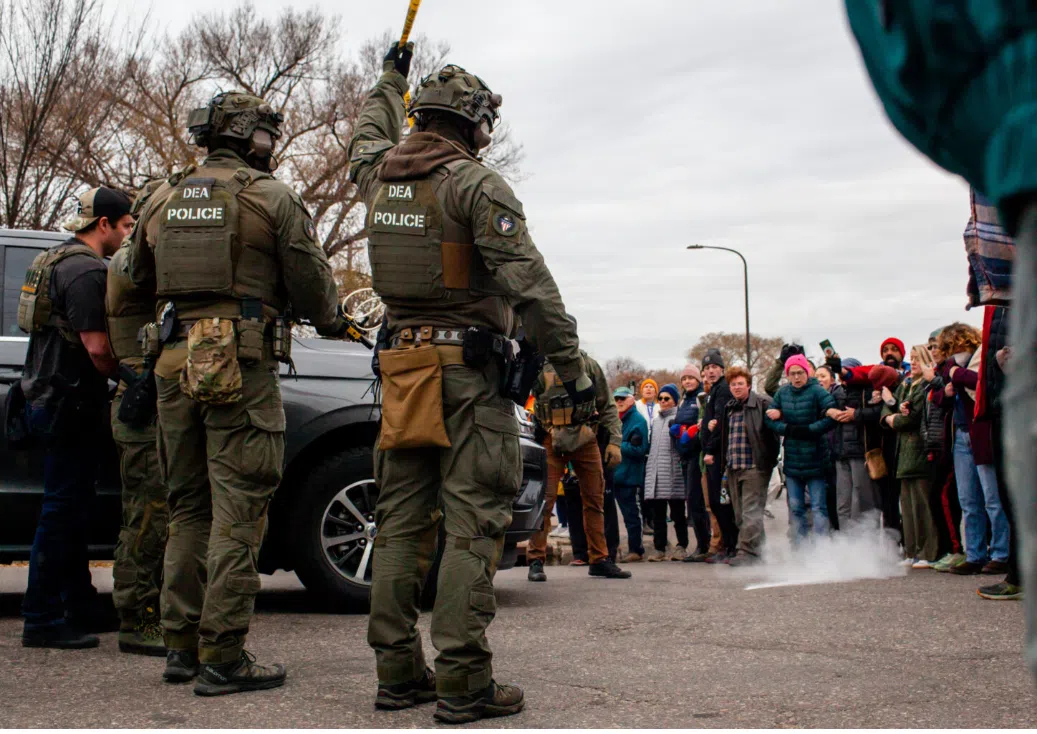
The statement “ICE did not bring chaos to our cities. Chaos brought ICE to our cities” argues that immigration enforcement is a reaction to pre-existing social disorder rather than its primary cause. Supporters of this view see immigration policy as part of a broader system responding to economic inequality, strained public services, political polarization, and fears about crime. In this framing, U.S. Immigration and Customs Enforcement operates where governments perceive instability, suggesting that enforcement emerges from conditions that already exist rather than creating them outright. ICE, then, is understood as a symptom of deeper structural failures, including a broken immigration system, inconsistent federal policy, and decades of neglect that left cities struggling to manage population growth and labor demands. Proponents argue that if these underlying issues were addressed through comprehensive reform, economic investment, and clearer legal pathways, the perceived need for aggressive enforcement would diminish.
Critics, however, argue that this statement minimizes the very real disruption caused by ICE operations. Raids, detentions, and deportations can lead to family separation, workplace instability, and widespread fear, even among legal residents and citizens. This fear often erodes trust in local institutions, discourages people from reporting crimes or seeking medical care, and destabilizes neighborhoods that were otherwise functioning. From this perspective, ICE does not merely respond to chaos but actively produces it through its practices and scope.
The slogan also risks shifting accountability away from policymakers by framing enforcement as inevitable rather than as a political choice. Immigration enforcement levels vary widely across administrations, budgets, and rhetoric, demonstrating that ICE’s presence is shaped by deliberate policy decisions, not just social conditions.
A more accurate understanding recognizes that cause and effect are intertwined. Social instability can drive increased enforcement, while enforcement practices can intensify instability, creating a self-reinforcing cycle. While the statement is rhetorically powerful, it oversimplifies a complex reality. Both the conditions that precede enforcement and the consequences that follow must be examined to move toward solutions that balance security with human dignity.
SOUTHAMPTON MAN ANGRY AFTER NEIGHBOUR STEALS HIS SNOW TO COMPLETE THEIR SNOWMAN
A man in Southampton has sparked amused disbelief online after expressing outrage that his neighbour allegedly stole snow from his property to finish building a snowman, turning an otherwise cheerful winter moment into a frosty neighbourhood dispute.
According to reports shared widely on social media, the incident occurred after a rare and much-celebrated snowfall blanketed parts of southern England. With snow being a limited and fast-melting commodity in the region, residents rushed outdoors to enjoy it while it lasted. Among them was the Southampton man, who later claimed that his neighbour had deliberately taken snow from his garden without permission to complete their own snowman.
The man reportedly noticed patches of snow missing from his lawn and driveway and soon realized where it had gone. Just a short distance away stood a freshly finished snowman in his neighbour’s garden larger and more complete than others nearby. Feeling wronged, he confronted the situation publicly, describing the act as inconsiderate and disrespectful, especially given how uncommon heavy snowfall is in the area.
While no laws were broken, the story quickly gained traction online due to its sheer absurdity. Many people reacted with humor, joking that snow theft might be “the pettiest crime of winter” or that the neighbour should be congratulated for “creative resource management.” Memes followed, with users mockingly calling for snow ownership deeds and imaginary snow police.
Others, however, sympathized with the man’s frustration. Some pointed out that boundaries still matter, even when the object in question is snow. In their view, taking anything from someone else’s property without asking no matter how temporary or trivial crosses a line. A few commenters argued that the neighbour could have simply asked, turning the moment into a shared laugh rather than a source of tension.
The incident also highlighted how rare snow can amplify emotions in parts of the UK where it doesn’t fall often. Snow becomes a novelty, a limited resource to be enjoyed before it melts away. That scarcity can turn small actions into big reactions, especially when neighbours already have strained relationships.
Local residents reportedly treated the situation lightly, with no formal complaints made. The snowman itself became something of a local attraction, with passersby stopping to take photos, some joking that it was “built with stolen goods.”
Ultimately, the dispute melted away almost as quickly as the snow itself. By the next day, warmer temperatures had erased most traces of the snowfall, leaving behind little more than muddy lawns and an internet story that entertained thousands.
While the argument may seem trivial, it served as a reminder that even the smallest misunderstandings can escalate when communication breaks down. In the end, the Southampton snow saga became less about stolen snow and more about human nature how scarcity, pride, and boundaries can clash, even in the most innocent of winter moments.
Source:Local UK community reports and viral social media posts
AMBER HEARD LOST THE ABILITY TO SPEAK ABOUT JOHNNY DEPP

Amber Heard is often described online as having “lost the ability to speak” about Johnny Depp, but the reality is more legal than literal. What she has effectively lost is the freedom to speak publicly without serious legal and financial consequences, following the highly publicized defamation trial and its aftermath.
After the 2022 defamation verdict in Virginia, in which a jury largely sided with Depp, Heard became legally constrained in a way few public figures experience. While no formal lifelong gag order exists, the verdict and the subsequent settlement created a powerful chilling effect. Any new public statements about Depp could potentially expose her to further lawsuits, financial penalties, or accusations of violating settlement terms. In practical terms, that means silence is the safest option.
Heard later settled the damages, agreeing to pay a reduced amount rather than pursue a prolonged appeal. As part of that resolution, both parties issued statements saying they wished to move on. Since then, Heard has avoided mentioning Depp by name in interviews or public forums. Legal experts have noted that even indirect commentary could be risky, as defamation law focuses on whether statements harm reputation, not just whether names are spoken.
This silence has fueled the narrative that Heard has been “silenced,” especially among supporters who argue that the trial itself punished her for speaking about alleged abuse. Critics counter that the verdict reflects findings about false or defamatory statements, not a blanket prohibition on speech. The truth sits uncomfortably in between: Heard is technically free to speak, but functionally constrained by the legal and financial risks of doing so.
The broader cultural impact has been significant. Advocacy groups and legal scholars have warned that the case may discourage others, particularly women from speaking publicly about alleged abuse, fearing similar backlash or litigation. Heard herself hinted at this concern in her post-verdict statements, saying the outcome set her back “decades” in terms of what victims can expect when they speak out.
Meanwhile, Depp has largely returned to public life, projects, and interviews, benefiting from a verdict that publicly rehabilitated his image. The imbalance in who can safely speak and who cannot has become part of the ongoing debate surrounding the case.
In short, Amber Heard did not lose her voice in a physical or legal absolute sense. But in the court of law and public opinion, the cost of speaking has become so high that silence is the only viable option. Whether one sees that as justice served or speech suppressed depends largely on how one views the trial itself. What is undeniable is that the case has reshaped how public figures and ordinary people calculate the risks of telling their stories out loud.




Leave a Comment