

Sophie Turner and Joe Jonas have moved into a “beautiful” co-parenting era in 2026, with both finding new love after their 2024 divorce settlement.
In a January 2026 interview with The Guardian, Sophie Turner, now 29, reflected on the “nesting” period of her 20s as a vital break from her Game of Thrones fame. While she and Joe Jonas finalized their divorce in September 2024 after a publicized custody battle, they now maintain a harmonious co-parenting relationship for daughters Willa (5) and Delphine (3). Jonas has recently “soft-launched” a serious romance with Puerto Rican model Tatiana Gabriela, who has already begun bonding with his daughters. Meanwhile, Turner is focusing on her physical health after intense training for her lead role in the 2026 Tomb Raider series uncovered a chronic back condition. Despite the “mum guilt” she admits to feeling while rebuilding her career momentum, Turner remains happily settled in the UK, stating she never wants to leave her home country again.
Sophie Turner is celebrating the “grounding” nature of early motherhood while gearing up to play Lara Croft in the 2026 Tomb Raider series.
At 29, Sophie Turner describes her daughters Willa (5) and Delphine (3) as the “right break” from a career that began when she was just 14. While her 2024 divorce from Joe Jonas was marked by a tense custody battle, both stars confirmed in late 2025 that they have established a “beautiful” co-parenting relationship. Turner is currently navigating a major career resurgence, with her heist thriller Steal premiering on January 21, 2026, and filming for Amazon’s Tomb Raider reboot officially beginning this month. Despite her $10 million net worth and aristocratic connection to ex-boyfriend Peregrine Pearson—from whom she reportedly split in late 2025—Turner remains candid about the “stalled momentum” of her 20s. Most recently, she revealed that intense training for her role as Lara Croft helped uncover a chronic back condition, a challenge she is managing as she returns to the spotlight.
In 2018, Jacinda Ardern made history as the first world leader to bring a baby into the UN General Assembly.
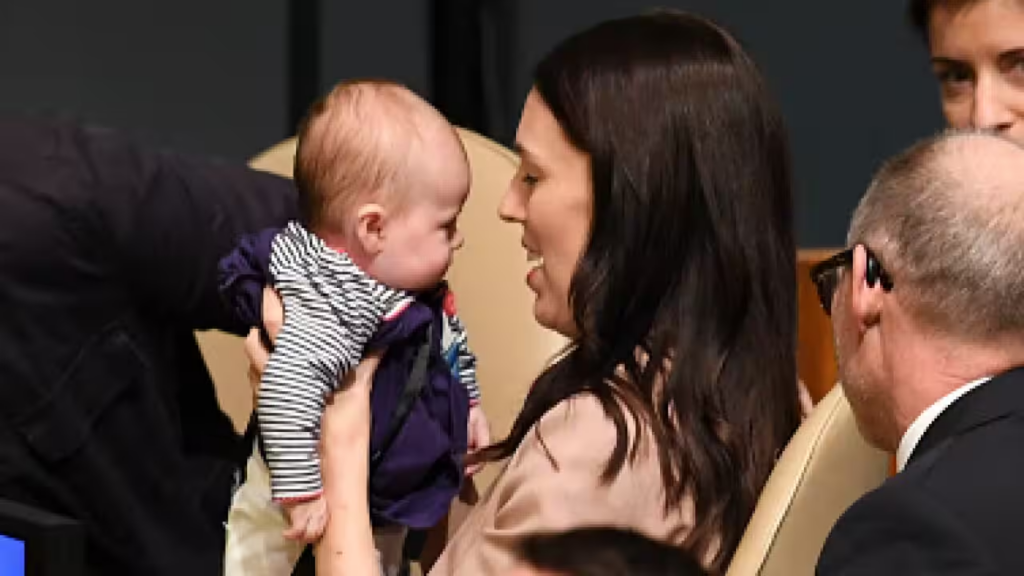
The 2018 image of Prime Minister Jacinda Ardern with her three-month-old daughter, Neve, at the UN General Assembly remains a global symbol of modern leadership and the normalization of motherhood in high office. At the time, Ardern was only the second elected world leader to give birth while in power, following Benazir Bhutto in 1990. Fast forward to January 2026, the now-Dame Jacinda Ardern has transitioned into a “post-premiership” life after her shock resignation in early 2023. She spent the last two years as a dual fellow at Harvard University, focusing on technology governance and extremist content, and recently published her memoir, A Different Kind of Power, in June 2025. She and her long-time partner Clarke Gayford finally married in early 2024, and the family has recently relocated to the United Kingdom, where she continues her advocacy for kindness in leadership and global environmental initiatives like the Earthshot Prize.
Angel discovered that her daughter’s resilient spirit didn’t just change her title to “mother”—it gave her the courage to have another child.
Five years after her first viral story, Angel reflects on how mothering Karunia, who has Apert syndrome, transformed her fear into “unwavering self-assurance.” Initially overwhelmed by the diagnosis, Angel credits a supportive community and her husband, Chandra, for helping her embrace her role. Karunia’s own zest for life was so infectious that it healed Angel’s doubts about expanding their family; nine years later, they welcomed a son, Keis. Now in 2026, Karunia is a confident 14-year-old leader in North Sulawesi, serving as a tambourine dancer and proof that “beauty comes in many forms.” Angel’s journey highlights a powerful shift in motherhood: moving from a place of questioning “why me?” to believing that Karunia is a divine blessing who taught her how to truly love and be confident.
Three-year-old Axel Combs has reached a “victory” milestone, completing his aggressive frontline chemotherapy as he moves toward a two-year maintenance phase.
After nine months of intensive treatment for T-cell acute lymphoblastic leukemia (T-ALL), Axel Combs has officially finished his fourth and most grueling round of chemotherapy. Diagnosed in April 2025 during a family vacation, Axel has endured multiple surgeries and blood transfusions, racking up $2.4 million in medical charges.
As of January 2026, his medical team is monitoring his Absolute Neutrophil Count (ANC); once it reaches a stable threshold of 750, he will transition from “frontline” treatment to the “maintenance” phase. This new stage, though lasting approximately two years, involves gentler, low-dose chemotherapy—often administered as daily oral tablets—designed to keep the leukemia in remission while allowing him to regain his energy. His family, sharing updates via the “Angels for Axel” community, reports that his playful spirit has already begun to return, marking a hopeful shift from the taxing treatments of the previous year.
Diane Keaton chose to skip marriage to protect her dreams, eventually finding her greatest love through adoption at age 50.
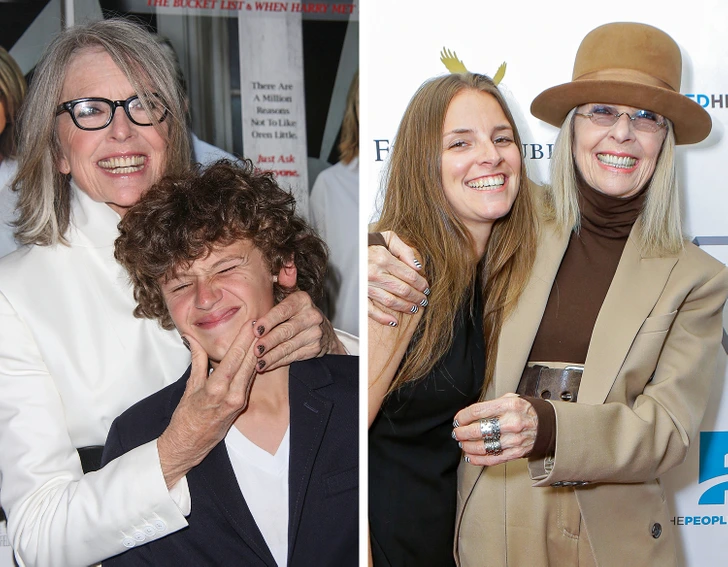
Despite a life filled with legendary romances with men like Al Pacino and Woody Allen, Diane Keaton never walked down the aisle, fearing marriage would require her to sacrifice her independence and her dreams. This deeply personal choice was rooted in watching her own mother set aside her passions to raise a family, a path Diane admired but did not want to repeat. At the age of 50, she redefined her life by becoming a single mother through adoption, welcoming her daughter Dexter and later her son Duke. She describes motherhood as her most humbling and life-altering experience, proving that a family built on choice and independent love is just as “fruitful” as a traditional one.
A mother bids a tearful goodbye to her beat-up Toyota Sequoia, realized it wasn’t just a “poop-colored” car, but a rolling time capsule of her children’s entire childhood.

For Kim Danielson, selling her aging Toyota Sequoia felt like closing a chapter on her family’s life. The car was a chaotic archive of memories, filled with everything from Great Dane slobber and embedded strawberry-vomit scents to the “masterpieces” her kids drew on the leather with Sharpies. It carried them through every milestone, transitioning from rear-facing infant seats to the day her eldest son began driving himself. Despite the broken Bluetooth and the mechanical gambles of a worn-out engine, the car provided a private sanctuary for singing along to sports “pump-up” songs and a quiet place to grieve after a friend’s funeral. While her new car is shiny and modern, the old Sequoia remains a symbol of a time when the whole family was always together under one roof—or, more accurately, one rusted roof rack.
In war-torn Ukraine, a mother of three autistic children found her “emotional anchor” in a parenting club that taught her that saving herself was the only way to save her family.

Oksana, a mother from Sumy, Ukraine, faces the extraordinary challenge of raising 11-year-old twins and a 10-year-old son—all on the autism spectrum—amidst constant shelling and the trauma of losing her home to a fire. Through the UNICEF-supported “Hug for You” program, she joined a parenting club that provided professional psychological help and a community of “buttons”—mothers who hold their families together. The club offered her a safe space to remove the mask of the “strong mom,” teaching her that acceptance is a lifelong journey and that her own mental health is the foundation for her children’s safety. Now, Oksana and her fellow members continue to meet weekly, transforming a structured program into a lifelong support system that provides hope even after the school years end.
A Millennial mom and counselor argues that “participation trophies” actually teach kids the grit to keep showing up—even when they fail.

Nikki Specht, a mother and professional counselor, reframes the “entitled Millennial” trope by asserting that rewarding participation is about honoring resilience rather than ego. She argues that modern parenting often “cops out” by shielding children from failure, leading to young adults who collapse under minor stress. Drawing from her own grief following her sister’s death, Specht credits her parents for giving her the “gift of figuring crap out,” a skill she now passes to her children by letting them struggle with small hurdles like putting on shoes or social exclusion. Research supports this approach, showing that a child’s resilience—their ability to overcome challenges—is the single greatest predictor of future success, outweighing factors like race, income, or gender. By encouraging her kids to stay on the soccer team even when they “suck,” she ensures they learn that showing up during a struggle is exactly how they earn their place in the world.



Leave a Comment