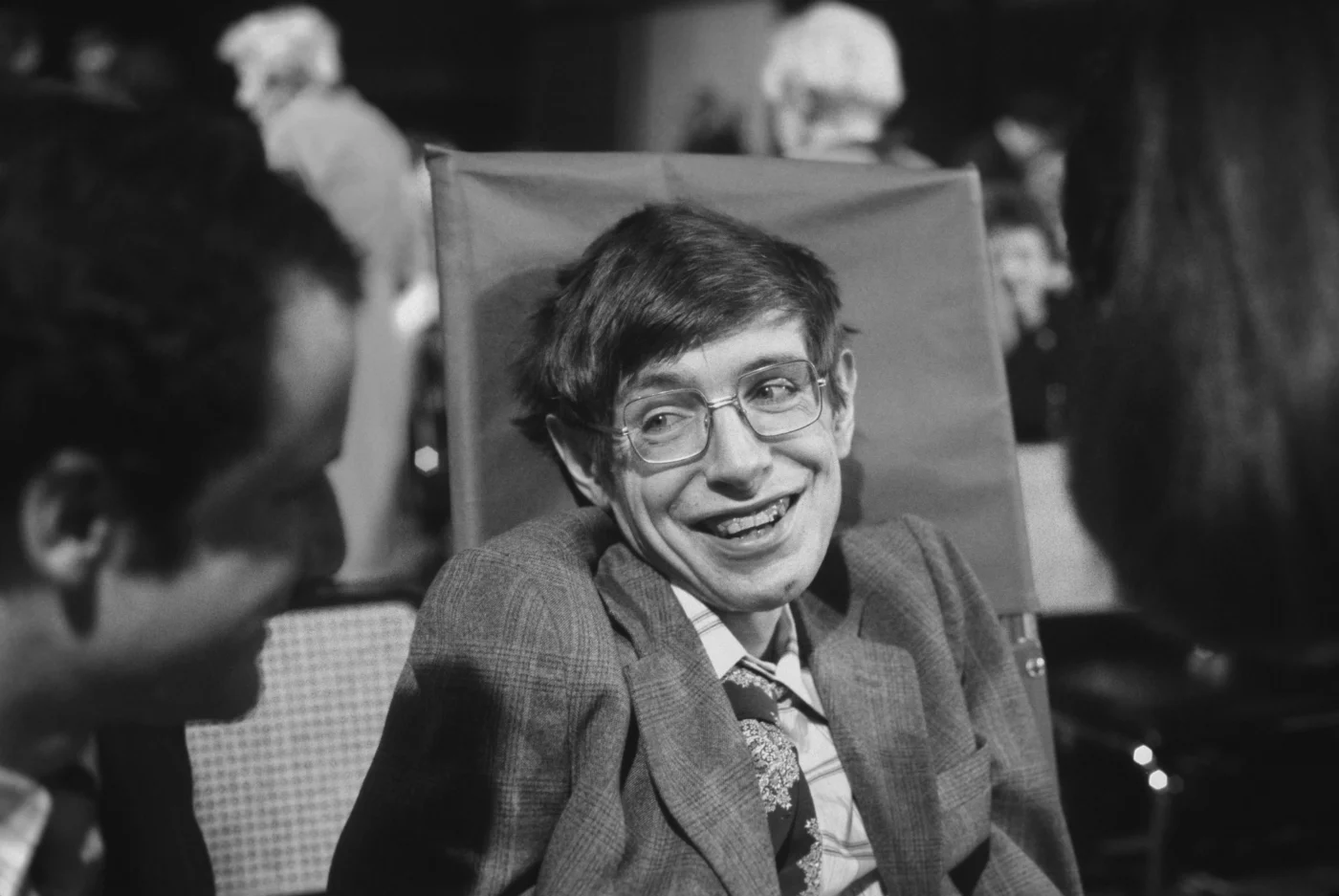

Born 300 years after Galileo, Stephen Hawking bent time and space and life itself turning a 21-year-old ALS diagnosis into a 76-year journey of cosmic discovery.
January 8, 1942. Stephen Hawking was born in Oxford, exactly three centuries after Galileo’s death, a cosmic coincidence he delighted in sharing. Fate would test him early. At 21, just beginning his Ph.D. at Cambridge, he was diagnosed with amyotrophic lateral sclerosis (ALS). Doctors predicted only a few more years.
Hawking refused to yield. His mind would outrun his body. His early work extended Einstein’s theories, exploring the limits of relativity and the universe’s beginnings. Alongside Roger Penrose, he discovered that singularities regions where space and time collapse were not just mathematical quirks but inevitable in black holes. Gravity, Hawking realized, was geometry in action.
By the mid-1970s, he made the insight that would captivate both scientists and the public: black holes are not entirely black. Through quantum effects, they emit radiation and can evaporate, challenging the boundaries of physics. His famous phrase, “black holes ain’t so black,” made the universe suddenly more mysterious and more human.
Hawking’s 1988 book, A Brief History of Time, transformed him into a global figure. It explained the universe’s greatest mysteries to people who had never touched a physics textbook, interweaving relativity, black holes, and the Big Bang with tales of his life. The world marveled not just at his intellect but at his resilience. He married Jane Wilde in 1965, raised three children, and traveled the globe, all while his body deteriorated.
I witnessed Hawking’s brilliance firsthand. In 1999, while completing my Ph.D., I watched lines stretch around Harvard for his lectures. Even surrounded by nurses and assistants, the energy he brought to a room was magnetic. Later, he co-signed a collaborative scientific letter with colleagues, personally reviewing edits with precision and humor. His stubbornness and playfulness weren’t quirks; they were survival.
Hawking’s grin became iconic. Impish, defiant, it masked profound physical struggle and revealed a mind still dancing among stars. He embraced media and comedy, appearing alongside Paul Rudd in a 2016 short film, showing that curiosity and wit could endure even when the body cannot.
He died on March 14, 2018 Albert Einstein’s 139th birthday. The coincidence seemed fitting. Hawking had spent his life chasing the questions Einstein once asked, pushing humanity’s understanding of space, time, and existence.
Stephen Hawking taught us that intelligence isn’t limited by circumstance. That perseverance can bend the odds. That humor, curiosity, and stubbornness are as vital as equations in exploring the cosmos. He showed the world that even when the body fails, the mind can soar across galaxies, leaving footprints in the fabric of space-time and human imagination.


Leave a Comment