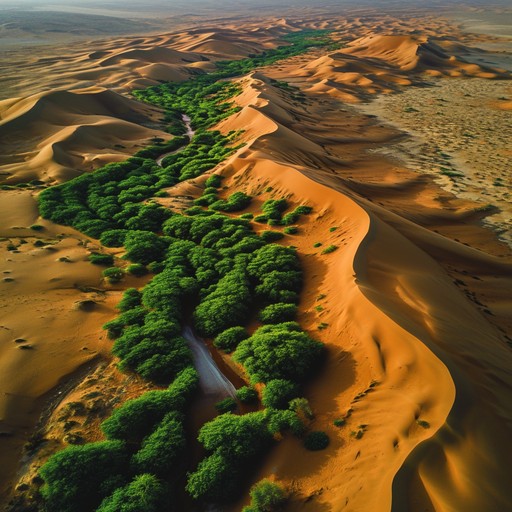

The Taklamakan Desert in western China, one of the world’s largest and driest, was long viewed as a biological void—nearly lifeless, with minimal vegetation and negligible role in the global carbon cycle due to extreme aridity and shifting sands.
For decades, it contributed little to carbon sequestration, as barren land releases rather than absorbs atmospheric CO₂. Since 1978, as part of the ambitious Three-North Shelter Forest Program (often called the Great Green Wall), the Chinese government has undertaken massive afforestation efforts along the desert’s edges.
Hardy shrubs and trees, suited to harsh conditions, were planted in a belt to halt desert expansion, reduce dust storms, protect agriculture, and restore ecosystems. By late 2024, this 3,000-kilometer green barrier around the Taklamakan was completed, transforming vast marginal lands into vegetated zones.
Recent research, including a 2026 study in the Proceedings of the National Academy of Sciences analyzing satellite data, reveals a remarkable shift. The planted vegetation shows increased solar-induced fluorescence—a sign of active photosynthesis—and measurable drops in atmospheric CO₂ over these areas.
The greened periphery now absorbs more carbon dioxide than it emits, turning the once-barren rim into a net carbon sink. This human-induced biospheric change demonstrates that well-planned ecological restoration can revive hyperarid regions, drawing down excess CO₂ even in challenging environments.
While the sink’s scale remains modest compared to global emissions, it highlights afforestation’s potential to combat desertification and support climate mitigation, converting a biological void into a productive, carbon-storing landscape




Leave a Comment