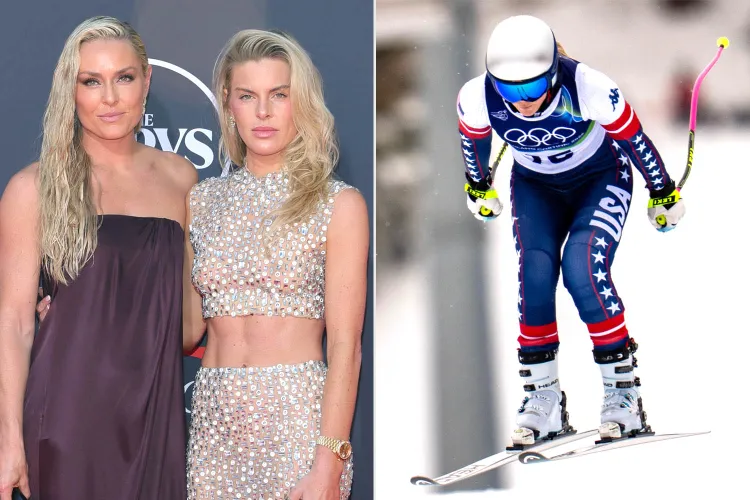

The helicopter’s shadow moved across the snow like a dark bird hunting. Below it, the mountain continued its indifferent existence—the same ice, the same light, the same finish line that had waited decades for this moment. Inside the helicopter, Lindsey Vonn, 41 years old, seven Olympic medals, eighty-two World Cup wins, one ACL torn a week ago and now who knows what else, was being airlifted off the mountain she had raced since she was old enough to understand what it meant to fall.
Thirteen seconds. That is how long her final Olympic run lasted. Thirteen seconds of speed, of edge against ice, of a body that had been rebuilt so many times it no longer remembered its original architecture. Then the catch, the release, the flight that was not flight but the beginning of a different kind of descent. The crash itself was almost mundane—the kind of thing that happens a hundred times a season to skiers whose names you will never know. But this was not a hundred times. This was the last time. This was the helicopter.
Her sister Karin stood in Cortina, speaking into cameras with the particular restraint of someone who has spent a lifetime watching a loved one court catastrophe. Her voice was steady, which is what families do in these moments: they hold themselves together so the person in the helicopter does not have to. “That definitely was the last thing we wanted to see,” she said. The understatement was almost architectural, a structure built to contain what could not be said. It happened quick. Yes. It always does. Thirteen seconds is quick. A lifetime of training, of recovery, of forcing a body to do what bodies were not designed to do—all of it condensed into thirteen seconds and then released, like a gate opening onto empty air.
When you start to see the stretchers being put out, that is not a good sign.
Hours earlier, Karin had posted a video of Lindsey waking up in her hotel room. The caption read “Perfect Day!” and in the video Lindsey was smiling, that particular smile she has always had—not the smile of someone who does not know fear, but the smile of someone who has decided, repeatedly, deliberately, that fear will not be the thing that defines her. She was excited. She was, at 41, after how many surgeries, how many comebacks, how many times she had been counted out and had refused to stay counted—she was excited. The mountain was waiting. The ice was ready. She had torn her ACL seven days earlier and she was still going to race, because that is what you do when you have spent your entire life becoming the person who does not stop.
I can’t guarantee a good result, but I can guarantee I will give it everything I have.
She wrote this on Instagram hours before the crash. The sentence is not a boast. It is not a promise. It is a statement of fact, like a skier describing the line she will take down a mountain she has memorized in her bones. No matter what happens, I have already won. This is the kind of thing people say when they are trying to convince themselves, and maybe it was that, too. But it was also the truth. She had already won. She had won by showing up at 41 with a body that had been through more than most bodies could survive. She had won by standing in the starting gate knowing she was already injured and going anyway. She had won by becoming the person who, when asked what she was afraid of, could honestly answer: nothing. Or at least: nothing that matters more than this.
Her sister described her as someone who “dares greatly” and “always goes 110%.” These are the phrases we use for athletes, for people whose daring is public, measurable, recorded in medals and statistics and slow-motion replays of their worst moments. But daring greatly is not just about the races you win. It is about the races you lose, the crashes you survive, the hospital rooms where you learn to walk again while the world moves on without you. It is about tearing your ACL a week before your final Olympic downhill and deciding, against every reasonable calculation, that you will race anyway.
Breezy Johnson won gold that day. Team USA’s first medal of the 2026 Games. The fans at the finish line watched Lindsey’s crash on the giant screen and then watched Breezy’s victory, and the two moments existed simultaneously, inseparable, the shadow and the light. This is how it always is in sport: someone’s best day is someone else’s worst, and the mountain does not care which is which. The helicopter rose. The crowd fell silent. The gold medal was awarded, and somewhere above them, Lindsey Vonn was being lifted away from the only place she had ever truly belonged.
I don’t really know exactly what happened.
Karin admitted this, and her admission was the most honest thing said that day. We never really know exactly what happened. We see the edge catch, the body release, the strange suspension of gravity that precedes impact. We see the stretchers and the helicopter and the faces of fans who came to witness glory and instead witnessed something else. But we do not know what happened inside that thirteen seconds, inside the mind of a woman who had spent forty-one years becoming someone who does not stop, who had decided, seven days ago, that a torn ACL was not a reason to quit. We do not know what she was thinking when the ice betrayed her, when the speed became chaos, when the flight began. We only know that she went, that she gave everything, that she had already won.
It did look like a pretty rough fall.
Yes. It did. They always do, these falls that end careers and define legacies and become the final frame of a story that should have ended differently. But the fall is not the story. The fall is the punctuation, not the sentence. The sentence is the thirteen seconds before, the eighty-two World Cup wins, the seven Olympic medals, the countless comebacks from countless injuries that would have retired anyone else. The sentence is the video from that morning, a woman waking up in a hotel room, excited, smiling, captioning her own perfect day. The sentence is the willingness to stand in the starting gate one more time, knowing what it costs, knowing what it risks, knowing that the mountain does not care about your history or your courage or your torn ACL.
She raced anyway. That is the sentence. That is the whole story. She raced anyway, and for thirteen seconds she was exactly where she wanted to be, doing exactly what she was born to do. The helicopter took her away, but it could not take that. It could not take the thirteen seconds, the smile that morning, the certainty that no matter what happened, she had already won. The mountain will still be there tomorrow, indifferent, eternal, waiting for the next person brave enough to believe that speed and ice and a body pushed past its limits are worth the risk. But today, the mountain holds the memory of Lindsey Vonn, who came, who raced, who fell, who rose—not on skis, not this time, but in a helicopter, lifting away from the only place she had ever truly belonged, still not stopping, still not done, still, even now, giving everything she had.


Leave a Comment