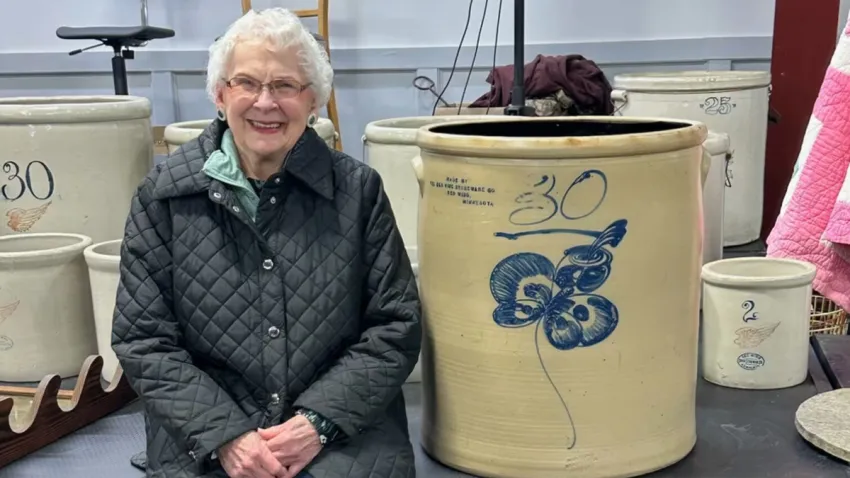

For almost thirty years, it sat on the back porch. Through the wet Nebraska summers when the air hung thick as gauze and the corn stood shoulder-high in the fields beyond town. Through the winters when snow drifted against the porch steps and the wind came down from the plains with nothing to stop it. Through the spring thaws and the autumn harvests and the long, still afternoons when the only sound was the creak of the house settling into its foundation. Thirty years. A 30-gallon stoneware crock, salt-glazed, the color of old cream, holding an extra propane tank and her late husband’s grill tools.
Lois Jurgens is 91 years old. She has lived long enough to see things become other things, to watch the objects of daily life drift across the border from useful to antique, from commonplace to rare. The crock was not rare when it came to her. It was just a crock, heavy and immovable, the kind of thing farm families kept in mudrooms and cellars for generations because throwing it away would have been wasteful and selling it would have been more trouble than it was worth. She probably did not think about it very often. It was there, and then her husband was gone, and the crock remained, holding his tools, holding the tank that held the propane that once grilled the steaks he used to cook on summer evenings. It was not a memorial. It was just there.
The family speculated, the way families do about objects whose origins have been lost to time. Probably from an old farm. Maybe from her grandpa’s time. The vagueness of these theories suggests how little the crock had been considered. It was not heirloom, not legacy, not the kind of thing you tell stories about at reunions. It was the thing on the back porch, the thing you moved around when you needed to reach something behind it, the thing you talked about maybe putting in a yard sale one day. Twenty dollars. Maybe a hundred, if they got lucky.
She is 91. She has outlived her husband, outlived the farm, outlived whatever original purpose the crock might have served in her grandfather’s time. She has reached the age when the future contracts and the past expands, when the objects that surround you begin to feel less like possessions and more like companions. She saw a small ad for a local antique auction. She decided to ask. This is not the act of a collector, a connoisseur, someone who suspects hidden value in forgotten things. This is the act of a 91-year-old woman looking at a cluttered porch and thinking, maybe it’s time.
Ken Bramer, the auctioneer, took one look. This is the moment the story pivots, the fulcrum on which thirty years of ignorance and thirty seconds of expertise turn. He knew immediately. Not that it was old, not that it might be worth something. He knew what it was, specifically, precisely: a Red Wing Stoneware crock from the late 1800s, salt-glazed, with rare double maker’s stamps and a blue butterfly design. The language of auctioneers is a language of classification, of provenance, of market value. But underneath that language was something else, something closer to wonder. This thing that had held a propane tank and grill tools for thirty years had been waiting, all that time, to be recognized.
The blue butterfly. It is worth pausing on this detail, because it is the detail that transforms the crock from artifact into art. The butterfly is hand-painted, cobalt oxide fired into the clay at temperatures that would melt bone. It has survived 130 years of farm life, porch winters, the weight of propane tanks and the scrape of grill tools. It is small, perhaps the size of a child’s hand, but it is the thing the auctioneer saw first, the thing the collectors bid for, the thing that separated this crock from the thousands of other crocks that filled American farmhouses in the nineteenth century. Someone painted that butterfly in 1880 or 1890, a craftsman in a Red Wing, Minnesota factory, applying cobalt to wet clay with a brush, not knowing that his work would outlive him by more than a century, that it would travel to Nebraska, that it would sit on a back porch for thirty years, that it would one day be recognized by an auctioneer and bid on by collectors and sold for more money than most people in Holdrege, Nebraska earn in a year.
January 10. Her 91st birthday. While Lois Jurgens was at a church funeral—another of the obligations that accumulate when you have outlived so many—the auctioneer opened the bidding at $1,000. The phones rang. Collectors called in from across the country, their voices traveling through wires and satellites to a small-town auction in Holdrege, Nebraska, all of them competing for the crock that had spent thirty years holding a propane tank on a back porch. A buyer from Kansas finally won it. The price: $32,000.
When Lois heard, her knees almost gave out. This is the body’s honest response to news that the mind cannot immediately process. Thirty-two thousand dollars. For the thing she had considered putting in a yard sale for twenty. For the thing that had held her husband’s grill tools. For the thing she had walked past every day for three decades without knowing what it was. Her knees buckled, and someone caught her, or she caught herself, or the sheer impossibility of the number held her upright through sheer disbelief.
Now she is the Crock Lady. This is what small towns do: they assign identities based on the extraordinary events that interrupt ordinary lives. Before January 10, she was Lois Jurgens, 91-year-old widow, member of her church, resident of Holdrege for however many decades. Now she is the woman whose crock sold for $32,000. The title is affectionate, a little awed, the kind of nickname that acknowledges good fortune without presuming to understand it. She did not seek this. She did not earn it, not in the way we usually mean. She simply had a crock, and she asked an auctioneer about it, and the universe rearranged itself around her question.
She plans to share some of the money with her church. This is not surprising. She is 91 years old, and the church has been the architecture of her spiritual life for decades, and when good fortune arrives at the door of a woman who has learned what matters, she opens that door and invites others in. The rest she will use on simple, everyday needs. Not a cruise, not a new car, not the extravagant purchases we imagine when we imagine sudden wealth. Simple things. Everyday needs. The things that 91 years have taught her are actually valuable: perhaps a new roof, perhaps help with medical bills, perhaps gifts for grandchildren or great-grandchildren whose names she sometimes forgets but whose faces she knows instantly. Simple. Everyday. Enough.
The crock is gone now. It sits in Kansas, probably, in the home of the collector who paid $32,000 to own a piece of nineteenth-century craftsmanship with a blue butterfly and double maker’s stamps. It will be displayed, perhaps, or stored in climate-controlled conditions, or passed down to children who will be instructed in its value and provenance. It will never hold a propane tank again. It will never sit through a Nebraska winter, snow drifting against its salt-glazed sides. It has been rescued from its thirty years of obscurity and elevated to its proper status as rare, as valuable, as worthy of recognition.
But before it was rare, it was useful. Before it was valuable, it was ordinary. Before it was the object of a bidding war between collectors from distant states, it was the thing on the back porch of Lois Jurgens’s house, holding her late husband’s grill tools and an extra propane tank. That is not a lesser history. That is the history that made the other history possible. The crock survived because it was not recognized as valuable, because it was allowed to be ordinary for thirty years while the world forgot what it was. It survived because Lois Jurgens did not throw it away, did not sell it at a yard sale for twenty dollars, did not decide that the porch needed to be cleared of unnecessary objects. She kept it. She walked past it every day. She used it, in the small way you can use a heavy stoneware crock in the twenty-first century. She did not know what she had. But she had it, and she kept it, and that was enough.
Her knees almost gave out. This is the moment the story will hold, the image that will outlive the details of auction prices and collector provenance. A 91-year-old woman in Holdrege, Nebraska, hearing that the thing on her back porch is worth $32,000, feeling her body respond with the honest weakness of shock. She did not faint. She did not fall. She held herself upright, or someone held her, and she absorbed the number and began the slow work of understanding what it meant.
She is the Crock Lady now. She will carry this story to her grave, tell it at church suppers and family gatherings, watch the faces of her listeners shift from polite attention to genuine wonder. Thirty-two thousand dollars. For the crock on my back porch. Can you believe it? They will not believe it, not really, not in their bones. But they will nod and smile and shake their heads, and Lois will nod with them, still not entirely believing it herself.
The blue butterfly has flown to Kansas. The grill tools have been relocated, the propane tank reassigned. The back porch is emptier now, and the Nebraska winter is settling in, and Lois Jurgens is 91 years old with $32,000 in her bank account and a story she will tell for the rest of her life. She did not know what she had. None of us know what we have. We walk past it every day, the ordinary objects that are waiting to be recognized, the quiet survivors of decades and centuries, the things that will outlive us and become someone else’s discovery. We do not know. We cannot know. We can only keep them, and use them, and one day, when we are 91 years old and looking at a cluttered porch, we can ask someone to take a look


Leave a Comment