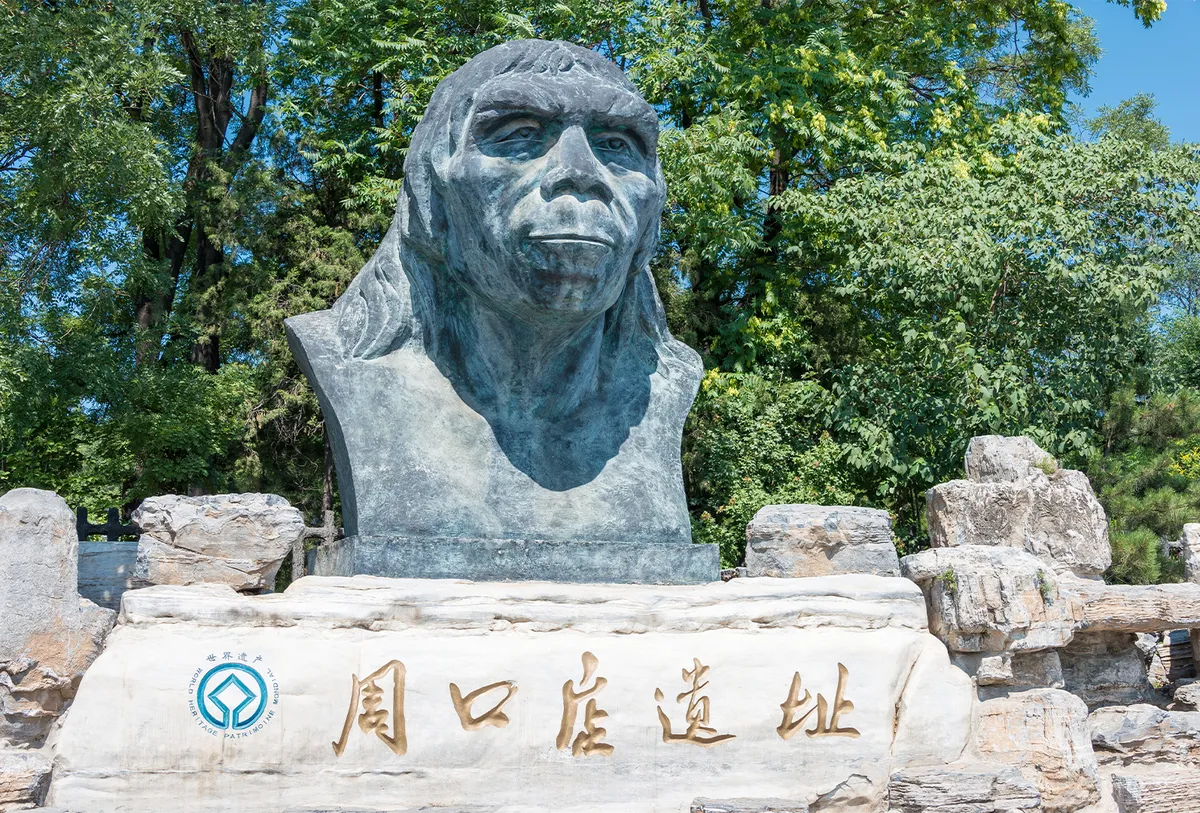

The fossils of Peking Man, an early human ancestor, were discovered in 1923 near Zhoukoudian, just outside Beijing. These significant finds offered a glimpse into human evolution, showing advanced tool use and life hundreds of thousands of years ago. However, the bones vanished during the chaos of World War II while being transported for safekeeping, and their fate remains one of archaeology’s greatest mysteries. Some theorize the fossils were lost at sea, while others suggest they remain hidden in China. Despite this, ongoing excavations at Zhoukoudian continue to uncover tools and evidence, keeping the story of Peking Man alive.
In 1923, a remarkable discovery near the village of Zhoukoudian, about 50 kilometers southwest of Beijing, transformed the study of human origins. Fossils belonging to a hominin species later named Homo erectus pekinensis, or Peking Man, were unearthed from a series of limestone caves. The findings revealed a creature with a mix of primitive and advanced traits, including a robust skull, prominent brow ridges, and evidence of tool use. The site became internationally famous as a key location for understanding human evolution in East Asia, providing invaluable insight into prehistoric life. Archaeologists meticulously documented the remains and associated stone tools, highlighting the sophistication of Peking Man’s daily activities and survival strategies.
The outbreak of conflict in Asia, however, plunged the fossils into a historical mystery. During the Japanese invasion of China in 1937, the Peking Man fossils were moved to protect them from destruction. In 1941, attempts were made to ship the priceless remains to the United States for safekeeping just before the attack on Pearl Harbor. Tragically, the shipment never reached its destination. The bones disappeared, and despite extensive investigation, their fate remains unknown. Some historians suggest the fossils sank aboard a transport ship, lost in the vast waters of the Pacific, while others speculate that they may have been hidden or buried somewhere in China during the turmoil. The loss represents one of archaeology’s most significant gaps, as the original specimens could have provided extraordinary opportunities for modern analysis using contemporary technologies such as DNA and isotopic studies.
Despite the disappearance of the original fossils, the legacy of Peking Man endures. Excavations at Zhoukoudian continue to yield stone tools, evidence of fire use, and fragments of animal bones, all illuminating the life and environment of early hominins. Casts and detailed photographs of the original bones remain available for study, allowing scientists to reconstruct aspects of Peking Man’s anatomy and behavior. The site has been recognized as a UNESCO World Heritage location, attracting researchers and tourists alike who are fascinated by the enduring mystery of the missing fossils. Each new artifact underscores the importance of Zhoukoudian as a center for understanding human evolution, while the question of where the original Peking Man bones disappeared continues to captivate both scholars and the public, leaving one of science’s most enduring historical puzzles unresolved.


Leave a Comment