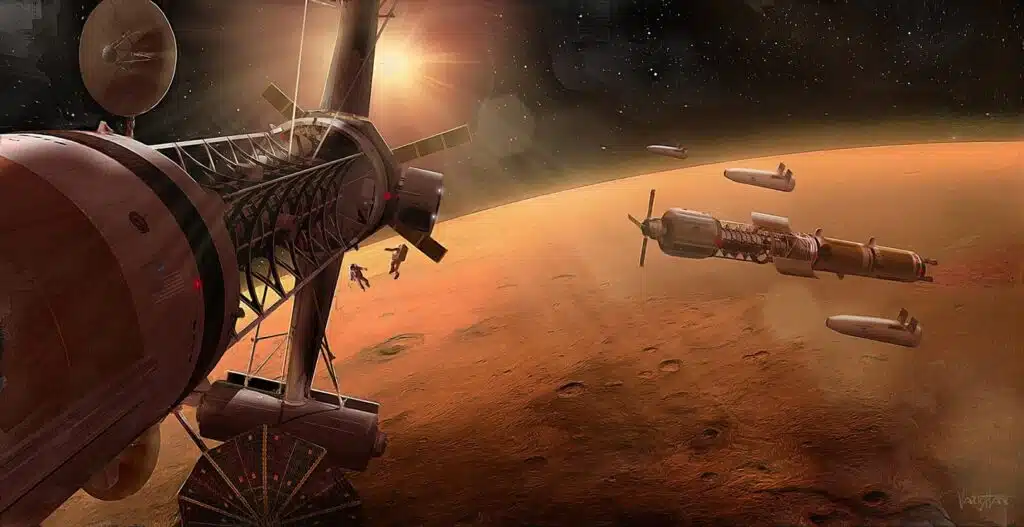

Russian scientists from Rosatom’s Troitsk Institute have developed a laboratory prototype of a plasma electric rocket engine based on a magnetic plasma accelerator.
This advanced propulsion system ionizes hydrogen into plasma—an electrically charged gas—and uses powerful electromagnetic fields to accelerate charged particles like protons and electrons to extremely high exhaust velocities of up to 100 km/s (about 62 miles per second or 360,000 km/h).
This far surpasses the roughly 4–5 km/s achieved by conventional chemical rockets, which rely on burning fuel and oxidizer for thrust. The key advantage lies in the engine’s high specific impulse, a measure of efficiency that allows much greater speed buildup with far less propellant—potentially reducing fuel needs by a factor of ten.
Although the prototype delivers modest thrust of around 6 Newtons and operates at an average power of 300 kW in pulse-periodic mode, its design supports prolonged continuous or semi-continuous acceleration over months.
This gradual buildup enables a spacecraft to reach the enormous velocities required for rapid interplanetary transit. Current chemical propulsion missions to Mars typically take 6–9 months one way due to limited speed and fuel constraints, exposing crews to prolonged cosmic radiation.
The Russian team claims their plasma engine, especially when paired with a nuclear power source for sustained energy, could shorten the journey to 30–60 days.
A 30-day trip would demand average speeds around 195,000 mph across the typical 140 million-mile distance (varying with orbital positions), making round trips feasible and significantly safer for astronauts by minimizing radiation exposure and life-support demands.
The prototype has demonstrated endurance exceeding 2,400 hours, and researchers aim for a flight-ready version by around 2030, potentially revolutionizing deep-space exploration if scaled successfully.




Leave a Comment