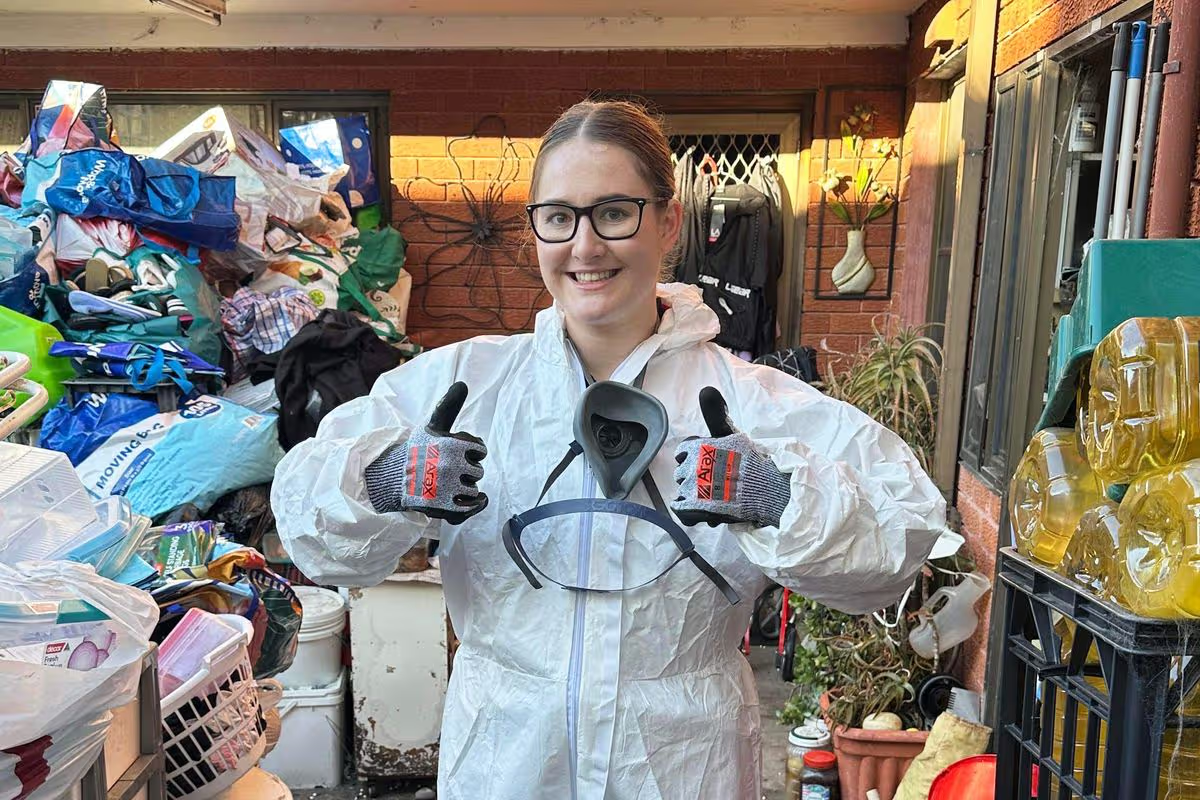

A 21-year-old Australian woman launched a cleaning company and now earns $10,000 monthly.
A 21-year-old Australian entrepreneur successfully established her own cleaning business, rapidly scaling it to achieve a consistent monthly revenue of $10,000. By targeting niche markets such as eco-friendly cleaning and post-construction services, she differentiated her company from competitors. Strategic use of social media marketing and customer referrals fueled her growth, allowing her to hire a small team within months. Her journey highlights the potential of service-based ventures for young innovators and demonstrates how identifying market gaps can lead to financial independence.
The Lucrative Potential of Australian Cleaning Businesses
The cleaning industry in Australia represents a significant economic force, with the commercial cleaning sector alone approaching a value of AUD 19.8 billion as of 2025, growing at approximately 5-6% annually . This robust market offers substantial opportunities for entrepreneurs willing to identify underserved niches and deliver quality service. While the industry remains highly fragmented with numerous small operators competing alongside large contract cleaners like ISS and Downer, the low barriers to entry make it an attractive starting point for young business owners .
Startup costs for a basic domestic cleaning service can be remarkably low, often under $2,000 for essential equipment, supplies, insurance, and initial marketing . This accessibility allows entrepreneurs to begin operations with minimal capital while scaling gradually as revenue grows.
Earnings Potential at Various Scales
For sole traders working independently, hourly rates typically range from $35 to $60, with annual earnings potentially reaching $50,000 to $90,000 before expenses . However, small team operations of two to four cleaners can generate substantially more, with annual turnover between $120,000 and $300,000 and net profit margins ranging from 10% to 30% depending on operational efficiency .
The $10,000 monthly revenue achieved by this 21-year-old entrepreneur aligns with successful small cleaning operations. For perspective, a commercial cleaning business in Port Macquarie recently listed for sale demonstrated annual turnover of approximately $110,000 with a net profit of around $40,000 using three casual staff—figures that could increase significantly if operated by an owner-manager without employee wages .
Strategic Differentiation Through Niche Markets
What separates thriving cleaning businesses from those struggling with price competition is often strategic differentiation. The industry faces fierce price competition due to low entry barriers, making it essential to stand out through service quality, reliability, compliance, insurance, staff training, and sustainability credentials .
Targeting niche markets allows entrepreneurs to command premium rates and build loyal clientele. Prominent niches include:
Eco-friendly or “green” cleaning: Using environmentally sustainable products and methods appeals to environmentally conscious consumers and businesses .
Post-construction cleaning: Specialized services for builders and renovators, removing construction debris and performing final cleans .
Medical cleaning: Meeting high disinfection and sanitation standards in hospitals and clinics .
Carpet and upholstery cleaning: Deep cleaning services requiring specialized equipment and expertise .
Window and facade cleaning: Specialized高空 work for commercial buildings .
Pressure washing: High-pressure water jet cleaning for driveways, roofs, and building exteriors .
The success story of Goop Guys, founded by Sunshine Coast couple Kirstee and Shane, demonstrates the power of niche specialization. Starting from a cleaning company called Dustbusters Queensland, they identified a recurring problem: damage to new windows, bathtubs, and benchtops during construction. Through experimentation with a chemist, they developed a protective coating that evolved into a nationwide franchise and global exporter .
The Power of Social Media Marketing
Strategic use of social media has proven transformative for cleaning businesses seeking rapid growth. The Rozie cleaning marketplace app case study demonstrates the effectiveness of influencer marketing—after shifting from Google Ads to collaborations with micro-influencers (2,000 to 20,000 Instagram followers), the company achieved an 81% increase in app installs and a 4.9x improvement in search-to-order conversion rates .
The key insight from Rozie’s experience was that “people trust people, not pixels.” A five-star rating means little until someone familiar vouches for the service. By partnering with lifestyle and family-focused creators whose audiences matched their target demographic, Rozie built the trust necessary for customers to invite cleaners into their homes .
Similarly, Amber Starling founded Good Witch Cleaning in Manhattan, Kansas, after struggling to find employment. She started with just a vacuum, $100 worth of supplies from a discount store, and Facebook posts advertising a $99 whole-house special. Within one year, she hired her first employee, and her business grew to approximately $500,000 in annual revenue .
Building Trust and Community Connection
Trust remains the fundamental currency of service businesses involving entry into customers’ private spaces. As Rozie’s co-founder Aleksandrs Tuls noted, “If your product involves strangers entering private space (cleaners, babysitters, dog walkers), budget first for trust fuel—faces your customers already know or objects that live inside their homes” .
Building trust extends beyond marketing to include proper licensing, insurance, and professional certifications. While Australia generally doesn’t require specific licenses for basic cleaning, obtaining certifications like the IICRC house cleaning technician certification demonstrates professionalism and expertise. Certain sectors may require police checks or Working with Children clearances, particularly for school or government contracts .
Community engagement also builds trust and loyalty. Good Witch Cleaning donated consulting services to local housing authorities, supported youth programs like the Boy Scouts and True Colors (an LGBTQ youth program), and even opened a free store in their office for donations and exchanges .
Operational Excellence and Team Development
Sustaining growth requires investment in team development and operational systems. Amber Starling emphasizes treating employees as career professionals rather than disposable labor. Her team receives extensive training, weekly staff breakfasts followed by training sessions, access to living wages, healthcare, and mental healthcare. “When I treat their job like a career by offering them training and treat them like human beings, making sure they can pay their bills and have time off to spend with their family, they want to stay with us. It’s not a hard concept to grasp,” she explains .
Operational efficiency also impacts profitability. Optimizing schedules and routes reduces transportation costs, while careful expense management and strategic investment in equipment and supplies improve profit margins .
Financial Management and Scaling Strategically
Rapid growth brings both opportunities and risks. When Amber Starling considered expanding to a new branch, participation in the SBA Emerging Leaders Program taught her that expanding too quickly was the leading cause of death for mid-size companies. Shortly afterward, the pandemic caused a 60% overnight loss of clients. Rather than abandoning her expansion plans, she reallocated funds to certifications in disinfection and sanitation, adapting to market conditions while maintaining financial stability .
Opening a separate business bank account helps separate personal and business finances, simplifying accounting and tax reporting. Tools like Wise Business enable entrepreneurs to manage cash flow efficiently, particularly when dealing with multiple clients paying at different times or international suppliers .
Lessons from Successful Entrepreneurs
Several patterns emerge from successful cleaning business entrepreneurs:
Start small, think big: Both Amber Starling and the Goop Guys founders began with minimal resources but maintained ambitious visions for growth .
Solve real problems: Goop Guys succeeded by addressing a genuine pain point in construction—damage to new surfaces—rather than simply offering another cleaning service .
Build trust intentionally: Whether through influencer partnerships, community involvement, or transparent communication about insurance status, successful entrepreneurs prioritize trust-building .
Invest in people: Providing genuine career opportunities with fair wages, benefits, and training creates loyal teams that deliver quality service .
Remain adaptable: When pandemic disruptions threatened Good Witch Cleaning, Amber Starling pivoted to disinfection certifications rather than abandoning her expansion vision .
The Road Ahead for Young Cleaning Entrepreneurs
For young Australians considering entrepreneurship, the cleaning industry offers a viable path to financial independence. With startup costs as low as $2,000, the ability to scale from sole trader to small team operator within months, and monthly revenue potential reaching $10,000 or more, the opportunity is substantial .
Success requires more than simply showing up with cleaning supplies. It demands strategic thinking about niche selection, intentional trust-building through marketing and community engagement, investment in team development, and careful financial management. The 21-year-old entrepreneur earning $10,000 monthly represents not an exception but an achievable goal for those willing to combine hard work with smart strategy.
As Kirstee of Goop Guys reflects on 25 years of building a cleaning business into a national franchise: “It’s been a journey. Ups, downs, hard work, but I wouldn’t change it”




Leave a Comment