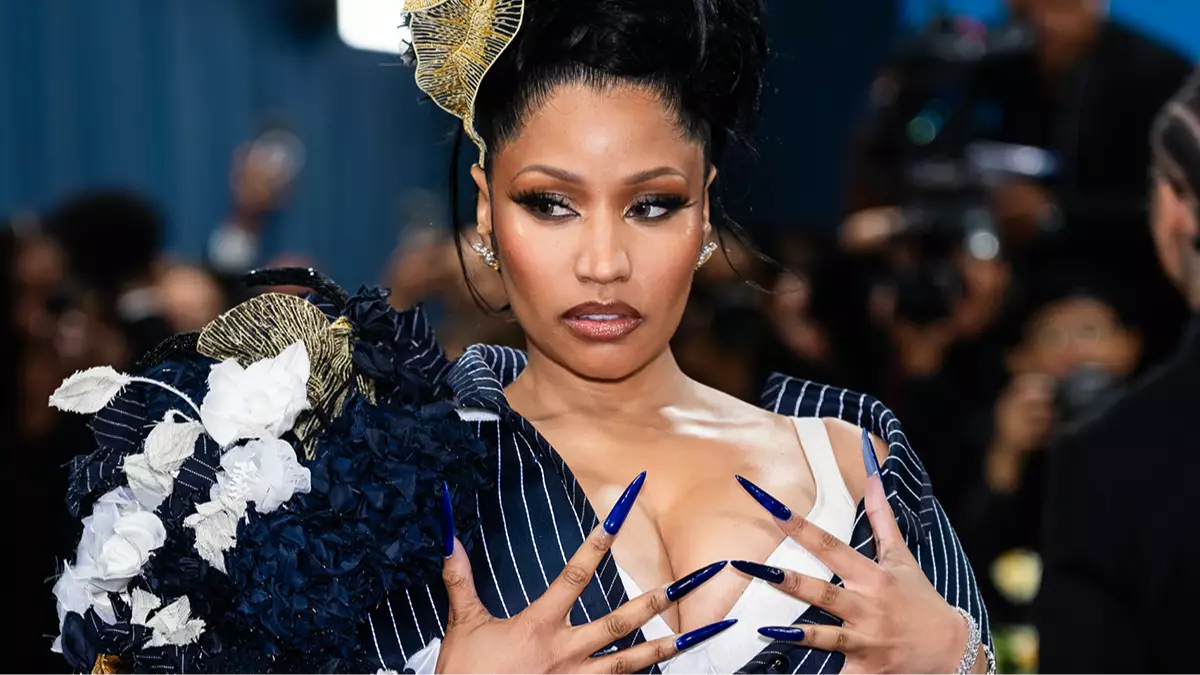

Rapper Nicki Minaj sparks major backlash after embracing a high-profile role supporting the Trump administration.
Rapper Nicki Minaj has ignited widespread criticism after dramatically aligning herself with President Donald Trump, accepting an unofficial role as a prominent supporter and attending multiple administration events. The Grammy-nominated artist, who once criticized Trump’s immigration policies, now declares herself the “president’s No. 1 fan” . Her political pivot has triggered intense backlash from fans, fellow celebrities, and political commentators who question the contradiction with her previous statements and the administration’s policies . Supporters argue her involvement could bridge divides and amplify underrepresented voices within conservative circles. The controversy highlights the complex intersection of celebrity, politics, and public expectation, with debates unfolding across social media and news outlets about artistic responsibility and political alignment .
From Critic to Cheerleader: A Political Transformation
Minaj’s journey from Trump critic to staunch ally represents one of the most dramatic celebrity political shifts in recent memory. During Trump’s first term in 2018, the Trinidad-born rapper had criticized the administration’s immigration crackdown, stating, “I came to this country as an undocumented immigrant when I was five years old” . She explicitly said in 2020 that she wouldn’t “jump on the Donald Trump bandwagon” .
Today, that distance has vanished. Minaj now explains her transformation as a response to what she perceived as unfair treatment of the president. In an exclusive clip from “The Katie Miller Podcast,” she revealed that Trump inspired her leap into politics. “When I saw how he was being treated over and over and over, I just couldn’t handle it,” she told Katie Miller, wife of top White House aide Stephen Miller .
Minaj drew parallels between Trump’s experience and her own public battles. “I felt that…a lot of that bullying, and the smear campaigns and all of the lying, I felt that that had been done to me for so many years,” she explained. “And I was watching it in real time happen to someone else, and I didn’t think he deserved it” .
The Summit Appearance: Declaring Herself “No. 1 Fan”
The most significant moment in Minaj’s political evolution came on January 28, 2026, when she attended the Trump Accounts Summit in Washington, D.C. . The event, held at the Treasury Department, promoted the administration’s new “Trump Accounts” program—a policy initiative providing $1,000 savings accounts for every child born between 2025 and 2028, with funds invested and accessible when children turn 18 .
President Trump invited Minaj on stage, where she walked to the microphone holding his hand . Standing at the podium, she made her allegiance unmistakably clear. “I am probably the president’s No. 1 fan, and that’s not going to change,” Minaj told the crowd .
She directly addressed the inevitable criticism. “The hate — or what people have to say — it does not affect me at all,” she continued. “It actually motivates me to support him more. And it’s going to motivate all of us to support him more” .
Minaj added that she believes critics have been “bullying” the president. “We’re not going to let them get away with bullying him,” she noted. “He has a lot of force behind him, and God is protecting him” .
Trump responded by calling Minaj the “greatest and most successful female rapper in history” . He added that she supports MAGA and “has been with us from start to finish” .
Financial Commitment and Policy Support
Beyond symbolic gestures, Minaj pledged significant financial support. She announced she would donate between $150,000 and $300,000 to fund Trump Accounts for her fans’ children . “The true meaning of paying it forward,” she wrote on X, adding that if she’d had access to something similar when she was younger, “my whole life would have been different” .
Her policy engagement has extended further. In February 2026, Minaj rallied her fans—collectively known as the “Barbz”—to support the SAVE America Act, a major election bill requiring documentary proof of U.S. citizenship for voter registration and photo identification for voting .
“Barbz, get your pretty little fingers out & call your senators,” Minaj wrote on X. “I’ll bribe you if I have to” . She appeared to use “bribe” rhetorically, with other posts suggesting rewards such as a new look reveal or a live X Spaces audio chat for fans who contacted their senators .
Minaj compared the voter ID provisions to pandemic-era vaccine mandates, writing, “The ppl who told you to get that vaccine, and to get a thousand boosters, and to show proof everywhere you went that you had been vaccinated—are now telling you that people should NOT show ID to VOTE. Haha. Dear God, help US” .
The Trump Gold Card and Immigration Irony
Shortly after the summit, Minaj revealed on X that Trump had granted her a “Trump Gold Card,” which offers applicants residency and a path to U.S. citizenship . “Finalizing that citizenship paperwork as we speak as per MY wonderful, gracious, charming President,” she wrote .
The development carries profound irony given Minaj’s immigration history. Born in Trinidad and Tobago, she moved to the United States at age five and has described herself as having been an “undocumented immigrant” as a child . Her alignment with an administration pursuing aggressive immigration enforcement has drawn sharp criticism from those who view it as contradictory.
White House officials later clarified that the document was a “memento” rather than an official immigration document . Nonetheless, the symbolism resonated strongly with both supporters and critics.
Beyond the Summit: Continued Engagement
Minaj’s political activities have extended well beyond the summit. In December 2025, she made an unexpected appearance at Turning Point USA’s AmericaFest conference, where she sat for an interview with Erika Kirk, widow of slain conservative activist Charlie Kirk . There, she described Trump as “handsome and dashing” and praised both him and Vice President JD Vance as “one of us” for their ability to connect with everyday Americans .
The day after the Trump Accounts Summit, Minaj attended the premiere of Melania Trump’s new documentary at the recently renamed Trump-Kennedy Center . She mingled with high-ranking administration officials including Health and Human Services Secretary Robert F. Kennedy Jr., Attorney General Pam Bondi, and FBI Director Kash Patel .
In November 2025, Minaj made a surprise appearance at the United Nations, calling for an end to what the Trump administration has described as faith-based persecution in Nigeria—an allegation the Nigerian government denies . She thanked Trump “for prioritizing this issue and his leadership on the global stage” .
The Backlash: Celebrity and Media Criticism
Minaj’s political pivot has generated significant backlash across entertainment and media. The most high-profile public criticism came at the 2026 Grammy Awards, where host Trevor Noah took direct aim during his opening monologue .
“Nicki Minaj is not here,” Noah said, pausing as the crowd erupted in applause. “She is still at the White House with Donald Trump discussing very important issues” . The comedian then impersonated Trump telling the rapper, “Actually Nicki, I have the biggest ass. Everybody’s saying it, Nicki. I know they say it’s you, but it’s me” .
Media commentator and former MSNBC host Joy Reid delivered a blistering critique, accusing Trump and MAGA figures of using Minaj as a “house pet” to put “blackface” on their movement . Reid argued that the administration needs Black figures to provide “cultural cool” and that Minaj serves that purpose .
“The Trinidadian who doesn’t care about the killing of Trinidadian fishermen, the female rapper who hates other female rappers, who hates on women who are more popular than her, Cardi B,” Reid said. “She’ll never be Rihanna. She’ll never have a brand like Rihanna. She’ll never be Beyoncé. She’s a 40-some year-old, Black female rapper who clearly don’t care that much about Black people or immigrants, even though she was an undocumented immigrant” .
Fan and Public Reaction
The response from Minaj’s fanbase has been mixed but notable. Some fans have announced plans to become Republican Party supporters following Minaj’s public shift to the right . Others have expressed disappointment, with some leaving the fan community entirely.
Minaj addressed the backlash directly at the summit, making clear she remains unmoved by criticism. “The hate — or what people have to say — it does not affect me at all,” she said. “It actually motivates me to support him more” .
Journalist Don Lemon, who clashed with Minaj over her political stance, offered pointed criticism during a TMZ interview. “I think Nicki Minaj has made it very clear how she feels about African Americans in this country. I don’t believe she identifies with them,” he said, also citing concerns about past remarks he described as homophobic or bigoted .
The Bullying Narrative
Throughout her political evolution, Minaj has consistently framed her support for Trump around shared experiences of public criticism. In her podcast interview with Katie Miller, she elaborated on this theme, saying she recognized in Trump’s treatment patterns familiar from her own career .
“Religious freedom is something that’s very important to me, but if I’m being honest, President Trump … when I saw how he was being treated, over and over and over, I just couldn’t handle it,” Minaj said .
She described the moment that pushed her toward political engagement. “During the last [presidential] campaign … I saw something, and I texted someone I knew right away, and I said, ‘This is a mistake.’ And I also said, ‘All of this is making me want to get into politics'” .
Reflecting on the shift, Minaj framed the decision as the result of prolonged pressure. “I will say, sometimes people can push you so much, that they push you all the way into your next calling. That’s what happened with me” .
Implications for Celebrity Political Engagement
Minaj’s transformation raises broader questions about celebrity political involvement. Her journey from Trump critic to “No. 1 fan” demonstrates how personal grievance and perceived persecution can override policy differences. It also illustrates the complex dynamics facing artists who venture into political territory.
The White House has embraced Minaj enthusiastically, with the official account posting a commemorative photo captioned “BARBZ x MAGA”—explicitly linking Minaj’s fanbase with Trump supporters . This strategic embrace suggests the administration sees value in celebrity endorsements for reaching diverse audiences.
For Minaj, the political alignment offers potential benefits including continued visibility, access to power, and perhaps resolution of personal concerns—some analysts have speculated that her husband’s legal status under the “Megan’s Law” registry could be affected by Trump’s willingness to consider legal reforms .
The Path Forward
As Minaj continues her public role supporting the Trump administration, the debate over her political transformation shows no signs of abating. She has made clear that criticism only strengthens her resolve, suggesting her engagement will continue. The rapper who once criticized Trump’s immigration policies now holds hands with him at the Treasury Department, calls him her “No. 1 fan,” and rallies her followers to support his legislative agenda.
Whether this alignment represents a genuine political evolution, a strategic calculation, or something in between remains debated. What is clear is that Nicki Minaj has become one of the most prominent—and controversial—celebrity voices in contemporary American politics, embodying the increasingly blurred lines between entertainment, activism, and partisan allegiance.


Leave a Comment