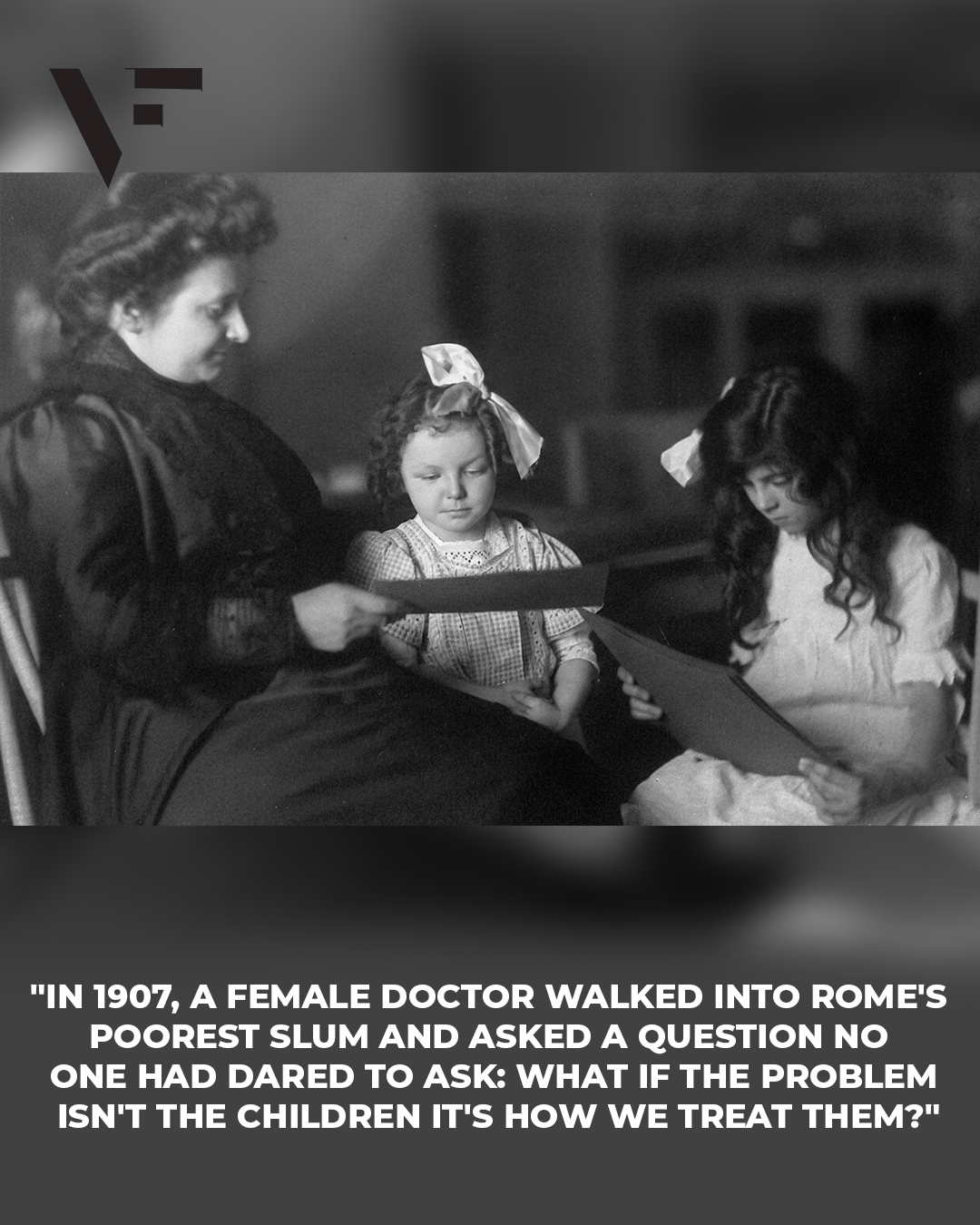

In 1907, in one of Rome’s poorest neighborhoods, Dr. Maria Montessori opened a classroom for children others had labeled “wild.” Instead of punishment and rigid control, she offered child-sized tools, freedom within limits, and careful observation. Years earlier, she had challenged expectations by becoming one of Italy’s first female physicians, studying children in asylums and realizing they were not deficient but deprived of stimulation. At Casa dei Bambini, she proved that respect and independence could cultivate calm, focused learners. Her ideas spread worldwide, reshaping education and redefining discipline as guidance rather than fear
desc ;
Rome, 1907. In the working class district of San Lorenzo, a physician entered a building filled with unsupervised children. Many were between two and seven years old, left alone while their parents labored in nearby factories. Officials wanted order restored. The woman they called was Maria Montessori.
Montessori had been born in 1870 in Chiaravalle, Italy. Defying expectations for women of her time, she enrolled in medical school at the University of Rome and became one of Italy’s first female physicians. Her early work in psychiatry brought her into contact with children labeled as intellectually disabled and confined to asylums. There, she observed that many of these children were deprived not of intelligence but of meaningful activity. She began experimenting with tactile materials and structured tasks, and some of her students demonstrated unexpected academic progress.
Rather than accept praise for working with disabled children alone, Montessori asked whether similar methods might benefit all children. When she opened the first Casa dei Bambini in January 1907, she introduced child sized furniture, self correcting learning materials, and extended periods of uninterrupted work. Her approach emphasized observation over coercion. Adults were to guide rather than command.
Montessori rejected the prevailing belief that discipline required silence and submission. She argued that self control developed through purposeful activity chosen within clear boundaries. In her view, freedom and structure were not opposites but complements. Children were to move, select tasks, repeat exercises, and return materials to their places. Order emerged from participation rather than punishment.
In 1909, she published The Montessori Method, outlining her educational philosophy. The book attracted international attention. Visitors from Europe and North America traveled to observe her classrooms. Among early supporters in the United States were inventor Alexander Graham Bell and his wife, who helped establish one of the first American Montessori schools.
In 1929, Montessori founded the Association Montessori Internationale to maintain standards and teacher training. Her ideas spread globally, influencing early childhood education, classroom design, and theories of developmental psychology. She later connected education to broader themes of social harmony, asserting that peace depended on nurturing independent, responsible individuals from early childhood.
Montessori’s career was not without controversy. Her methods competed with other educational philosophies, and political shifts in Italy during the fascist period complicated her work. She eventually left Italy and continued teaching and lecturing abroad. She was nominated for the Nobel Peace Prize multiple times in the late 1940s and early 1950s.
Maria Montessori died in 1952 in the Netherlands. Today, thousands of schools worldwide identify with her approach. Core elements such as mixed age classrooms, hands on materials, and respect for a child’s pace have entered mainstream practice in various forms.
The San Lorenzo experiment began as an attempt to control disorder. It became a challenge to conventional assumptions about childhood. Montessori’s central question remained consistent: whether behavioral problems reflected moral failure or unmet developmental needs. Her answer reshaped educational practice and continues to influence how teachers and parents understand discipline and learning



Leave a Comment