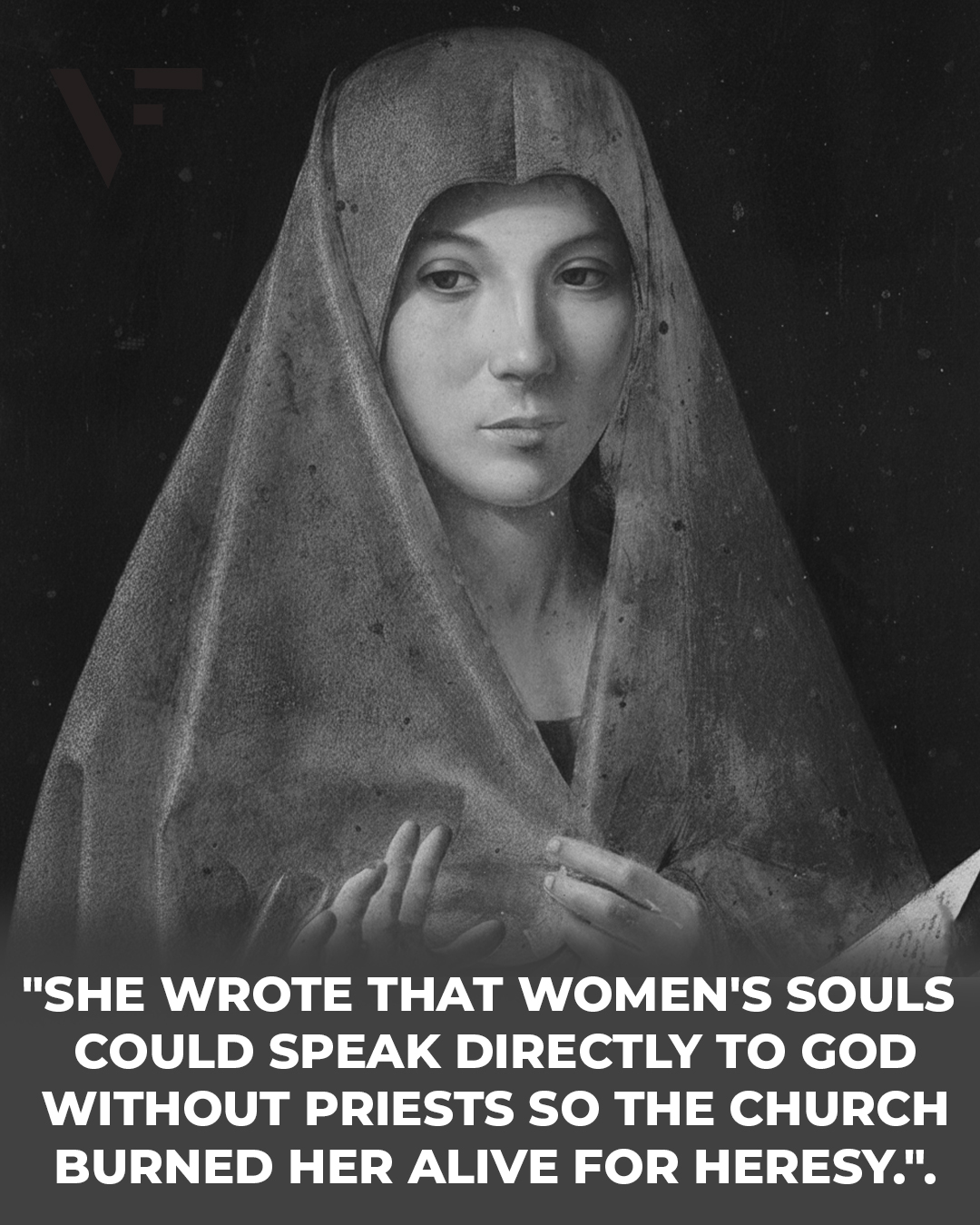

In June 1310, in a Paris square, Marguerite Porete was burned alive for heresy. Her crime was writing The Mirror of Simple Souls, a book arguing that a soul united with divine love no longer required priests, sacraments, or church hierarchy to reach God. A member of the Beguine movement, she refused to recant even after her book was publicly condemned. Imprisoned for over a year, she would not recognize the Inquisition’s authority. Her calm at the stake stunned witnesses. Though executed, her book survived anonymously for centuries. Today, it is recognized as a masterpiece of medieval mysticism and a testament to spiritual courage
desc :
Paris, June 1, 1310. In the Place de Grève, a woman stood before a gathered crowd and a prepared stake. She had spent more than a year in prison, refusing to answer questions from ecclesiastical judges. Her name was Marguerite Porete. She had been condemned as a relapsed heretic.
Porete was born in the County of Hainaut in the late thirteenth century, a region that now lies along the border of France and Belgium. She became associated with the Beguines, lay religious women who lived in community without taking permanent monastic vows. Beguines devoted themselves to prayer, charitable work, and spiritual reflection while remaining outside formal convent structures. Their independence drew scrutiny from Church authorities, who were wary of religious expression beyond direct clerical control.
Sometime in the late thirteenth century, Porete composed a work titled The Mirror of Simple Souls. Written in Old French rather than Latin, the book described the soul’s journey toward complete union with divine love. It presented this path through allegorical dialogue between figures such as Love, Reason, and the Soul. The text argued that at the highest stage of spiritual development, the soul becomes so united with God that it acts purely from love rather than from fear of punishment or hope of reward.
The theological implications were significant. Medieval Christianity emphasized the role of the Church and its sacraments as necessary mediators between humanity and God. Porete distinguished between what she described as the institutional Church and a broader spiritual community of souls united with divine love. While she did not reject the Church outright, her claim that advanced souls could transcend external rules alarmed authorities. Some theologians interpreted her language as suggesting that a person in perfect union with God was beyond moral law, a position associated with heresy.
Around 1306, the Bishop of Cambrai condemned her book and ordered it burned. Porete was warned not to circulate it further. She continued nonetheless. In 1308, she was arrested in Paris and brought before an inquisitorial tribunal. Throughout her imprisonment, she reportedly refused to respond to the court’s questions or to recant her teachings. This silence was taken as confirmation of obstinacy.
In 1310, the tribunal declared her a relapsed heretic and handed her over to secular authorities for execution. Contemporary accounts describe her demeanor at the stake as composed. The execution was intended as a public warning against unauthorized theological teaching, particularly by women.
Despite the attempt to suppress her work, The Mirror of Simple Souls survived. Manuscripts circulated anonymously across Europe in the fourteenth and fifteenth centuries. Some readers attributed it to male authors, assuming its theological sophistication required a clerical writer. In the twentieth century, scholars connected surviving manuscripts with trial records and identified Marguerite Porete as the author.
Her case reflects tensions within medieval Christianity over authority, gender, and mystical experience. It also illustrates how ideas condemned in one era can persist and later be reassessed. The book that led to her execution continued to influence spiritual thought long after the flames in the Place de Grève had died out




Leave a Comment