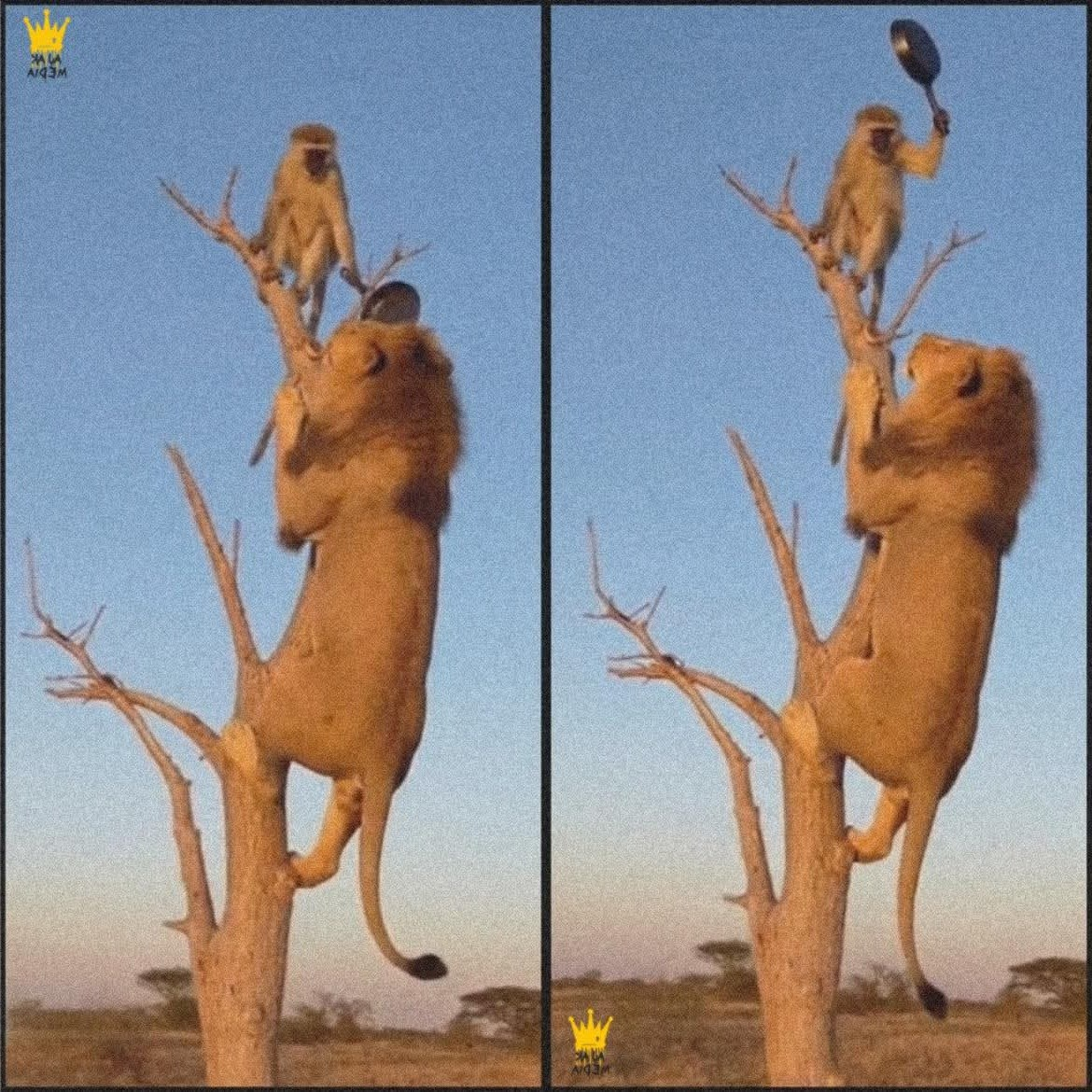

LION’S HUNT TAKES ABSURD TURN AFTER MONKEY ALLEGEDLY DEFENDS ITSELF WITH FRYING PAN, LEAVING PREDATOR STUNNED, RETREATING, AND INTERNET COMPLETELY LOSING IT
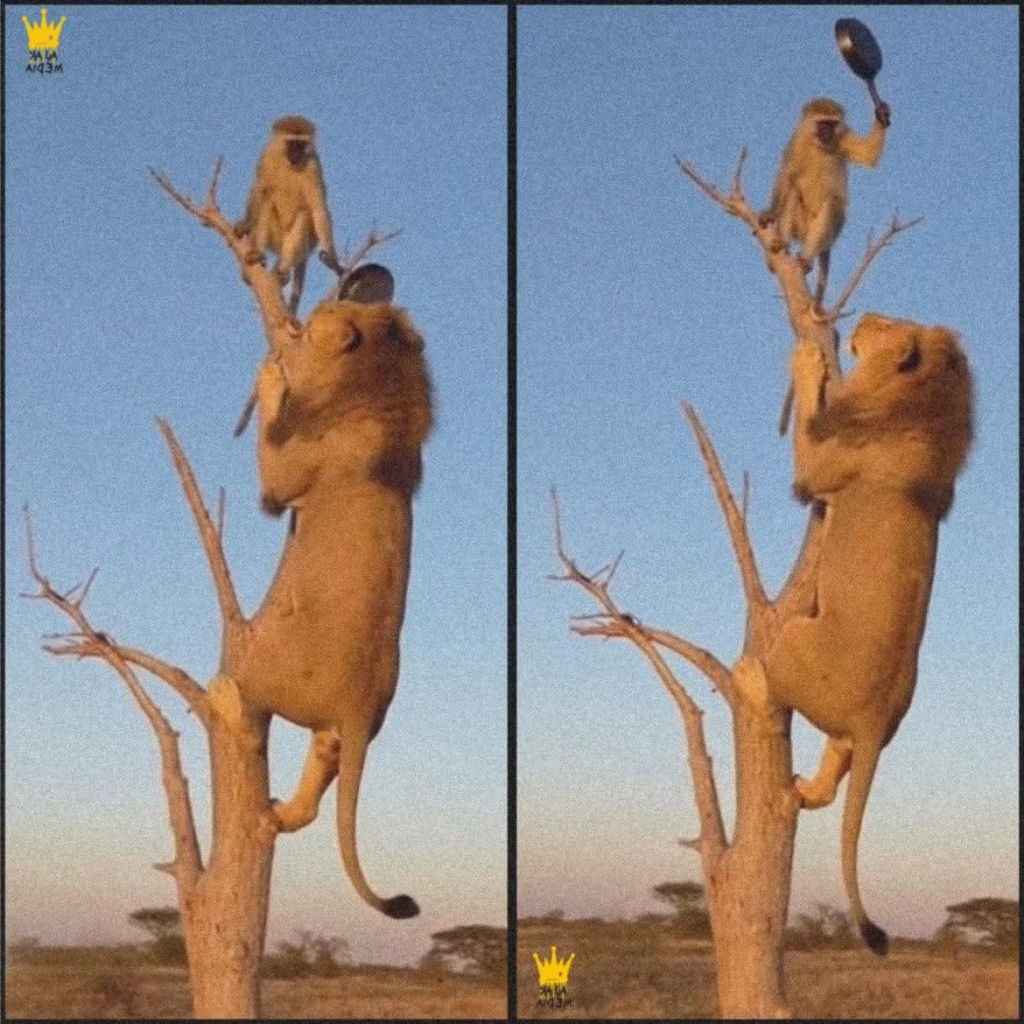
What began as a routine moment in the wild quickly spiraled into one of the most bizarre and viral animal tales circulating online. According to a widely shared story, a hungry lion spotted what appeared to be an easy target: a lone monkey perched inside a dead tree. Confident and focused, the lion approached with the calm certainty of a predator that believed the outcome was already decided.
Witnesses, and countless social media users recounting the moment, say the lion slowly climbed closer, eyes locked on its prey, unaware that this particular monkey was anything but defenseless. Hidden from view was an unexpected object that would change the entire encounter: a cast-iron frying pan.
As the lion closed the distance and prepared to strike, the monkey allegedly swung the pan with near-perfect timing, delivering a sharp blow directly to the lion’s nose. The result was instant shock. The lion recoiled, backing away in visible confusion, stunned not by injury but by the sheer absurdity of what had just happened.
The monkey, meanwhile, remained perched above, unharmed and seemingly victorious, transforming a classic predator-prey scenario into a moment of slapstick comedy. While the lion was not seriously hurt, observers noted that its retreat appeared driven by embarrassment and disbelief as much as physical surprise.
The story has since exploded online, with users dubbing the monkey a “chef of chaos” and joking that the lion was left “questioning its life choices.” Animal experts caution that such encounters should be viewed cautiously, as exaggerated storytelling often blends with real wildlife behavior on social platforms.
Still, the moment has struck a chord with audiences worldwide. Whether factual, embellished, or symbolic, the tale taps into a timeless fascination: the idea that intelligence, timing, and unexpected ingenuity can sometimes overpower brute strength, even in the wild.
ANIMAL RESCUER SENTENCED TO 90 DAYS IN JAIL FOR SAVING FOUR SICK CHICKENS WORTH $24, SPARKING OUTRAGE OVER JUSTICE, CORPORATE POWER, AND ANIMAL RIGHTS

A controversial sentencing in California is sending shockwaves through the animal rescue and activist communities, raising urgent questions about justice, corporate influence, and the treatment of nonviolent offenders.
Zoe Rosenberg, a longtime animal rescuer, has been sentenced to 90 days in jail after removing four sick chickens from Perdue’s Petaluma Poultry slaughterhouse. The chickens, later named Poppy, Ivy, Aster, and Azalea, were reportedly valued at just $24. Despite the low monetary value and the nonviolent nature of the act, Rosenberg was convicted in October of three misdemeanors and one felony conspiracy charge.
Under the court’s order, Rosenberg must report to the Sonoma County Main Adult Facility on December 10 to serve at least 30 days behind bars. She may be eligible for alternative custody for the remaining 60 days, but supporters argue that even a short jail stay could pose a serious threat to her life.
Rosenberg lives with Type 1 diabetes and depends on a continuous insulin pump to survive. Advocates warn that incarceration creates heightened medical risks, citing concerns about access to proper care and emergency response inside county jail facilities.
Her attorney strongly criticized the ruling, calling it “unconscionable” to imprison someone for rescuing suffering animals worth less than the price of a meal. He argued that the sentence reflects a legal system more focused on protecting a multibillion-dollar poultry industry than safeguarding human life or animal welfare.
Meanwhile, the four chickens at the center of the case are alive and thriving at a sanctuary, their recovery frequently shared by supporters as a symbol of what they see as moral clarity amid legal punishment.
The case has ignited a broader debate nationwide, with critics questioning how a peaceful rescue resulted in felony charges, while violent crimes often receive lighter consequences. For many, Rosenberg’s sentencing has become a stark illustration of the growing tension between activism, corporate interests, and the boundaries of the law.
SURVEY REVEALS 1 IN 2 MEN BELIEVE THEY COULD LAND A COMMERCIAL AIRPLANE IN AN EMERGENCY, AVIATION EXPERTS WARN THE REALITY IS FAR MORE DANGEROUS

A new survey has sparked widespread debate after revealing that nearly half of men believe they could successfully land a commercial airplane in an emergency, even without any formal flight training.
The findings highlight a striking gap between confidence and competence, according to aviation professionals, who warn that piloting a modern passenger jet is among the most technically demanding skills in the world. While respondents expressed strong belief in their ability to “figure it out,” experts say the reality inside a cockpit is far more complex than movies, video games, or popular culture suggest.
Commercial aircraft are operated by pilots who undergo thousands of hours of training, simulation drills, and strict certification processes. Even with advanced autopilot systems, pilots must understand aircraft systems, air traffic control communication, weather conditions, emergency procedures, and precise landing techniques, all under intense pressure.
Aviation specialists note that while autopilot can assist with navigation and stability, it does not replace human expertise, especially during emergencies. Situations such as engine failure, severe weather, or system malfunctions require rapid, highly technical decision-making that cannot be improvised.
Psychologists say the survey reflects a broader phenomenon known as overconfidence bias, where individuals overestimate their abilities in unfamiliar, high-stakes situations. This effect is often amplified by exposure to flight simulators, action films, and viral stories that make emergency landings appear straightforward.
Some experts also point out that confidence itself isn’t inherently harmful, but misplaced confidence can be dangerous. In real-world aviation emergencies, untrained intervention could worsen outcomes rather than improve them.
The survey has reignited conversations about public perception of skilled professions and the hidden complexity behind them. While the idea of stepping in heroically during a crisis may feel empowering, aviation authorities stress that commercial flight safety depends on years of discipline, precision, and respect for the limits of human ability, not instinct alone.
UKRAINIAN SOLDIER RETURNS HOME AFTER 730 DAYS AT WAR, PHOTOS CAPTURE THE SILENT WEIGHT OF SURVIVAL, SACRIFICE, AND A LIFE FOREVER CHANGED

After 730 days on the front lines, a Ukrainian soldier has finally returned home, marking an emotional moment that reflects not triumph, but survival.
For more than two years, his daily reality was defined by air raid sirens, shifting frontlines, loss, and constant uncertainty. Home existed only in memory, a place paused in time while the war relentlessly moved forward. When he stepped back into his hometown, the reunion carried the invisible weight of everything endured during those 730 days away.
The photographs from his return have struck a deep chord online. In them, there is no dramatic celebration, no victorious pose. Instead, viewers see exhaustion, relief, hesitation, and quiet disbelief. His posture tells a story words struggle to capture — a man physically present, yet still carrying the war within him.
Those close to him describe the return as overwhelming. Relationships that once felt effortless now require patience. Familiar streets feel unfamiliar. Time lost cannot be recovered, only acknowledged. Like many soldiers, he returns changed in ways that are permanent and deeply personal.
Experts say such moments highlight the long-term human cost of war, beyond battlefield statistics and political developments. Soldiers often struggle with reintegration, grappling with trauma, survivor’s guilt, and the challenge of reconnecting with a civilian life that continued without them.
This homecoming is not framed as an ending, but as another difficult transition. The war may fade from daily headlines, but for those who lived inside it, its impact lingers long after the uniform comes off.
As Ukraine’s conflict continues, stories like this serve as a stark reminder: war reshapes lives in ways that cannot be undone. Victory and defeat are abstract concepts. Endurance, measured in days survived, loved ones missed, and scars carried, is the reality many soldiers return home with.
ROMANIAN INMATE ALLEGEDLY HACKS PRISON IT SYSTEM, ALTERS SENTENCES AND COMMISSARY LIMITS FOR HIMSELF AND 15 OTHERS BEFORE AUTHORITIES CATCH ON

Romanian authorities are investigating a stunning security breach after an inmate allegedly hacked into a prison’s internal IT system and manipulated sentence records, not only for himself, but for other prisoners as well.
According to officials, the incarcerated man gained unauthorized access to the facility’s digital infrastructure, exploiting weaknesses that remain under investigation. Once inside the system, he reportedly began by modifying his commissary privileges, allowing himself to make significantly larger purchases than normally permitted.
But the hack didn’t stop there.
Investigators say the inmate then altered sentence-tracking data, making it appear as though he had already served more time than he actually had. This digital manipulation effectively shortened his remaining sentence on paper, raising serious concerns about how closely such systems are monitored.
Emboldened by his success, the inmate allegedly extended the same “benefits” to at least 15 other prisoners, adjusting records to increase their purchasing power and reduce their recorded time remaining behind bars. Authorities have not confirmed whether any early releases occurred as a direct result of the altered data.
The breach was eventually detected, triggering an internal review and criminal investigation. Officials say the inmate now faces additional charges related to cybercrime, fraud, and interference with judicial records, offenses that could significantly extend his time in custody.
The Romanian government has acknowledged the incident and stated that urgent measures are being taken to strengthen prison cybersecurity systems nationwide. “This case highlights critical vulnerabilities,” a spokesperson said, adding that safeguards are being reassessed to prevent similar incidents in the future.
While officials work to untangle the digital trail, one question remains unanswered: what happens to the goods purchased using the inflated commissary credits? Authorities have not indicated whether inmates will be required to return the items, leaving the fate of those ill-gotten snacks, including reportedly purchased Cheetos, humorously unresolved.
Behind the jokes, however, the incident exposes a serious flaw in institutional security, one that turned a prison sentence into editable data.
MAN MEETS MATCH ON FACEBOOK DATING, ONE KISS LATER SPARKS INSTANT CONNECTION THAT LEFT THEM BOTH STUNNED, SOCIAL MEDIA REACTS TO VIRAL ROMANCE
A man’s Facebook Dating encounter recently turned into a story that’s capturing the attention of the internet, proving that sometimes one kiss can change everything.
According to his account, the two matched online and decided to meet in person, both filled with excitement and a hint of nervous anticipation. What followed, however, was unexpected. One simple kiss sparked an immediate rush of emotions, leaving both individuals astonished at the intensity of their connection. The story, which has since gone viral, has resonated with thousands, highlighting how digital matches can sometimes ignite real-world chemistry in ways no one predicts.
“I didn’t think it would hit me like that,” the man reportedly said, describing how the moment felt electric and surreal. The woman shared similar sentiments, admitting she was equally surprised by the instant bond. Friends and onlookers online have flooded social media with reactions ranging from swooning admiration to humorous commentary about the unpredictability of modern romance.
While online dating often comes with skepticism and caution, this tale reminds everyone that genuine connection can sometimes bypass all expectations. The couple’s story shows that even in a world dominated by swipes, likes, and algorithms, human chemistry remains unpredictable and powerful.
Experts on modern relationships note that moments like these, while rare, demonstrate the emotional potential behind online interactions. “Digital platforms can facilitate introductions, but real-life chemistry is still a unique, spontaneous experience,” one relationship analyst told reporters.
The story has also sparked wider discussions online about the role of technology in modern love, the thrill of first encounters, and how one unexpected moment can leave a lasting impression. Social media users continue to share, comment, and debate, proving that in today’s dating world, sometimes all it takes is a single kiss to go viral.
COUPLE WHO IDENTIFIED AS GAY BEFORE MEETING CLAIM THEY’RE “HALF HETEROSEXUAL, QUARTER PANDEMSEXUAL”, THEIR PLAYFUL TAKE ON LOVE IS SPARKING VIRAL CONVERSATIONS ABOUT MODERN RELATIONSHIPS

A couple from Leeds is turning heads online after sharing a refreshingly unconventional perspective on love, sexuality, and identity. Both partners previously identified as gay, but after meeting each other, they now jokingly describe themselves as “half heterosexual, a quarter pandemisexual,” explaining that life has never felt better.
Their candid, humorous take on their relationship has struck a chord with thousands on social media. Far from confusing, their story is a celebration of fluidity, self-discovery, and the freedom to define love on one’s own terms. The pair say that their bond transcends traditional labels, blending affection, respect, and playful identity exploration into a relationship uniquely their own.
“We’ve realized that relationships don’t need a rigid framework,” they told reporters. “It’s about connection, laughter, and discovering each other, not a checklist of what sexuality is supposed to be.” The couple has embraced humor as part of their identity journey, allowing them to navigate intimacy and romance in a way that feels authentic and joyful.
Experts on modern relationships note that stories like this reflect a growing trend of sexual fluidity and self-definition. “People are increasingly rejecting conventional categories,” one sociologist explained. “They’re creating language and labels that resonate with their lived experiences, which is empowering and healthy for emotional expression.”
The story has ignited widespread discussion online, from memes and playful commentary to serious conversations about the evolving understanding of sexuality. By sharing their experience, this Leeds couple is challenging norms while inspiring others to embrace love, laughter, and identity on their own terms. Their viral tale is a reminder that relationships are ultimately about connection and joy, not fitting neatly into society’s expectations.
“YOU HAVE A HUSBAND WHO IS A SX OFFENDER AND A BROTHER WHO’S A PED*”**

Television host Don Lemon has found himself at the center of a heated discussion after publicly responding to rapper Nicki Minaj’s recent criticisms of him. The confrontation quickly escalated when Lemon reminded Minaj about the man she chose to marry, as well as her family background, highlighting that her husband is a registered sex offender and that her brother has a prior conviction for a sex crime.
Lemon framed his remarks in the context of current administration policies, noting that Minaj’s situation could raise serious immigration questions under federal law. While some viewers applauded Lemon for pointing out facts that may be legally relevant, others argued that his comments were unnecessarily personal and could be considered a breach of journalistic boundaries.
The exchange started after Minaj publicly called Lemon “awful” on social media, prompting the host to defend his reporting and provide context for his critiques. In his commentary, Lemon stressed that his statements were based on verifiable information, emphasizing the broader implications rather than personal attacks.
Social media has exploded with divided reactions. Some see Lemon’s response as fair and factual, arguing that public figures should expect scrutiny, especially when personal and legal issues intersect with their public statements. Others contend that the host went too far by bringing Minaj’s family into the discussion, raising questions about ethics and proportionality in media coverage.
Legal analysts point out that the situation touches on a complex mix of media responsibility, public accountability, and immigration law. Meanwhile, Minaj’s fans have rallied in her defense, framing Lemon’s remarks as an unfair personal attack rather than an objective commentary.
As the debate unfolds, the broader conversation continues: in the age of social media and instant commentary, where is the line between factual reporting and personal judgment? Lemon’s comments have made this question more relevant than ever.




Leave a Comment