

The Five-Year-Old Fire Guide
Short Info: A child remembered her safety lesson, leading her blind grandmother and dog from burning flames.
Full Info: When a fire erupted in their Kenner, Louisiana home, five-year-old Cloe Woods became the calm leader her family desperately needed. Remembering crucial safety tips from a local firefighter’s visit, she took her blind grandmother’s hand, gathered their dog, and navigated them through the smoke-filled house to safety. Her clear-headed actions under extreme pressure not only saved lives but also highlighted the profound impact of community safety education. Cloe’s instinctive bravery proves that courage and preparedness are not bound by age, and that the smallest among us can become the most vital heroes in a crisis.
2. The Face of D-Day’s Quiet Resolve
Bob Noody, a paratrooper with the 506th Parachute Infantry Regiment of the 101st Airborne Division, was immortalized not by an act of heroics, but by a single, powerful photograph. Taken on the evening of June 5, 1944, aboard a C-47 at Upottery Airfield, England, the image captured him in a moment of quiet contemplation, moments before takeoff for the Normandy invasion. Published widely, the photo became an iconic representation of the airborne soldier on the brink of history.
In the frame, Noody was laden with roughly 250 pounds of gear—an M1 rifle, a bazooka, rockets, mines, and all the necessary equipment for an assault jumper. The image conveys the immense physical burden and profound psychological weight carried by the men who boarded those planes, many knowing they might not return. Hours after it was taken, Noody jumped into occupied France, landing near Sainte-Mère-Église, one of the first towns liberated on D-Day.
His combat was brief; he was wounded in the leg near Carentan and evacuated. But the photograph endured. It transcends the story of one soldier to capture the universal reality of that night: the solemn preparation, the staggering load of responsibility, and the calm resolve of young men facing the unimaginable. Bob Noody survived the jump, and his photographed moment survives as a timeless testament to the quiet courage that launched the liberation of Europe.
3. Florida’s Dexter’s Law bans anyone convicted of animal cruelty from adopting or buying dogs or cats.
Florida has enacted Dexter’s Law, legislation that prohibits individuals convicted of animal cruelty from adopting or purchasing cats or dogs. Named after a severely abused dog whose case highlighted systemic gaps, the law aims to prevent repeat offenses by restricting abusers’ access to new pets. This preventative measure moves beyond punishment to proactively protect animals, ensuring they are placed in safe and responsible homes. The law addresses a previous loophole that allowed convicted abusers to continue obtaining animals, strengthening both animal welfare enforcement and public awareness of the link between animal cruelty and public safety
4. Two grieving seniors in their 70s met at a senior center and later married in 2025.
Brenda Mullins, 71, and Bob Wagoner, 74, both grieving the loss of loved ones, met at the Montgomery County Senior Center in Georgia where they initially bonded over card games and companionship. Despite initially hesitating to remarry, their friendship deepened, and Brenda eventually felt ready to accept Bob’s proposal. They married on December 23, 2025, at the same senior center where they first connected, surrounded by supportive friends. The couple now plans a quiet spring honeymoon fishing by a lake, demonstrating that meaningful relationships and new beginnings can flourish at any stage of life. Their story highlights the healing power of community and the possibility of love after loss.
5. A Voice for Disability Rights, Defying Limits
From the outset, Haben Girma’s life has been a powerful narrative of navigating and reshaping a world not designed for her. Deafblind since birth, she has transformed perceived limitations into a profound advocacy platform. In 2013, she made history by becoming the first Deafblind person to graduate from Harvard Law School, a milestone that announced her arrival as a formidable force for systemic change.
As a disability rights attorney and author, Girma’s work strategically targets the root of exclusion. She advocates for comprehensive accessibility in digital technology, education, transportation, and public policy, arguing that inclusive design benefits everyone. Her approach is grounded in the belief that disability is not a personal obstacle to overcome, but a mismatch between a person and their environment—a mismatch that society has a responsibility to correct.
Beyond her professional achievements, Girma’s personal passions—including surfing, rock climbing, and kayaking—actively dismantle stereotypes about the capabilities of Deafblind individuals. Through her speeches, writing, and public discussions, she continues to be a leading voice, reminding corporations, governments, and institutions that accessibility is not a niche concern but a fundamental right and a catalyst for innovation. Haben Girma’s legacy is not defined by what the world thought she couldn’t do, but by what she has systematically shown is possible, paving a more inclusive path for generations to come.
6. A Beauty Queen’s Enduring Fight
Andrea Andrade, a California beauty queen, exemplified a fight that was as beautiful as it was relentless. Diagnosed with stage 3 colon cancer in 2017, she was given only six months to two years to live. She defied those odds for nine years, filling that time not just with personal milestones—including winning five pageant titles and marrying the love of her life—but with profound acts of service.
Alongside her husband, Chris Wilson, she co-founded “Not All Heroes Wear Capes,” a heartfelt initiative inspired by a young boy in a superhero costume she met during her own chemotherapy. The program was dedicated to visiting hospitals, delivering toys, and spreading cheer to children battling cancer, an endeavor she called one of the most rewarding of her life. Her advocacy shifted the spotlight from her own struggle to the needs of others, using her platform to bring moments of joy to families in their darkest times.
Though the cancer eventually returned, reaching stage 4, Andrade’s spirit remained unconquered. Her husband remembered her as someone who “never, never stopped fighting,” and who was “so inspirational to so many people.” Her legacy is a dual testament: to the fierce will to live life fully in the face of a terminal diagnosis, and to the transformative power of turning personal pain into a force for communal compassion and hope.
7. MrBeast’s Gift of a First Hand
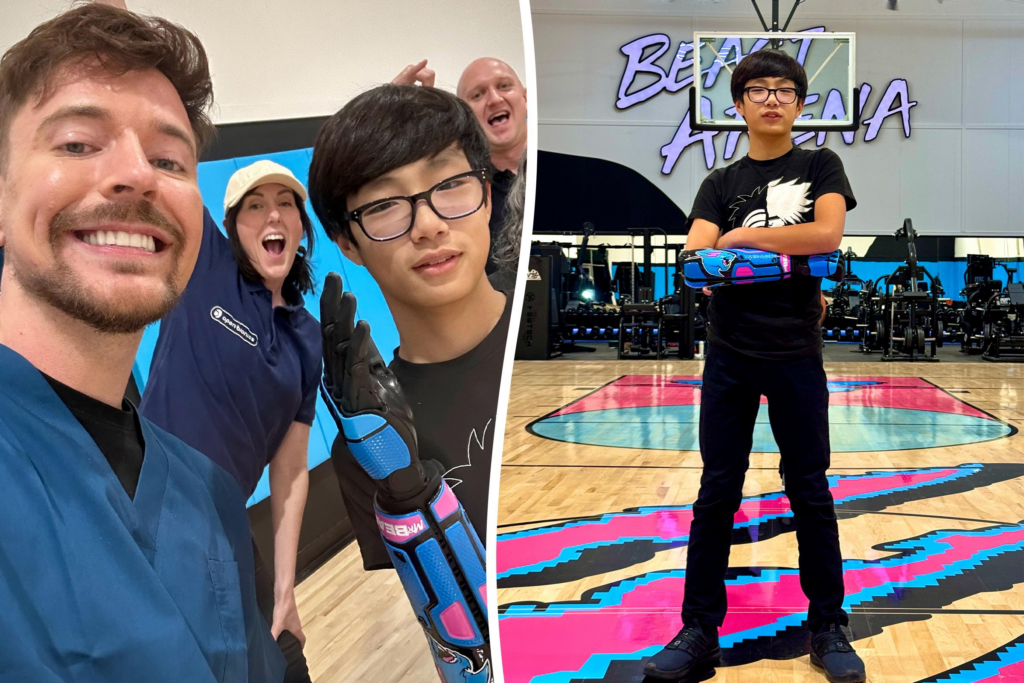
In a heartwarming and impactful gesture, YouTuber Jimmy “MrBeast” Donaldson gifted 12-year-old Kai Pollnitz with his first bionic arm. Kai, who was born without his right hand, had long hoped for a functional prosthetic to aid with everyday tasks and boost his confidence at school. Despite his family’s efforts through crowdfunding, the cost of a myoelectric prosthetic—which uses muscle signals to control movement—remained out of reach, as insurance would not cover the advanced device.
MrBeast’s surprise took place at an Open Bionics clinic in Austin, Texas, where he presented Kai with a custom Hero PRO bionic arm. The device, personalized with MrBeast’s branding and Kai’s own name, is a wireless unit capable of lifting up to 55 pounds. This life-changing technology immediately allowed Kai to perform two-handed tasks for the very first time, transforming his independence and daily experience.
The moment highlights the tangible, life-altering power of accessible technology and philanthropic intervention. While showcasing MrBeast’s signature style of grand generosity, it also underscores the critical gaps in healthcare coverage for advanced prosthetic devices. For Kai, the gift was more than a viral video moment; it was the key to a new level of autonomy, proving how innovation, when made accessible, can fundamentally rewrite a young person’s world.
8. Honnold Conquers Taipei 101 Solo
In a breathtaking display of human focus and physical mastery, American free solo climber Alex Honnold scaled the 508-meter (1,667-foot) Taipei 101 skyscraper in Taiwan. He completed the ascent of the 101-story tower—designed to resemble a stalk of bamboo—in just 1 hour and 31 minutes, using no ropes, harnesses, or safety equipment of any kind. The climb, delayed initially by wet weather, was streamed live on Netflix with a broadcast delay as a precaution.
Honnold, globally renowned for his unprecedented free solo of Yosemite’s El Capitan in 2018, more than halved the previous recorded climbing time for the building; French climber Alain Robert had taken four hours using ropes. Honnold was greeted at the summit by his wife, Sanni McCandless, who had expressed anxiety about the wind and heat during his climb. Taiwan’s Vice-President, Hsiao Bi-khim, congratulated him, while onlookers watched from inside the building’s windows.
This feat pushes the boundaries of urban free soloing, transferring an extreme discipline from natural rock faces to a man-made megastructure. It underscores Honnold’s unparalleled mental control and technical precision, turning a skyscraper into a vertical test of life and death. The successful climb adds another legendary chapter to his career, demonstrating that for him, the most formidable walls are not made of granite alone, but also of steel, glass, and concrete.
Leave a Comment