
LOIS GIBSON IS THE MOST SUCCESSFUL SKETCH ARTIST EVER, HELPING IDENTIFY 1,300 SUSPECTS.
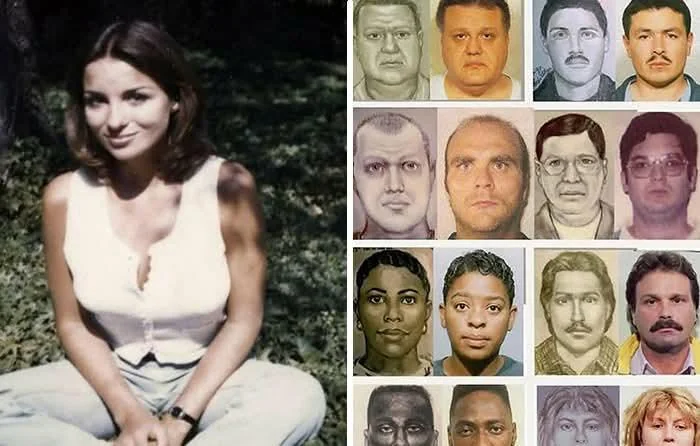
In a world dominated by fingerprints, DNA, and surveillance cameras, Lois Gibson has quietly built a legendary career solving crimes with nothing but a pencil, paper, and the power of memory. Considered the most successful forensic sketch artist in history, Gibson has helped law enforcement identify more than 1,300 criminal suspects over the course of her decades-long career.
Gibson’s work is far more than artistry; it is a combination of listening, psychology, and patience. She meets with witnesses, sometimes hours after a traumatic event, and begins the painstaking process of translating fragmented recollections into detailed sketches. “Memory is tricky,” Gibson explains. “People see things differently. My job is to take their fear, their emotions, their flashes of recognition, and turn them into a face that law enforcement can use.”
Her sketches have played a crucial role in numerous high-profile investigations. Unlike photos, which are often impossible to obtain at the moment of a crime, Gibson’s drawings capture the essence of a suspect as remembered by those who saw them firsthand. Her uncanny ability to balance accuracy with subtle human detail has resulted in hundreds of arrests and convictions, earning her respect from detectives, prosecutors, and even FBI agents.
One of Gibson’s key techniques is building trust with witnesses, many of whom are traumatized or terrified. She patiently guides them through their memories, prompting them with questions that awaken overlooked details. The resulting sketches not only help police narrow suspects but often reinvigorate stalled investigations. “It’s not about drawing beautifully,” she says. “It’s about creating an image that can bring justice.”
Her contributions have earned her a place in the International Association for Identification’s Hall of Fame and recognition from law enforcement agencies worldwide. Gibson has trained countless other sketch artists, emphasizing the critical importance of observation, empathy, and communication.
Despite technological advances in criminal identification, Gibson insists that her role remains invaluable. “A camera doesn’t feel fear. It doesn’t remember how someone’s hands trembled, how their eyes darted, or how their hair fell across their face,” she notes. “Witnesses carry those details, and I turn them into something actionable.”
Lois Gibson’s career is a testament to the enduring power of human perception. She proves that even in an era of technology, patience, skill, and empathy can turn memories into justice. In the end, it is not just her pencil that solves crimes, it is her ability to see the human story behind every face she draws.
DURING A RAINY BRAVES GAME, A FAN QUIETLY HELD AN UMBRELLA OVER A MARINE CORPS JROTC CADET STANDING AT ATTENTION BESIDE THE POW MIA CHAIR OF HONOR
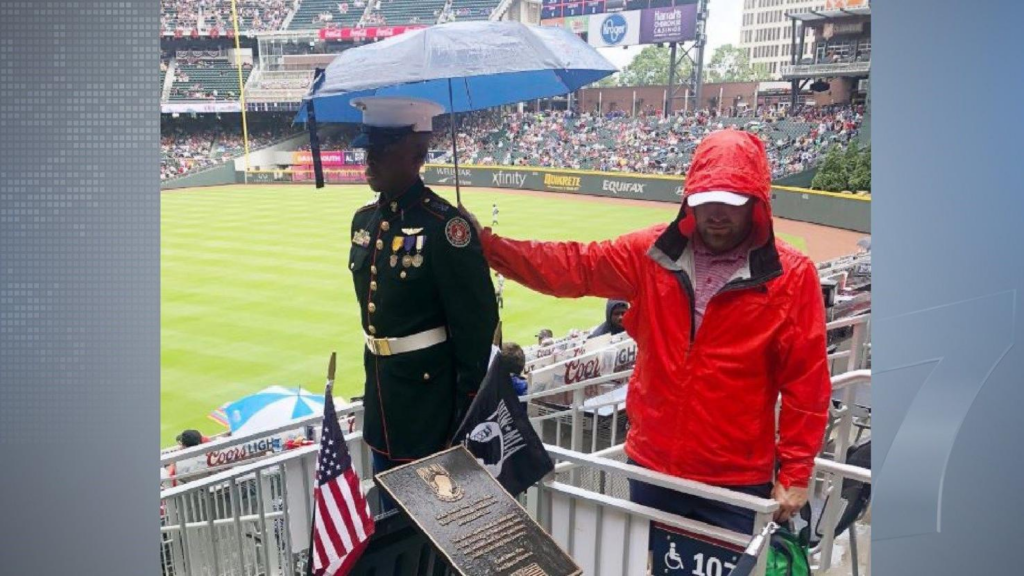
Sometimes the smallest gestures make the biggest impact. During a recent Atlanta Braves game at Truist Park, a Marine Corps JROTC cadet stood perfectly still beside the POW/MIA Chair of Honor, a memorial representing prisoners of war and service members still missing in action. Rain poured relentlessly, soaking the cadet, yet he remained unwavering, a quiet embodiment of discipline, reverence, and respect.
While many fans were focused on the game, one individual noticed the young cadet’s commitment. Without fanfare or recognition, the fan stepped forward, holding an umbrella over the cadet, shielding him from the storm. There were no announcements, no applause, no photos in that exact moment, just a selfless act of honor.
The POW/MIA Chair of Honor is more than a symbol; it is a solemn reminder of sacrifice and service. For the cadets, standing in the rain was a demonstration of the values taught through the JROTC program: discipline, respect, and honor.
The fan’s gesture highlighted another lesson: anyone can choose to do the right thing, even in small, unnoticed ways. The act exemplified empathy and respect, bridging generations and connecting civilians with those who dedicate themselves to service.
Witnesses captured photos and shared them on social media, praising both the cadet’s steadfastness and the fan’s humility. Comments poured in: “True patriotism isn’t always loud, it’s in moments like this,” one wrote. Another remarked, “This is what respect looks like: quiet, patient, and sincere.”
Together, the cadet and fan created a fleeting, yet unforgettable, display of humanity. Their interaction demonstrated that honoring sacrifice does not require a stage, recognition, or ceremony sometimes, it only takes attentiveness, empathy, and the courage to act correctly.
As the rain continued to fall and the game went on, the cadet remained in place, standing guard over a symbol of remembrance. The fan, unnoticed by many, offered shelter not only from the elements but also from the indifference that often surrounds acts of service and sacrifice.
This quiet scene serves as a reminder that integrity and respect often come in simple forms. Small, intentional acts, like holding an umbrella over someone in need, can carry a profound message: honor is not measured in applause, but in actions taken when no one is watching.
“WHERE’S PAPI?” A 6-YEAR-OLD GIRL WAS LEFT ALONE AFTER ICE DETAINED HER NEW JERSEY FATHER AS HE STEPPED OUTSIDE TO GET DINNER.

MORRISTOWN, New Jersey A six-year-old girl was found alone and distressed on a residential street in Morristown after her father was arrested by Immigration and Customs Enforcement (ICE) agents, prompting shock and concern among neighbors and local advocates.
According to the girl’s mother, Gabby Rosa, the incident occurred on January 11, when her partner, Adonay Mancia Rodríguez, stepped out of their apartment to pick up food. Moments later, ICE agents detained him as part of a broader enforcement action in the area.
While Rodríguez was taken into custody, the six-year-old identified as Annabella remained inside the apartment. Neighbors later spotted her on the street, crying and repeatedly asking, “Where’s Papi?” before assisting her and bringing her back inside.
Rosa, who was at work during the incident, said she was alerted by a phone call from a concerned neighbor who had seen her daughter alone. The mother rushed home after hearing what had happened. Later, social media footage showed Rodríguez among those detained in the enforcement operation.
A spokesperson for the Department of Homeland Security confirmed that ICE detained 11 people during what they described as “routine immigration enforcement actions” in Morristown that day. Those arrested were reportedly living in the U.S. without legal permission and are now either in removal proceedings or being processed for deportation. The agency did not immediately confirm whether Rodríguez was among the 11 or detail the specific allegations against him.
The incident has ignited local outrage and concern, as critics argue that ICE enforcement carried out near residential areas can have traumatic effects on families especially young children. Civil liberties and immigrant advocacy groups highlight that millions of U.S.-citizen children have at least one undocumented parent, and sudden parental detentions can contribute to anxiety, fear, and long-term emotional harm.
In response to the raid, community members have organized protests and called for increased protections for immigrant families. Morristown Mayor Timothy Dougherty condemned the manner in which the operation was carried out, saying the town was not informed in advance and emphasizing the community’s diversity and contributions. He urged immigration attorneys to provide volunteer legal help to detainees and expressed concern about actions that could endanger children and disrupt families.
The case serves as a stark example of the human impact of immigration enforcement. While ICE and homeland security officials maintain that their actions are lawful and part of federal mandates, the image of a young child alone and crying for her father has become a powerful symbol in ongoing debates over how immigration policies are implemented in daily life.
As Annabella’s family navigates this crisis, neighbors and advocates continue to push for broader community support, legal resources, and discussions about how to protect vulnerable children who are inadvertently caught in the crosshairs of enforcement operations.
DESPITE BEING A U.S. CITIZEN, A 5-YEAR-OLD GIRL WAS DEPORTED TO HONDURAS.
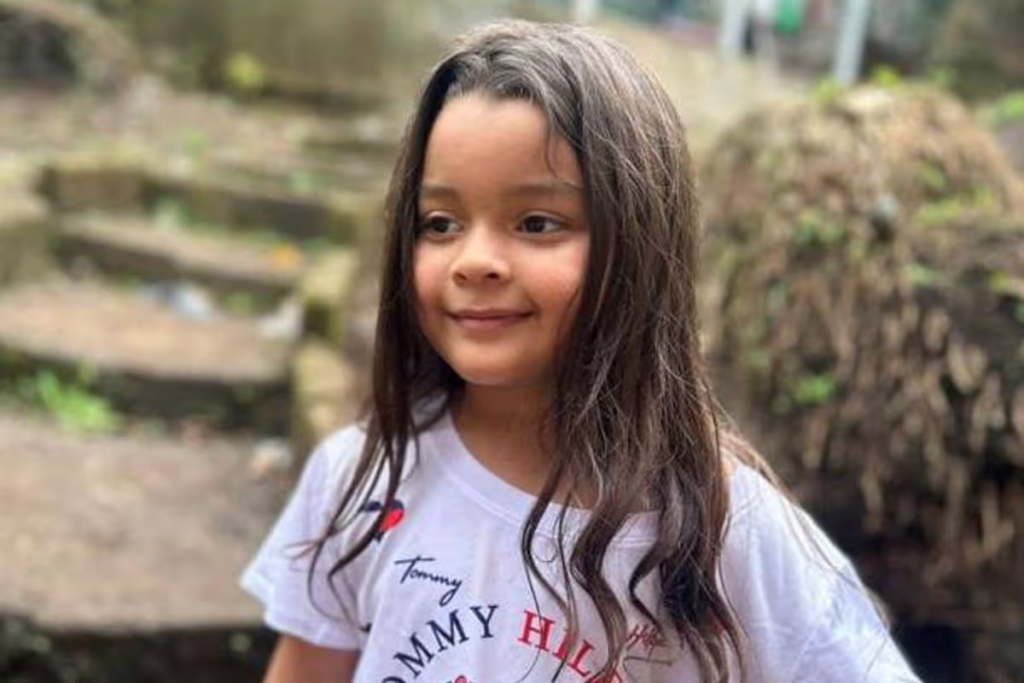
A deeply troubling immigration enforcement case has drawn national attention after a 5-year-old U.S. citizen was sent to Honduras earlier this month not for any wrongdoing of her own, but because her mother was deported. The case highlights growing concerns over how Immigration and Customs Enforcement (ICE) conducts removals involving families, especially when U.S. citizen children are caught in the middle.
Génesis Ester Gutiérrez Castellanos was born in the United States and raised in Austin, Texas, where she attended kindergarten and lived with her family. Earlier this January, ICE agents detained Génesis and her mother, Karen Guadalupe Gutiérrez Castellanos, following an Austin Police Department call. The family reports that they were held for nearly a week at a hotel about 80 miles from home, during which time they had no access to a lawyer or a hearing before a judge. Relatives did not know their whereabouts for days.
Karen came to the United States in 2018 and had applied for legal protection as a survivor of domestic violence under U.S. immigration law, a form of relief that was still pending due to processing delays. Despite this, federal agents acted on an administrative deportation order issued years earlier against Karen, a record that predates Génesis’s birth. Because the deportation order pertained to the mother, ICE removed both her and Génesis from the country, and the pair arrived in Honduras on January 11.
Génesis had never lived in Honduras and has no ties to the country beyond her mother’s nationality. She left behind cousins, classmates, and kindergarten teachers in Austin, according to reports from advocacy groups. The deportation of a U.S. citizen child, even accompanying a parent subject to removal, has sparked significant legal and ethical concerns, with critics arguing it undermines constitutional protections afforded to U.S. citizens.
Advocacy groups, including Austin’s Grassroots Leadership, have condemned the case as emblematic of broader issues with current immigration enforcement practices. They say ICE’s handling including holding the family incommunicado in a hotel and restricting access to legal counsel raises serious due process questions. Critics point out that U.S. citizenship under the Fourteenth Amendment generally protects individuals from deportation, prompting debate over how a citizen child could end up abroad without meaningful judicial oversight.
The case has mobilized activists and legal experts, renewing calls for clearer separation between immigration enforcement and the rights of citizen children. Some argue that parents should be required to arrange lawful care or custody within the United States for their citizen children before any removal takes place, while others urge broader legal reforms to prevent similar occurrences.
In the days since arriving in Honduras, Karen has indicated plans to seek legal avenues for Génesis’s return to the United States with other family members. Until then, both mother and daughter remain separated from the community and support systems they knew in Texas. The emotional, legal, and political ramifications of this case continue to unfold, drawing widespread attention to the human impact of immigration policy and enforcement practices.
In the midst of the war front, a woman risks her life to save animals.
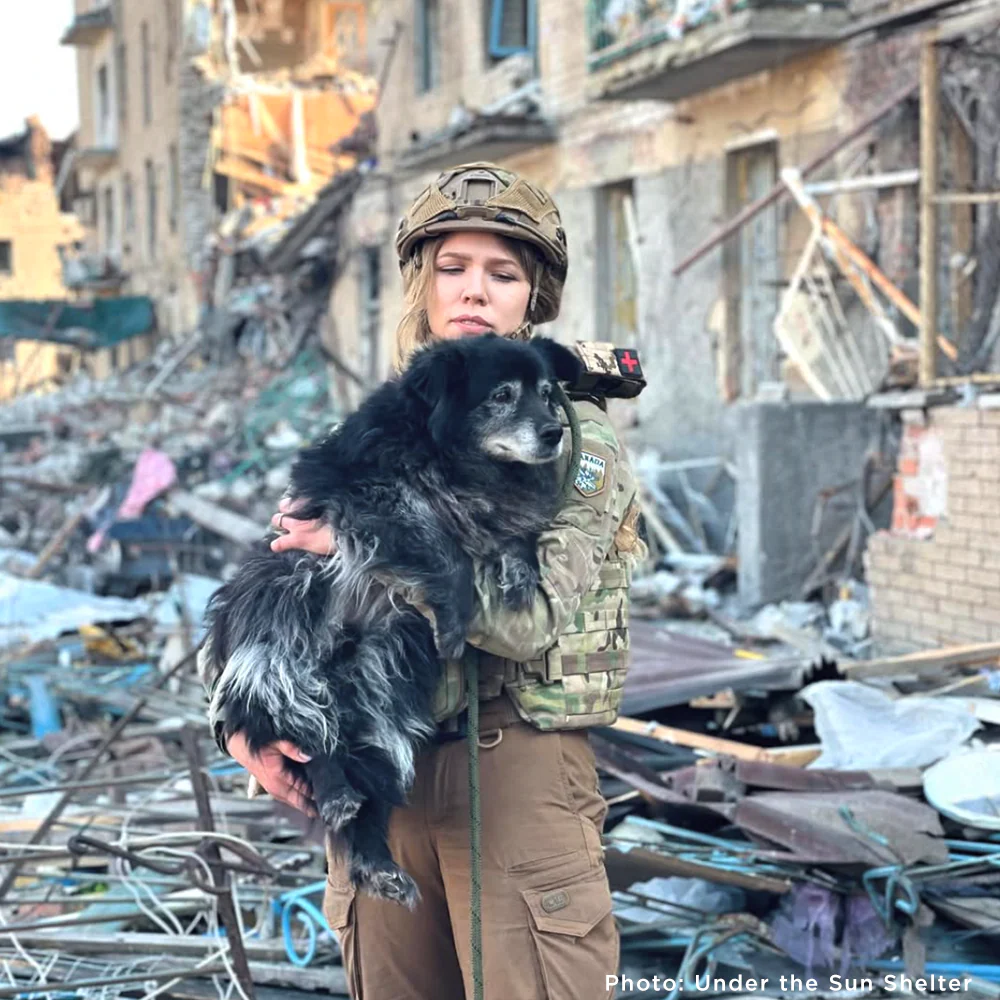
When the war in Ukraine began, Krystina was a young architecture student with dreams of designing buildings. Three years later, her life looks nothing like she imagined. Today, she navigates bombed-out towns, broken roads, and dangerous areas to rescue animals trapped by conflict.
Krystina has saved hundreds of cats and dogs, many injured, abandoned, or too frightened to escape. In the town of Podilsk, she transformed a war-damaged house into a functional shelter named Under the Sun. The shelter started with no electricity, no food, broken fences, and muddy grounds, but today it has kennels, secure fences, and a small team of volunteers.
Despite limited resources, Krystina does everything herself when needed. She cooks meals when there’s no commercial animal feed, treats injuries with whatever supplies she can find, and works tirelessly to ensure each animal has a chance for adoption. She partners with animal welfare organizations to move rescued animals to safer areas, yet continues returning to dangerous zones.
“For me, it’s not bravery,” Krystina says. “It’s a necessity. They cannot escape on their own. If I don’t go, they have no one.”
Her work is a testament to compassion in the midst of chaos. Each rescue requires careful planning, sometimes navigating destroyed roads, dodging shelling, and working around barbed wire. Yet, she persists. Krystina believes that even in the darkest circumstances, every life saved is a victory.
Through her efforts, the shelter has become more than a temporary refuge. It provides stability and hope for animals traumatized by war. Dogs once too scared to eat now wag their tails at volunteers. Cats that would hide for hours now venture out to play. Krystina sees these small moments as signs that survival and healing are possible, even amid destruction.
Her story has inspired volunteers and donors both in Ukraine and internationally. People now send supplies, money, and expertise to help her maintain the shelter and continue rescues. Yet, she remains focused on the animals in need rather than personal recognition.
Krystina’s transformation from student to frontline rescuer reminds the world of the unforeseen heroes that arise in times of crisis. Her dedication proves that even when life is torn apart by conflict, compassion and courage can make a lasting difference. She fights not for fame or glory, but to give a voice and a chance to the voiceless.
In the ruins of war, Krystina has created hope under the sun, proving that love and determination can thrive even in the most challenging conditions.
Doctors were going to disconnect him, but his father entered the hospital armed to save him.
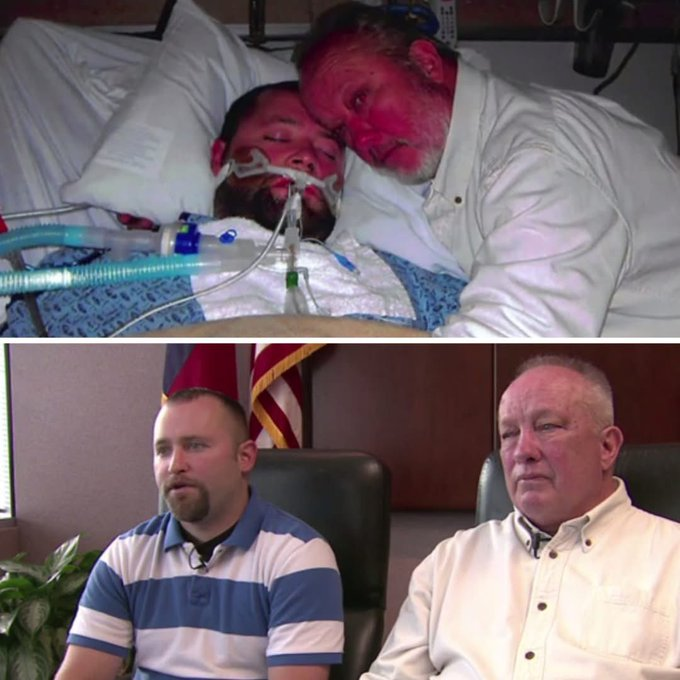
In a tense hospital room in Texas, George Pickering III’s life hung in the balance. Doctors had declared him brain-dead and prepared to withdraw life support. Notifications were even sent to an organ donation organization. For the medical staff, the case seemed clear but for George’s father, George Pickering II, it was anything but.
Refusing to accept the verdict, George II made a desperate choice. He entered the hospital armed, determined to stop the disconnection of the machines keeping his son alive. For hours, he confronted police and hospital staff, insisting that something more needed to be done.
Then, an extraordinary moment occurred. When George II held his son’s hand and asked him to respond, George III squeezed back. Multiple times. In that tense, surreal instant, the impossible became reality: the man declared brain-dead was conscious.
Medical staff halted the disconnection immediately. George Pickering III remained on life support, but hope was renewed. Over the following days and weeks, he slowly began to recover, eventually regaining full consciousness. Today, George III is alive and well, a living testament to persistence, faith, and parental love.
The ordeal came at a cost. George Pickering II spent months in jail for his dramatic actions. Yet both father and son insist it was worth every sacrifice. “I am alive thanks to that,” George III said, reflecting on the life-altering intervention.
This story has resonated far beyond Texas. It challenges assumptions about medical authority, brain death declarations, and the limits of human will. Experts note that while cases like George III’s are exceedingly rare, they underscore the complexity of neurological assessments and the human element in critical care.
Families and advocates have hailed George Pickering II’s unyielding advocacy as extraordinary. While his actions were extreme, the outcome is undeniable: a life saved when the odds were stacked against it. George III’s recovery serves as a reminder that sometimes, hope cannot be measured by machines or charts alone.
Today, father and son continue to live life fully, bound by an experience that has defied explanation. Their story has become a symbol of resilience, the power of determination, and the lengths a parent will go to protect a child.
George Pickering III’s survival is nothing short of miraculous, a rare story where instinct, love, and refusal to give up overcame the starkest of medical predictions.
This man invented a device that allows people with paralysis to use a cellphone with only their tongue.

Technology often dazzles with flashy innovations, but sometimes the most powerful advances are quiet, precise, and profoundly human. The MouthPad is one such invention. Developed by Tomás Vega, an engineer trained at MIT, this device is changing the daily lives of people with paralysis.
The MouthPad started as a research project. By 2019, it became the foundation of a startup called Augmental, aiming to bring practical autonomy to those who cannot use their hands or arms. The system is deceptively simple: a small retainer sits on the roof of the mouth, detecting even subtle tongue movements. These movements are translated into digital commands that allow users to type, navigate devices, or control their smartphones.
For users, the impact is transformative. Tasks that once required assistance sending a text, browsing social media, or composing an email are now possible independently. “It’s not about gimmicks or flashy displays,” Vega explains. “It’s about giving people back the basic control over their lives that most of us take for granted.”
Unlike other assistive devices that require external sensors or complex setups, the MouthPad is minimally invasive and intuitive. Users can quickly learn to perform precise commands with simple tongue gestures. This accessibility makes it ideal for everyday use, allowing people to maintain privacy and autonomy in ways that other systems often cannot.
The startup Augmental has focused on real-world application rather than spectacle. Early testers report not just convenience, but a renewed sense of freedom. For many, the ability to independently communicate and interact with the digital world fosters confidence and restores a level of dignity often lost to severe mobility limitations.
While similar technologies exist, the MouthPad distinguishes itself by combining accuracy, simplicity, and comfort. It doesn’t promise science-fiction-style mind control or robotic limbs. Instead, it harnesses one of the few voluntary movements preserved in many paralyzed individuals, the tongue and turns it into a powerful tool for independence.
Vega emphasizes that the ultimate goal is human-centric technology. “Sometimes, the best tech isn’t about complexity. It’s about restoring a human capability that allows people to live life more fully,” he says.
As Augmental continues refining the device, plans for wider distribution and further testing are underway. The MouthPad exemplifies the intersection of engineering, empathy, and practicality proving that the simplest tools, when thoughtfully designed, can profoundly transform lives.
For many who have felt trapped by paralysis, this tiny retainer is not just a device it is a key to reconnecting with the world.
SERGEI KRIKALEV WAS IN SPACE ABOARD MIR WHEN THE SOVIET UNION COLLAPSED IN 1991, DELAYING HIS RETURN AND EARNING HIM THE TITLE “THE LAST SOVIET CITIZEN IN SPACE.
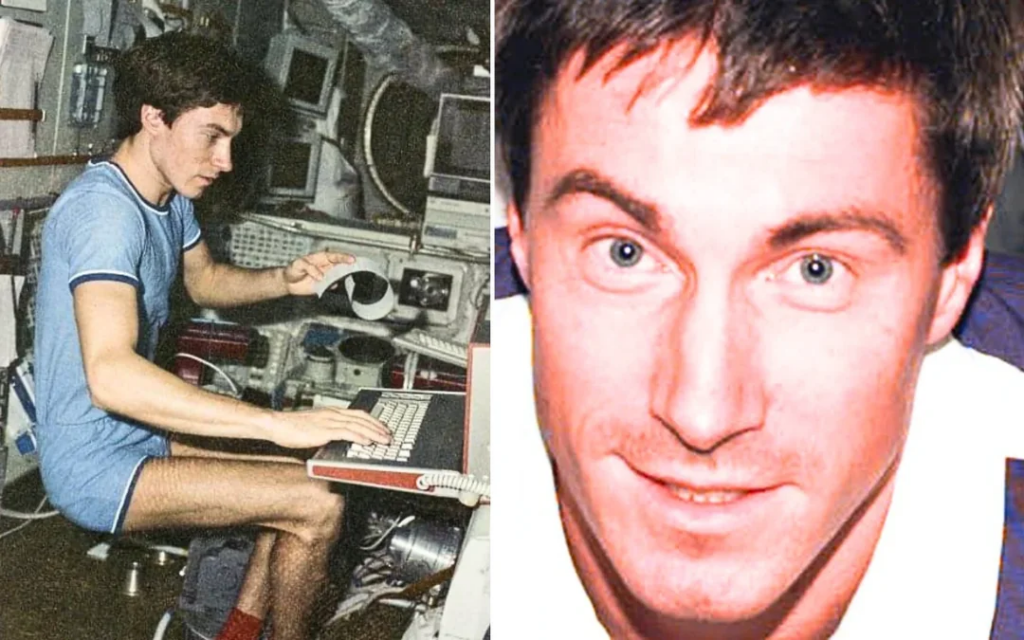
When Sergei Krikalev stepped aboard the Soviet space station Mir in 1991, he expected a routine mission. Little did he know that his journey into space would also become a journey through history. During his mission, the Soviet Union, the country that had trained, launched, and funded him collapsed completely, leaving him orbiting Earth as the last Soviet citizen.
Krikalev’s original mission plan included a standard return to Earth after a few months. But political chaos, the sudden dissolution of the USSR, and associated funding problems delayed his return. What was meant to be a few months turned into a staggering 311 days in orbit, one of the longest missions ever undertaken by a human being at the time.
During those 311 days, Krikalev watched the world below transform. Countries he had once known including his homeland were in flux. Borders, governments, and national identities were changing, all while he floated hundreds of kilometers above Earth in a confined space station.
In orbit, Krikalev had to navigate not only the technical challenges of extended spaceflight, but also the psychological strain of witnessing a massive geopolitical shift from isolation. Supplies were carefully rationed, experiments continued, and the routine of life in microgravity went on, even as the world he had left behind vanished.
By the time he returned to Earth, Krikalev had become a historical symbol. He had launched as a citizen of a superpower and landed in a country that no longer existed. His experience highlighted the intersection of human endurance and historical upheaval, the personal side of world-changing events that often goes unnoticed in textbooks.
Today, Krikalev is remembered not only for his extraordinary endurance in space but also as a living bridge between two eras. “The last Soviet citizen in space” has since become a phrase synonymous with resilience, patience, and the surreal reality of witnessing history from orbit.
Beyond the politics and the headlines, Krikalev’s story is also a testament to human adaptability. He conducted his duties on Mir with professionalism, performing experiments, maintaining equipment, and ensuring the safety of the station, all while the country that had trained him dissolved beneath him.
Krikalev’s journey remains one of the most striking examples of how global events can collide with individual human experience and how courage and dedication in the face of uncertainty can leave a lasting legacy.
For decades, his mission has been studied as both a remarkable technical feat and a unique human story. Krikalev’s orbiting perspective reminds us that sometimes history isn’t just something we read about, it’s something we live through, even hundreds of kilometers above the Earth.


Leave a Comment