

Russia Files $229 Billion LawsuitOver Frozen Assets In Europe

Russia has filed a $229 billion lawsuit against Euroclear, the Belgium-based institution that holds the largest share of Russian assets frozen in Europe.
These assets — mostly central bank reserves — were blocked after Russia’s invasion of Ukraine, as part of coordinated Western sanctions.
Around €210–€260 billion of Russian sovereign funds are currently immobilized across Europe, with Euroclear managing the majority.
In recent years, European governments have debated not just freezing these assets, but using the interest and profits to fund military aid, reconstruction loans, and long-term support for Ukraine — a move Moscow calls illegal and a violation of international property rights.
Russia argues the freeze has caused massive financial losses, including lost investment income, and warns that allowing governments to repurpose sovereign reserves could undermine trust in the global financial system.
Critics say the lawsuit is unlikely to succeed in European courts, but it raises serious concerns for countries that keep reserves in Western institutions.
If the dispute escalates, it could push more nations to move reserves away from Europe, accelerate de-dollarization efforts, and reshape how sanctions are used worldwide.
This isn’t just about money — it’s about who controls global finance in times of conflict.
Drones In Australia Are Delivering Medicines To Remote Outback Towns, Reducing Travel Time From Hours To Minutes

In a groundbreaking shift, drones are now delivering essential medicines, vaccines, and pathology samples to remote outback towns across Australia — reducing delivery times from hours to just minutes.
These high-tech sky couriers are bridging vast distances, helping rural and Indigenous communities access faster healthcare in emergencies and daily needs.
Operated by companies like Swoop Aero and Wing, these drones can fly over rough terrain, blocked roads, and vast bushland — especially vital during bushfires, floods, or isolation events.
From saving lives to boosting healthcare equity, drones are proving that geography should never be a barrier to care.
Australia is leading the way — one flight at a time.
Pope Leo Says Religion Should Not Be Used To Excuse War, Violence, Or Extremism

“Faith Is Not A Free Pass For Violence” — Pope Leo’s Powerful Message To The World
Pope Leo just delivered a bold reminder: no one should use religion to justify war, hatred, or extremism.
Speaking at a historic interfaith gathering in Turkey, he urged leaders to unite against violence and reclaim faith as a force for peace, compassion, and humanity — not conflict.
In a world where tensions keep rising, this message couldn’t be more important.
No matter the religion, violence has no divine approval.
A 12-Year-Old Created Powerful Virus-Removing Classroom Air Filters, Earning $11.5 Million To Install Them Statewide

Student innovator Eniola Shokunbi has created highly effective DIY air purifiers using nothing more than a box fan, a furnace filter, and some tape.
The results are impressive.
These low-cost filters can remove more than 99 percent of airborne viruses.
What started as a simple science fair idea has grown into a major project, earning $11.5 million in state funding.
Now, schools across Connecticut are installing these units to give thousands of students cleaner, healthier air.
A great reminder that big solutions can come from young thinkers.
China Launches World’s First Commercial 10G Home Broadband Network, Capable Of Downloading A 20GB 4K Movie In Under 20 Seconds

China Just Launched the World’s First 10G Home Internet and It’s Insanely Fast
China has officially rolled out the world’s first commercial 10-gigabit (10G) home broadband network, and the speed is hard to believe.
This isn’t mobile 5G. This is fiber-to-the-home internet built using next-generation 50G-PON technology, developed by China Unicom and Huawei.
In real-world testing:
Download speeds reached 9.8 Gbps
Upload speeds crossed 1 Gbps
Latency dropped to just 2–3 milliseconds
What does that mean in simple terms?
A full 20 GB 4K movie can download in about 16–20 seconds under ideal conditions. A 100 GB game could download in under 2 minutes. Multiple 8K streams can run at the same time without buffering.
The network is currently live in pilot regions of Hebei Province and Xiong’an New Area, with plans to expand in the future.
This kind of speed isn’t just for faster movies and gaming. It’s built for the future:
• AI computing at home
• Cloud gaming with zero lag
• Smart cities and smart factories
• VR, AR, and holographic communication
• Remote medical services and education
Important reality check: Most homes will need special routers and 10G-ready hardware to fully use these speeds.
Still, this puts China at the front of the global internet speed race.
Internet just entered a new era.
-Japan’s Bullet Trains Are So Precise Tha a 20-Second Delay Gets an Apology And Major Delays Can Trigger Refunds
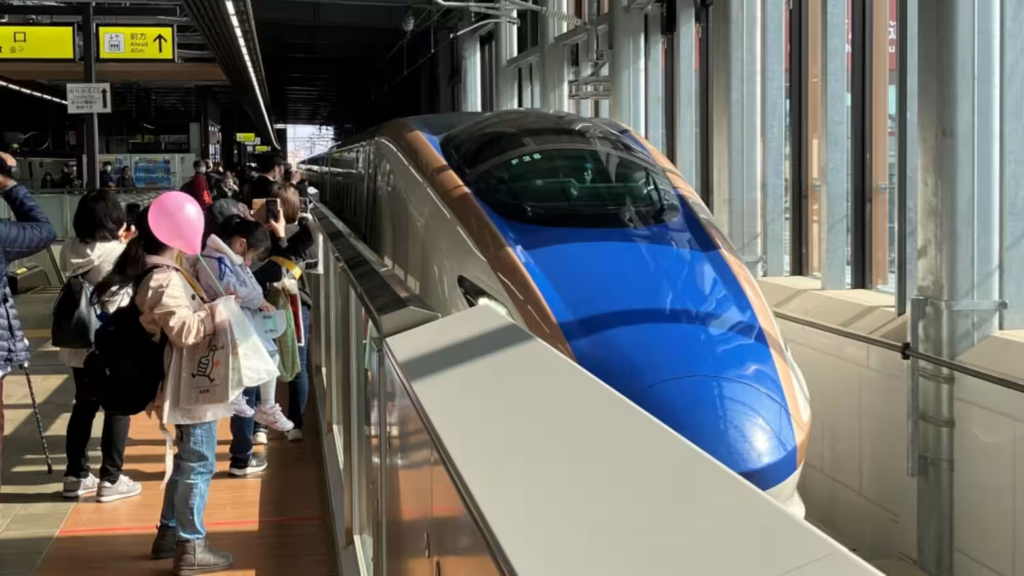
Japan’s Bullet Trains Are So Precise That Even a 20-Second Mistake Gets an Apology — And Major Delays Can Even Trigger Refunds
Japan’s Shinkansen is famous not just for speed, but for precision that borders on unbelievable. On the busiest high-speed lines, the average delay is usually under a minute — even with hundreds of departures every single day. In some years, the delay average has dropped to just 24 seconds, including storms and peak travel crowds.
And when timing slips?
Japan treats it seriously.
Rail staff apologize for even 1-minute delays, conductors make announcements, and platform teams bow to passengers. In rare cases, railway companies have even issued formal written apologies when a train departed 20 or 25 seconds early, calling it a service failure that might inconvenience travelers.
But here’s what many people don’t know:
Japan also has one of the world’s clearest passenger-rights systems.
Small delays (1–5 minutes):
You get a polite apology — no money, because the system normally runs within seconds.
Moderate delays (5+ minutes):
Passengers receive a delay certificate (chien-shō), which they use at work or school to show the delay wasn’t their fault.
Major delays (usually 2+ hours):
You may qualify for refunds, especially on limited express and Shinkansen services. In many cases, the express fee is refunded, and for severe disruptions, companies may offer additional compensation.
Through all of this, one thing stays constant:
Your time is treated with respect.
Japan’s railway culture combines engineering discipline, advanced safety systems, and a deep national belief that public services should never waste a passenger’s day. That’s why meals, meetings, and entire routines are planned around the trust that trains will arrive exactly when they’re supposed to.
In a world where delays feel normal, Japan shows what’s possible when punctuality becomes a commitment — not a slogan.
_
In 1952, A London Bus Jumped Tower Bridge With 20 Passengers Onboard
The London Bus That Literally Jumped Tower Bridge — And It Really Happened! 🇬🇧
It sounds like a scene from an action movie — but it’s true.
On December 30, 1952, London bus driver Albert Gunter made history when his No. 78 double-decker jumped a rising section of Tower Bridge — with around 20 passengers still on board.
Here’s what happened
Gunter was driving across Tower Bridge when, without warning, the south bascule (the lifting section) began to rise — the relief watchman had forgotten to ring the warning bell and close the gates.
Realizing what was happening, Gunter had seconds to act. He accelerated instead of braking, racing up the rising road and leaping across a gap of about 3–6 feet to land on the opposite bascule, which hadn’t yet started to lift.
The landing was hard, but everyone survived. The conductor broke his leg, and several passengers had minor injuries — but there were no fatalities.
London Transport later rewarded Gunter with £10 and a day off for his incredible quick thinking (about £290 today).
The bus was a classic AEC Regent III RT, and the event became part of Tower Bridge legend.
The photo you see online isn’t real — no photo of the actual jump exists. It’s a recreated or edited image inspired by the true story.
Gunter’s daring leap remains one of London’s most unbelievable — yet completely true — tales of courage and composure behind the wheel.
This German Couple Turned Their Mercedes G-Class Into a Home on Wheels – Traveling 900,000 Km Across 214 Countries Over 26 Years!

The Man Who Drove Around the World — For 26 Years Straight
In 1989, a German couple, Günther and Christine Holtorf, set off on what was supposed to be an 18-month adventure in their 1988 Mercedes-Benz 300 GD, lovingly nicknamed “Otto.”
That trip never really ended.
Over 26 years, they covered more than 884,000 kilometers (≈ 550,000 miles) — driving across 215 countries and territories on every continent except Antarctica.
After Christine passed away in 2010, Günther kept going solo until 2014.
By the end, Otto had crossed jungles, deserts, warzones, and mountain ranges — without a single major breakdown.
He shipped the car 41 times between continents, drove through the Sahara and the Andes, and even became the first Westerner to drive in North Korea.
When he finally parked for good, Otto was placed in the Mercedes-Benz Museum in Stuttgart, still wearing the dust of half the world.
A journey that began as a simple vacation turned into the longest documented road trip in history — not powered by money or fame, but by curiosity, patience, and love for the open road.




Leave a Comment