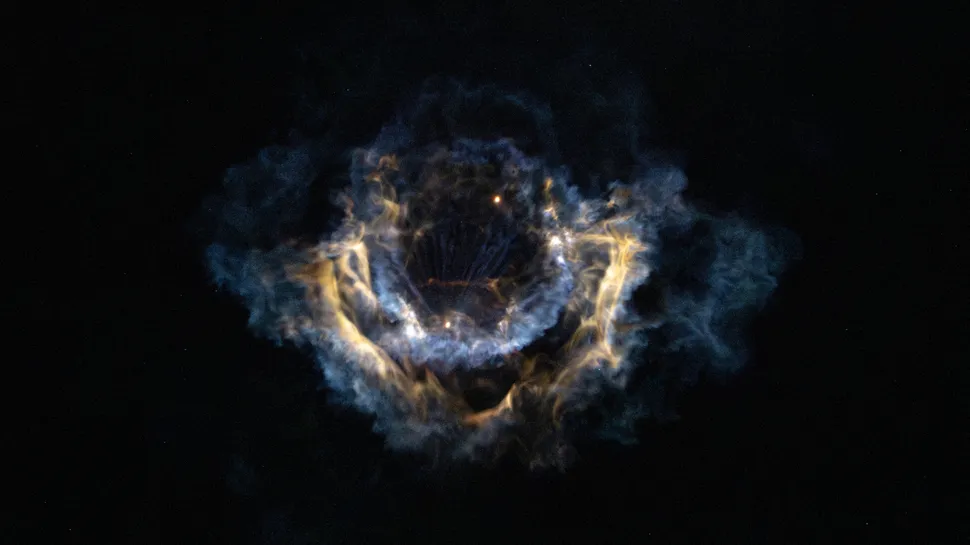

NASA has released a stunning image of the SpaceX Falcon 9 rocket that launched the Crew-12 mission to the International Space Station on Feb. 13. Photographed by John Kraus from Cape Canaveral, the shot captures the exhaust plume from an almost directly overhead angle, revealing intricate patterns of gas, vapor, and soot illuminated by the nine Merlin engines below. The result resembles a blooming flower or a distant nebula, a dramatic example of the “jellyfish” plumes Falcon 9 rockets are known for. The Crew-12 mission delivered four astronauts for an eight-month stay aboard the ISS.
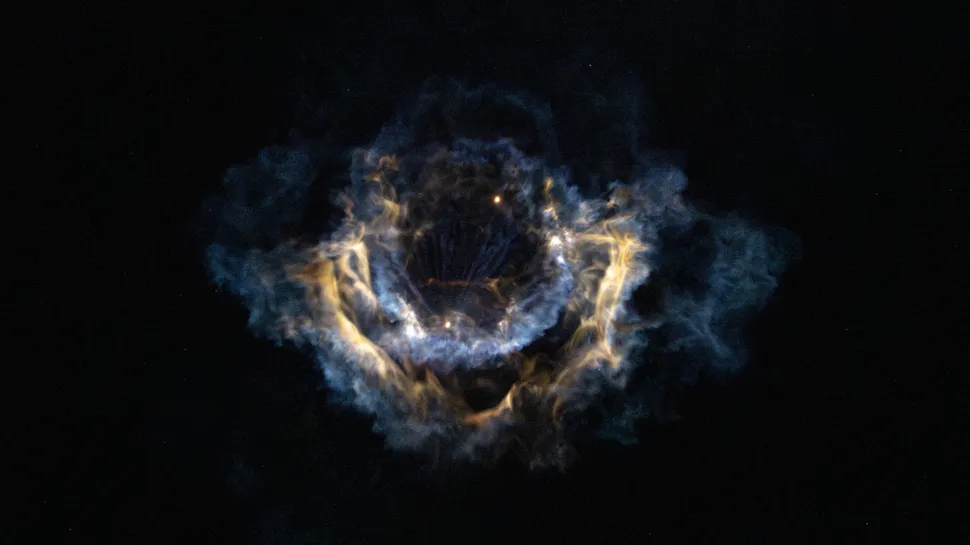
A rocket plume that looks exactly like a flower blooming in space. NASA has released a breathtaking image of the SpaceX Falcon 9 rocket that launched the Crew-12 mission to the International Space Station on Feb. 13, and it’s unlike any launch photo you’ve seen before. Photographer John Kraus captured the moment from a novel angle, looking almost directly up into the rocket’s exhaust plume as it was shaped and backlit by the furious labors of the nine Merlin engines below.
Falcon 9 rockets are known for creating dramatic “jellyfish” plumes when viewed from a distance. The engines burn a mix of liquid oxygen and kerosene to generate the thrust needed to punch through Earth’s dense atmosphere, resist gravity, and achieve orbit. As the exhaust expands rapidly into the surrounding atmosphere, it forms complex patterns of gas, vapor, and soot. In Kraus’s image, those patterns resemble a blooming flower or a nebula formed in the wake of a supernova explosion.
The Crew-12 mission launched at 5:15 a.m. EST on Feb. 13 from Cape Canaveral Space Force Station in Florida. Onboard were NASA astronauts Jessica Meir and Jack Hathaway, European Space Agency astronaut Sochie Adenot, and Russian cosmonaut Andrey Fedyaev. Their SpaceX Crew Dragon spacecraft rendezvoused and docked with the International Space Station on Feb. 14, marking the beginning of an eight-month stay in low-Earth orbit as part of Expedition 74.
The arrival was particularly significant for the space station’s crew. Since Jan. 8, the ISS had been operated by a skeleton crew of just three: NASA’s Chris Williams and cosmonauts Sergei Mikaev and Sergey Kud-Sverchkov. That reduced staffing followed the medical evacuation of four Crew-11 astronauts due to an undisclosed health issue. The new crew’s arrival restores full operational capacity to the orbital laboratory.
For Meir, this mission marks a return to space following her previous flight in 2019-2020, during which she participated in the first all-female spacewalk. Hathaway, Adenot, and Fedyaev are all first-time fliers, beginning their space exploration careers with this eight-month expedition.
The stunning launch photo serves as a reminder of the beauty inherent in space exploration. Rockets are engineering marvels, but they’re also capable of producing moments of unexpected artistry. Gas and vapor expanding into the Florida sky, illuminated by engine exhaust, created something that looks more like a carefully crafted digital rendering than a photograph of a launch.
Kraus’s image joins a long tradition of iconic rocket photography. From the early days of Mercury and Gemini through the Space Shuttle era to today’s commercial launches, photographers have captured the majesty of human spaceflight. But this particular shot stands out for its composition and timing, freezing a moment when the plume’s structure aligned perfectly with the light to create something transcendent.
The Crew-12 astronauts will spend the coming months conducting scientific research, maintaining the space station, and perhaps capturing their own stunning images of Earth from 250 miles up. From their perspective, the planet below occasionally resembles a marble suspended in blackness. From our perspective, the rocket that carried them there occasionally resembles a flower. Different angles, different views, same sense of wonder.




Leave a Comment