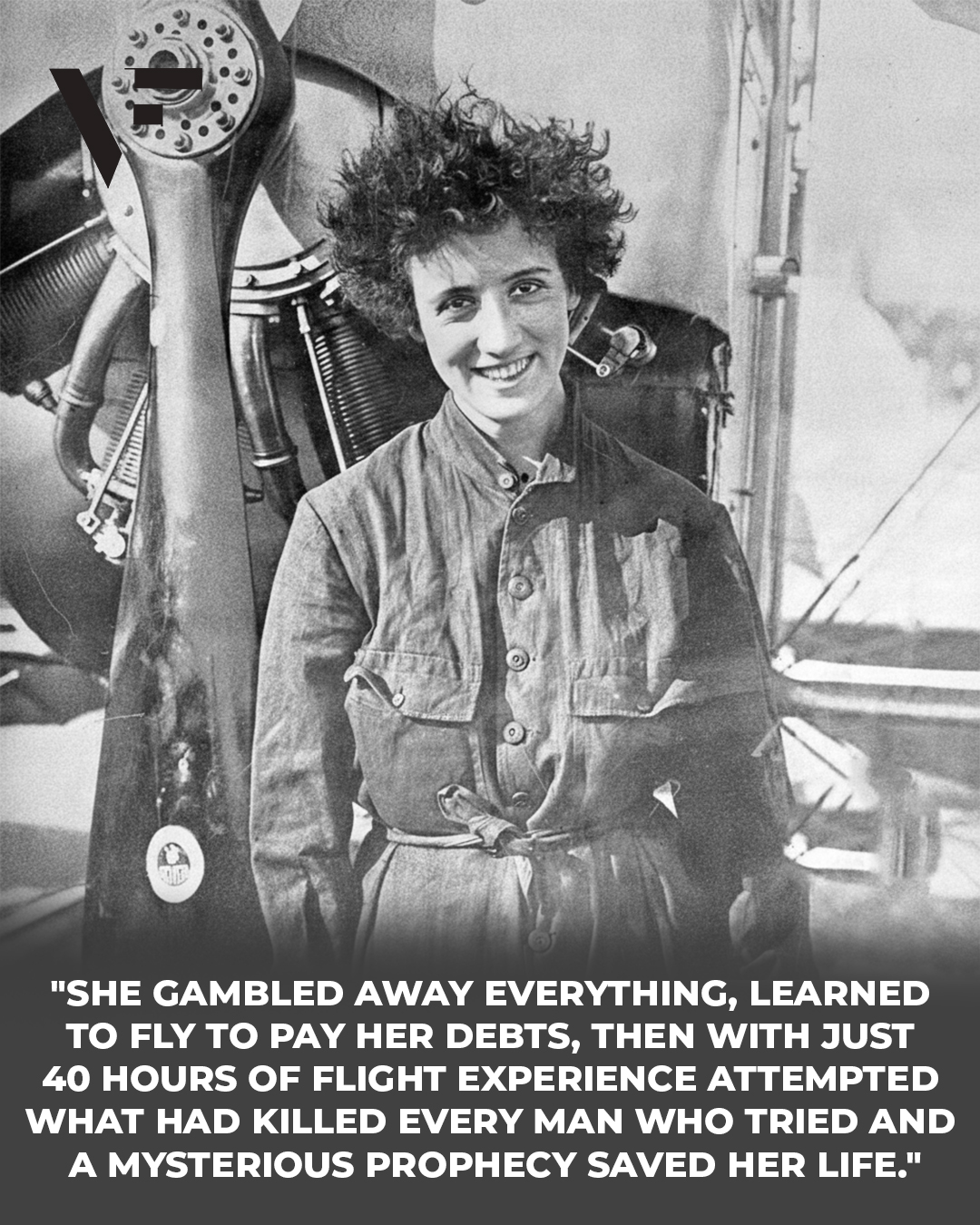

In April 1921, with just 40 hours of flight experience, Adrienne Bolland lifted her fragile Caudron G.3 into the thin air above Argentina and aimed for the Andes. Pilots before her had failed. Some had died. The mountains rose higher than her aircraft could safely climb. The night before, a stranger had warned her of a choice she would face in the sky. Hours later, she saw it: an oyster-shaped lake and two possible paths. She chose the more dangerous turn. Minutes later, Chile stretched before her. Bolland became the first woman to cross the Andes, proving that courage is sometimes the act of turning toward the mountain when fear demands you turn away
desc ;
At dawn on April 1, 1921, a fragile biplane lifted off from Mendoza, Argentina, and climbed toward the wall of the Andes. The pilot, Adrienne Bolland, had logged barely forty hours of flight time. Ahead of her rose peaks exceeding 20,000 feet. Her aircraft, a Caudron G.3, had no enclosed cockpit, no radio, and no oxygen supply. The margin for error was thin.
Bolland had begun flying less than two years earlier. Born in 1895 in France, she came of age in a society that did not expect women to enter aviation. In late 1919, seeking income and independence, she enrolled in training at the Caudron factory in Le Crotoy. She earned her pilot’s license in January 1920, becoming one of the early French women to qualify. René Caudron, co founder of the aircraft company, recognized the publicity value of a woman pilot demonstrating his planes.
In August 1920, she crossed the English Channel, attracting press attention. The following year, she traveled to South America to promote Caudron aircraft. There, she announced an intention that drew skepticism. Since 1913, several aviators had attempted to cross the Andes between Argentina and Chile. The mountains’ altitude and unpredictable winds had defeated many efforts.
Bolland requested a more powerful aircraft but was informed none would be sent. She decided to attempt the crossing in the G.3. The planned route required threading through valleys because the plane could not outclimb the highest summits. Navigation depended on visual landmarks and estimation.
On the evening before departure, Bolland later recounted an encounter with a woman who described a distinctive lake and warned her which direction to choose if she saw it. Whether coincidence, intuition, or later embellishment, the story became part of the flight’s legend. What is documented is that during the crossing she reached a high valley and altered course in a way that carried her safely over the final ridgeline.
After four hours and seventeen minutes in the air, she landed near Santiago, Chile. She had completed one of the earliest trans Andean flights and became the first woman to do so. South American newspapers celebrated the achievement. In France, recognition was slower, though she was eventually appointed Chevalier of the Legion of Honour.
Bolland continued flying and set aerobatic records, including a series of consecutive loops in 1924. In 1930, she married aviator Ernest Vinchon. During the Second World War, both were involved in activities associated with the French Resistance against German occupation.
She died in 1975 in Paris. In later decades, memorials in France and Argentina marked the centenary of her Andes crossing. The flight itself remains a study in early aviation risk, undertaken in an aircraft originally designed for training rather than mountain navigation.
The enduring image is not of prophecy but of decision. In thin air above unfamiliar terrain, Bolland relied on judgment formed through limited experience and determination. The Andes did not yield to symbolism or narrative. They demanded precise control of a wood and fabric machine. Her success demonstrated that early aviation was shaped not only by engineering advances but by individuals willing to test the boundary between possibility and miscalculation.


Leave a Comment