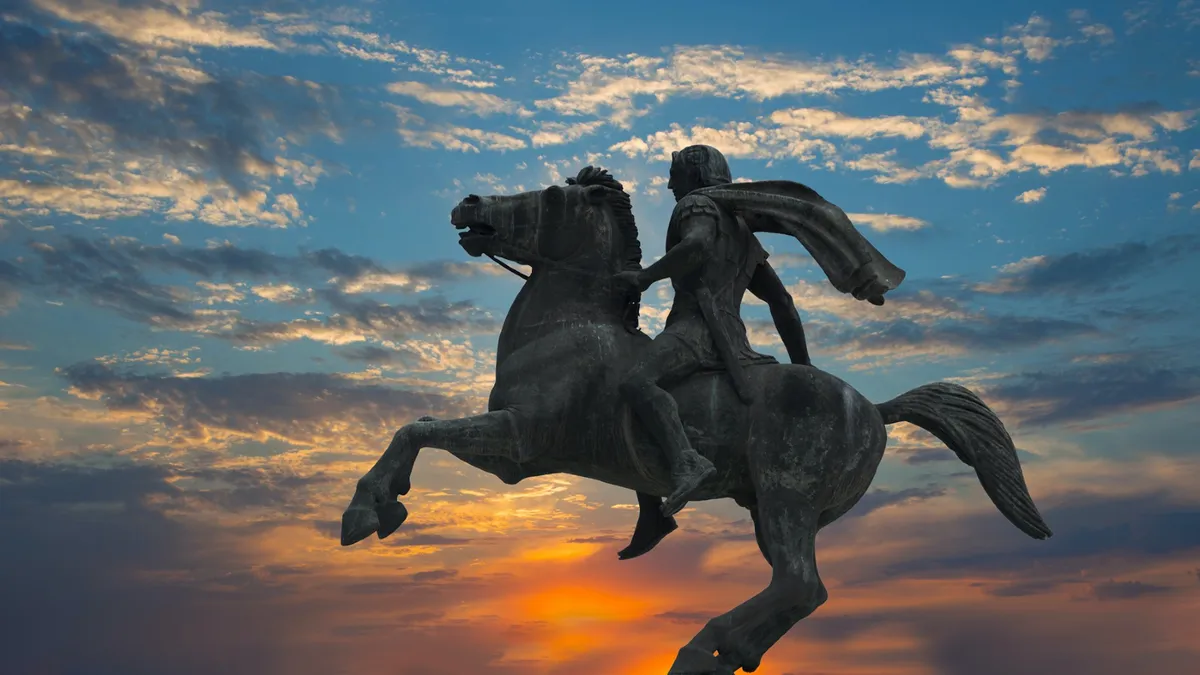

Alexander the Great, one of history’s greatest conquerors, died at just 32 in Babylon, leaving behind an empire stretching from Greece to India. Historical records suggest his body was brought to Egypt, temporarily kept in Memphis, and a grand tomb was built in Alexandria to honor the legendary king. Yet, over two millennia later, the location of Alexander’s final resting place remains unknown. Some speculate the tomb sank beneath the sea in the now-submerged Palaces District, while others believe it was destroyed by human activity or natural disasters. Despite exhaustive searches, the tomb, and the secrets it may hold, remains lost.
Alexander III of Macedon, universally known as Alexander the Great, reshaped the ancient world before dying at the tender age of 32 in Babylon in 323 B.C. By then, he had carved out an empire stretching from the Balkans across Persia and into India, leaving a legacy that would inspire generals, kings, and historians for millennia. Following his sudden death from an illness, his generals debated what should be done with his body. Ancient accounts indicate that Ptolemy I, one of his trusted generals, transported Alexander’s remains to Egypt two years later. There, the corpse was temporarily housed in Memphis while preparations were made for a tomb in Alexandria, a city Alexander had founded and envisioned as a monument to his empire.
Despite detailed accounts from ancient historians, including Pausanias and Plutarch, the exact location and structure of Alexander’s tomb remain shrouded in mystery. Scholars suggest the tomb was situated in the city’s Palaces District, which over centuries has become partially submerged due to the shifting coastline and Nile delta activity. Earthquakes, floods, and urban expansion over thousands of years may have further destroyed or concealed the site. Even if the tomb were discovered, identifying it as Alexander’s would pose significant challenges. Ancient sources left few physical descriptions, and the absence of definitive inscriptions or identifying markers complicates modern archaeological efforts. Speculation ranges from the tomb lying beneath the modern streets of Alexandria to being entirely lost beneath layers of sediment and water, leaving the world to wonder whether Alexander’s final resting place ever survived the march of time.
Archaeologists and historians continue to search for clues, often combing through underwater ruins, ancient maps, and historical texts, but so far, no confirmed evidence has emerged. While the mystery endures, the story of Alexander’s tomb underscores the transient nature of even the most monumental human achievements. It also highlights how natural forces and human development can erase once-iconic sites, leaving only records in texts and art. The quest to locate Alexander’s remains is as much about uncovering the past as it is about understanding how history itself can vanish. For now, the tomb of the man who conquered the known world remains a tantalizing enigma, lost to time, but forever alive in legend, inspiring explorers, scholars, and treasure hunters to continue the search for one of history’s most elusive graves.


Leave a Comment