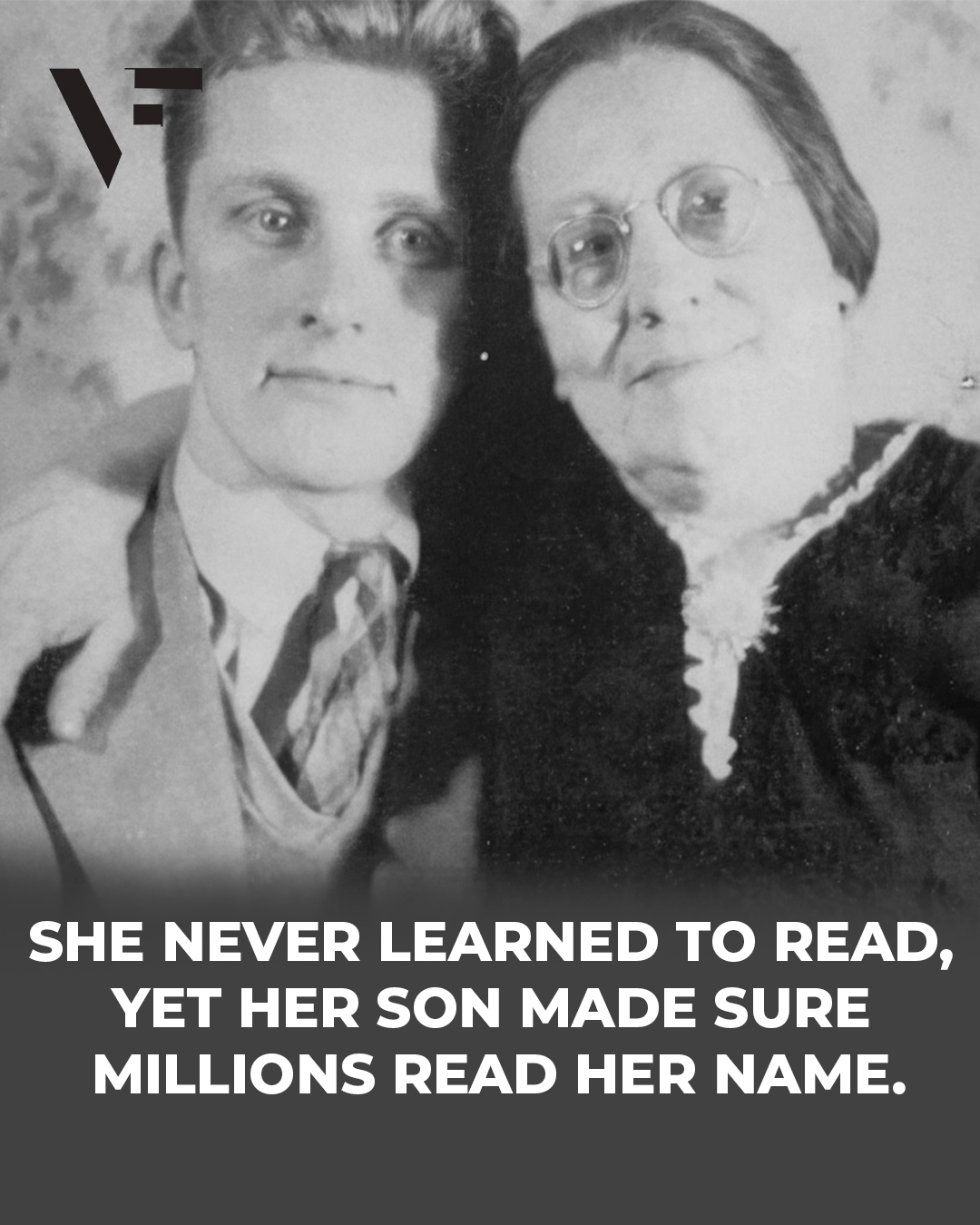

In a small mill town in New York, Bryna boiled butcher bones to feed her seven children, stretching thin broth across hungry days. She could not read or write, but she believed fiercely in her only son, Issur, when he dreamed of becoming an actor. The world knew him later as Kirk Douglas. He never forgot the poverty, or the faith that sustained him. When he formed his production company, he named it Bryna, placing her name on screens across America. One night in Times Square, he showed her those glowing letters. She looked up and wept. Her son had turned belief into legacy, and made sure the world would read her name.
desc;
On a cold night in the late 1950s, beneath the electric glow of Times Square, an elderly immigrant woman looked up at a theater marquee. High above the crowd, in bright letters, was a single word: Bryna. She could not read English. But she knew her own name.
The woman was Bryna Demsky. Her son, born Kirk Douglas, had brought her there deliberately. For decades, her life had been defined by factory work, poverty, and survival. Now her name stood illuminated above one of the busiest intersections in America.
Bryna had arrived in the United States in the early twentieth century from what is now Belarus, part of a wave of Jewish immigrants fleeing hardship and persecution in Eastern Europe. She settled with her family in Amsterdam, New York, a mill town far removed from the wealth and spectacle of Manhattan. Life revolved around labor. Her husband worked as a ragman, collecting scrap to resell. Money was uncertain, and food was not guaranteed.
Bryna never learned to read or write. What she possessed instead was endurance. She took in laundry, scrubbed floors, and managed a household with seven children on minimal income. When meat was unaffordable, she asked local butchers for discarded bones, boiling them into broth to stretch meals across several days. Hunger was not an abstract memory for her children. It was routine.
Her only son, Issur Danielovitch, grew up in that environment. He later described childhood marked by scarcity and humiliation, including fights that earned him the nickname Izzy Demsky. Yet he also recalled his mother’s conviction that education and ambition could change their circumstances. When he expressed a desire to become an actor, an aspiration that seemed implausible for a poor immigrant’s son, Bryna did not dismiss it.
Issur Danielovitch became Kirk Douglas, a leading actor of mid twentieth century American cinema. His performances in films such as Spartacus and Champion established him as one of Hollywood’s prominent figures. In 1955, he founded a production company and named it Bryna Productions. The choice was deliberate. Each time a film opened with the company’s name, it served as a public acknowledgment of his mother’s influence.
Douglas often spoke of the formative impact of poverty and of his mother’s resilience. When he escorted Bryna to Times Square to see her name displayed, it was not an act of spectacle but recognition. For a woman who had scrubbed laundry to keep her children fed, the illuminated sign represented something larger than commercial success. It signaled that her sacrifices had carried forward.
Bryna died not long after that visit. Douglas continued his career for decades, later becoming known not only for acting but for philanthropy and advocacy. He lived to the age of 103, witnessing changes in both the film industry and American society.
Yet in interviews and memoirs, he returned repeatedly to the same point. His achievements began in a cramped house in upstate New York, shaped by a mother who believed that ambition was not reserved for the wealthy or educated. Bryna Demsky left no written record of her own. Her name endured in film credits viewed by millions, placed there by a son who understood that before he was a star, he was a child sustained by her labor and faith.


Leave a Comment