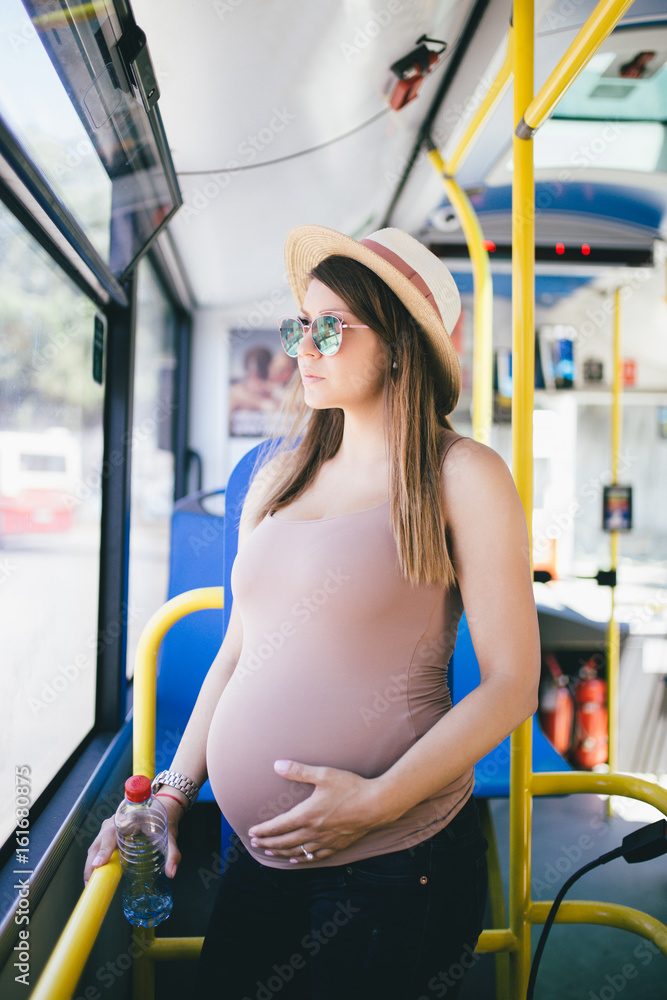

A man refused to give his bus seat to a pregnant woman, stating “pregnancy was her choice.”
The bus was crowded, as buses often are during peak hours. Passengers stood in the aisle, swaying with each turn, holding straps and poles for balance. A pregnant woman boarded and scanned the seated passengers, her eyes passing over the man who remained seated, his attention fixed on his phone or perhaps the window or perhaps simply the middle distance of public transit anonymity. She asked, presumably, if he would give up his seat. He declined. His reasoning, later shared and debated and dissected across countless social media platforms, was that her pregnancy was a personal choice and not his responsibility. The woman remained standing. The man remained seated. The bus continued its route. And the incident, captured perhaps on a phone or merely in the memory of witnesses, became a parable for our divided times.
The argument that pregnancy is a personal choice is factually accurate in many but not all cases. Some pregnancies are chosen, planned, celebrated. Some are not. The man on the bus had no way of knowing which category this particular pregnancy fell into, nor did he inquire. He simply asserted that her condition was the result of her own decisions and therefore did not obligate him to sacrifice his comfort. This framing situates pregnancy within the logic of individual responsibility that characterizes contemporary discourse on everything from healthcare to housing to education. You made your choices; now live with the consequences. The logic is coherent, consistent, and utterly indifferent to the reality that human beings exist in community and that community requires mutual accommodation.
The concept of chivalry, or more broadly of courtesy toward pregnant women, has historical roots that predate modern debates about gender equality and personal responsibility. In an era when pregnancy was both more common and more dangerous, when maternal mortality rates were substantially higher and medical intervention substantially less effective, the sight of a pregnant woman evoked a specific response: protectiveness, accommodation, deference. This response was not based on the woman’s individual merit or her relationship to the protector. It was based on her visible embodiment of the future, her literal carriage of the next generation. The man who declined his seat was rejecting not only a specific request but this entire historical and cultural framework.
The debate that followed the incident’s documentation and dissemination followed predictable contours. Those who defended the man’s choice emphasized personal autonomy and the rejection of entitled demands. They argued that pregnancy does not confer special privileges, that women who choose to become pregnant should accept the physical inconveniences that accompany their choice, that men should not be expected to sacrifice their own comfort for strangers whose circumstances are the result of their own decisions. This position has internal logical consistency, but it requires the rejection of any moral obligation beyond the minimal requirements of the law. It is a vision of society as a collection of autonomous individuals, each pursuing their own interests, bound only by the prohibition against actively harming others.
Those who criticized the man’s choice emphasized community responsibility and basic human decency. They argued that pregnancy is not merely a personal choice but a contribution to the collective future, that accommodating the physical needs of pregnant women is a minimal expression of social solidarity, that the failure to offer a seat is not merely discourteous but indicative of a broader erosion of mutual obligation. They pointed out that the man did not know whether this pregnancy was chosen or not, that his assumption of choice was itself a judgment he was not entitled to make. They noted that the woman was not demanding special treatment but simply asking for the same accommodation that has been extended to pregnant women for generations.
The pregnant woman in this incident has not been identified, nor has the man who declined her request. Their anonymity allows the debate to proceed without the complicating factors of individual personality or circumstance. They have become symbols, representatives of competing worldviews rather than particular human beings with particular histories and motivations. This is the function of viral incidents: to transform specific events into generalized lessons, to strip away context and complexity until only the stark outline of competing principles remains. The woman is Pregnancy. The man is Choice. The bus is Society. The empty seat is the contested territory where our values collide.
The physical experience of pregnancy is not uniform, and the need for a seat varies dramatically across individuals and trimesters. Some pregnant women experience minimal discomfort and are capable of standing for extended periods without distress. Others contend with fatigue, back pain, pelvic pressure, dizziness, and a host of other symptoms that make standing on a moving bus genuinely hazardous. The man on the bus could not assess the woman’s specific medical condition, nor was he obligated to do so. He was simply asked for accommodation and declined. His refusal communicated not only his personal unwillingness but his rejection of the premise that such requests deserve consideration.
The broader context of public transit design and policy is relevant to this incident but rarely addressed in the debates it generates. Buses have designated seating for elderly and disabled passengers, but these seats are not always sufficient to meet demand, and the definition of disability does not typically include pregnancy. Transit agencies encourage courtesy but rarely enforce it. The physical configuration of buses, with their narrow aisles and limited handholds, makes standing particularly challenging for those with balance or mobility issues. The man who remained seated while a pregnant woman stood was not violating any law or regulation. He was simply declining to exceed the minimum requirements of the system.
The concept of responsibility invoked by the man’s defense is philosophically complex. If pregnancy is a personal choice, then the costs and inconveniences of pregnancy are properly borne by the individual who made that choice. But the same logic would apply to virtually every human condition that might require accommodation. Illness is often the result of personal choices about diet, exercise, and lifestyle. Injury frequently follows from participation in risky activities. Aging is the cumulative consequence of decades of decisions about health and safety. The logic of personal responsibility, taken to its extreme, dissolves the foundation of mutual aid upon which functional societies depend. We accommodate others not because their circumstances are blameless but because we recognize that vulnerability is universal and that our own need for accommodation is only a matter of time.
The temporal dimension of this incident is worth considering. The man’s refusal to offer his seat occupied perhaps thirty seconds of his day, a negligible investment of time and comfort that would have been quickly forgotten if he had simply stood up and moved aside. Instead, his refusal generated a protracted debate that has consumed thousands of hours of collective attention, produced millions of words of commentary, and entrenched the opposing positions more deeply than ever. The cost-benefit calculus of his decision is difficult to defend on any reasonable grounds. He sacrificed virtually nothing by standing, and he gained virtually nothing by remaining seated except the opportunity to make a point about personal responsibility. That point, however satisfying it may have been to him in the moment, has now been weighed and found wanting by a substantial portion of the public.
The gender dimensions of this incident are inescapable. Pregnancy is a uniquely female experience, and the accommodation of pregnant women has traditionally been framed as an obligation of chivalry, a masculine duty to protect vulnerable women. The man who declined his seat was rejecting not only a specific request but this entire gendered framework. His assertion that pregnancy is a personal choice and not his responsibility can be read as a rejection of the premise that men owe women any special consideration based on their biological capacities. This position is consistent with certain strains of feminist thought that have criticized chivalry as a form of benevolent sexism that reinforces gender hierarchy while appearing to honor women. The difficulty, of course, is that the woman on the bus was not seeking ideological validation or gendered protection. She was simply seeking a seat.
The online response to this incident has been characterized by the particular viciousness that social media platforms enable and amplify. Both the man and the woman have been subjected to harassment, threats, and the kind of sustained public judgment that was once reserved for celebrities and politicians. Their appearances have been analyzed, their characters impugned, their motivations assumed and condemned. The anonymity that initially protected them has been partially eroded by the efforts of online sleuths determined to identify and expose the man who refused to stand. This secondary layer of cruelty, enabled by the same technologies that disseminated the original incident, illustrates the difficulty of having measured debates about complex social questions in an environment optimized for outrage and division.
The bus reached its destination, as buses always do. The pregnant woman disembarked, her day continuing with whatever appointments or obligations awaited her. The man remained seated, perhaps for several more stops, until his own destination arrived. Their interaction was over, its duration measured in seconds, its consequences extending into weeks and months of public debate. Neither of them anticipated, when they boarded the bus that morning, that they would become symbols in a national conversation about courtesy and responsibility and the obligations we owe to strangers. Neither of them chose this role. It was thrust upon them by the peculiar alchemy of contemporary media, which transforms ordinary moments into extraordinary controversies and ordinary people into representatives of opposing worldviews.
The empty seat on the bus represents something more than contested physical space. It is the space between individual autonomy and collective obligation, between personal choice and social responsibility, between the minimal requirements of law and the maximal possibilities of courtesy. We occupy this space differently depending on our values, our circumstances, and our capacity for empathy. The man who declined to offer his seat occupies one end of this spectrum, asserting the primacy of individual choice and rejecting the premise that strangers owe each other anything beyond non-interference. His critics occupy the other end, asserting that community requires mutual accommodation and that the failure to extend even minimal courtesy reflects a dangerous erosion of social solidarity. Most of us exist somewhere in the middle, offering our seats to pregnant women most of the time but occasionally failing, occasionally distracted, occasionally resentful of the cumulative burden of countless small accommodations.
The debate over this incident will eventually fade, as all such debates fade, replaced by newer controversies generated by newer incidents captured on newer phones and shared across newer platforms. The man and woman who collided so briefly on that crowded bus will return to anonymity, their fifteen minutes of unwanted fame concluding as abruptly as it began. But the questions their interaction raised will persist, unresolved and unresolvable, because they are fundamental questions about how we should live together in dense, diverse, demanding societies. We will continue to negotiate the space between autonomy and obligation, between personal responsibility and collective care, between the minimal requirements of law and the maximal possibilities of courtesy. We will continue to disagree about where to draw the lines and how to allocate the burdens. And we will continue to encounter strangers on buses and trains and sidewalks who ask us, explicitly or implicitly, to accommodate their needs. How we respond to these requests is the measure of our commitment to the communities we claim to value. The man who declined to stand gave his measure. The rest of us must give ours.


Leave a Comment