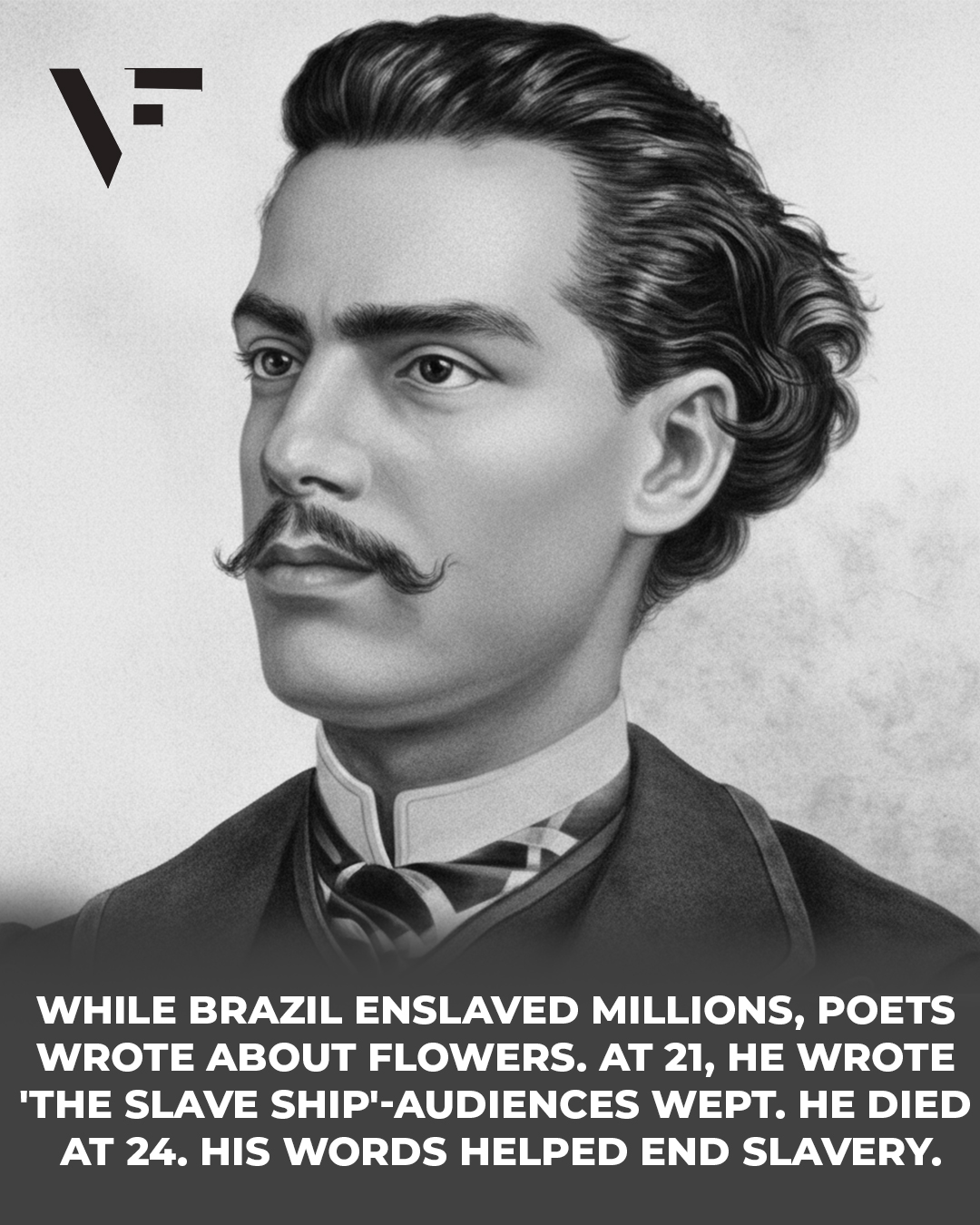

In 1868, at just 21 years old, Antônio de Castro Alves stood before a packed theater and recited “O Navio Negreiro” (The Slave Ship). While much of Brazil’s literary world wrote about romance and nature, he described enslaved Africans chained in darkness, whipped, dying, and thrown into the sea. His words were so vivid that audiences wept. In a nation still built on slavery, he made indifference impossible. Though he died at 24, Castro Alves became the poetic voice of Brazil’s abolitionist movement. His verses helped awaken public conscience, proving that art can confront injustice—and sometimes change history.
desc ;
Salvador, 1868. In a crowded theater, a 21 year old law student stepped forward to recite a new poem. Brazil was still an empire sustained by enslaved labor. Sugar, coffee, and cotton enriched landowners while millions of Africans and their descendants remained in bondage. Much of the country’s literature favored romantic landscapes and idealized love. The young poet chose a different subject.
His name was Antônio de Castro Alves.
Born in 1847 in Bahia, Castro Alves came of age in a society where slavery was central to the economy. Brazil had imported more enslaved Africans than any other country in the Americas. Although the transatlantic slave trade had been formally banned in 1850, illegal trafficking continued, and slavery itself remained legal. Public debate over abolition was growing but still contested.
In 1868, Castro Alves composed O Navio Negreiro, known in English as The Slave Ship. The poem opens with images of the ocean at night before shifting to the interior of a slave vessel. It describes chained bodies, disease, and death during the Middle Passage. The tone moves from lyrical observation to moral indictment, culminating in an appeal that condemns the system sustaining such voyages.
Castro Alves did not confine his work to print. He performed his poetry publicly, using theatrical delivery to intensify its impact. Contemporary accounts describe audiences responding with emotion, sometimes leaving in distress, sometimes applauding in support. His verses circulated among students and intellectuals aligned with the abolitionist cause.
The poem did not stand alone. Castro Alves wrote other works condemning slavery and advocating liberty, linking Brazil’s condition to broader struggles for human dignity. His language combined romantic style with political urgency, contributing to a current within Brazilian literature known as the “condoreira” movement, characterized by lofty rhetoric and social engagement.
His career was brief. In 1868, he suffered a severe injury from a hunting accident, leading to complications that required amputation of part of his foot. At the same time, he was battling tuberculosis, a common and often fatal disease in the nineteenth century. Despite declining health, he continued writing.
Castro Alves died in 1871 at the age of twenty four. His major collection, Os Escravos, was published posthumously. Over the following decades, abolitionist sentiment strengthened. In 1888, Brazil enacted the Lei Áurea, formally ending slavery and making Brazil the last country in the Western Hemisphere to do so.
Abolition resulted from political activism, economic change, resistance by enslaved people, and international pressure. Poetry alone did not end the institution. Yet Castro Alves’s work contributed to the cultural climate in which slavery could no longer be defended without challenge. His imagery forced readers to confront the violence underlying economic prosperity.
Today, Castro Alves remains a central figure in Brazilian literature. Schools continue to teach The Slave Ship as part of the national canon. His name appears on streets and institutions. The intensity that characterized his performances has faded into history, but the text endures.
He wrote in a period when many artists avoided direct engagement with slavery. By choosing to describe what others omitted, he aligned art with public conscience. His life was short, but his work entered a larger movement that reshaped Brazilian society. The poem that once unsettled theater audiences continues to testify to the power of language to bear witness




Leave a Comment