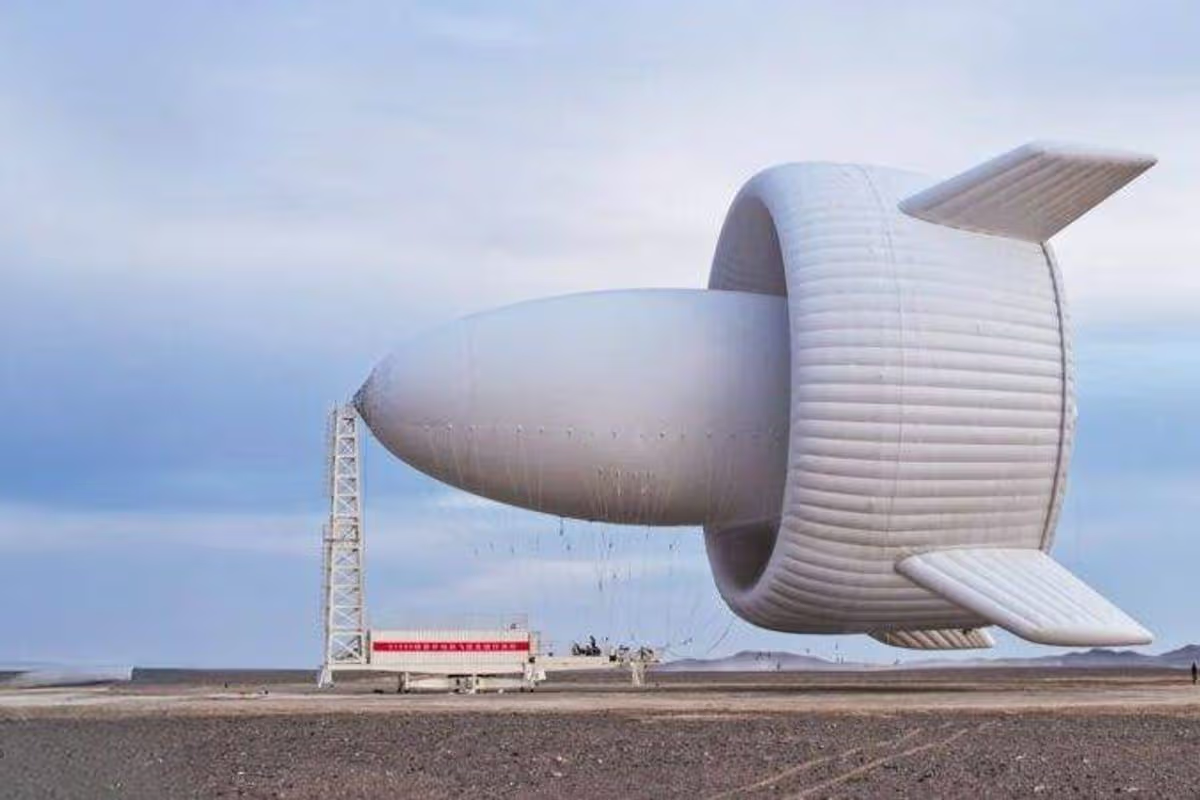

China has recently achieved a breakthrough in renewable energy by successfully testing the S2000 Stratosphere Airborne Wind Energy System (SAWES), a megawatt-class airborne wind power device.
In early 2026, this innovative system completed a test flight in Yibin, Sichuan Province, rising to an altitude of 2,000 meters for about 30 minutes and generating 385 kilowatt-hours of electricity, which it fed directly into the national grid—a world first for such high-altitude wind technology designed with urban deployment in mind.
Unlike traditional wind turbines fixed to massive steel towers on land or offshore platforms, this “flying” turbine operates as a helium-filled, airship-like platform that hovers high above the ground.
At these elevations, winds are significantly stronger, more consistent, and richer in energy potential compared to surface-level flows, where conventional turbines are limited by slower and more variable conditions.
Developers claim this approach allows the system to potentially generate up to 10 times more energy than equivalent ground-based turbines, thanks to access to superior wind resources that boost overall output and capacity factors.
Simultaneously, by eliminating the need for heavy, resource-intensive towers and foundations, it uses approximately 40% less material in construction, which also contributes to lower costs—estimates suggest around 30% cheaper electricity production once scaled.
The tethered design transmits power via cables to the ground, combining mobility for rapid deployment (ideal for disaster relief or remote areas) with stable, high-efficiency generation.
This test marks a promising step toward expanding high-altitude wind energy, potentially transforming how clean power is harnessed more efficiently and sustainably worldwide.




Leave a Comment