

Society’s obsession with your looks is a cage you don’t even see.

Taryn Smith’s solo journey across the Atlantic is a polarizing slap in the face to a world obsessed with curated perfection and “male gaze” aesthetics. Since embarking on December 14, 2025, the 25-year-old has endured a grueling 12-hour daily rowing schedule, physical hives, and muscle atrophy, but she claims the most “freeing” part of the ordeal isn’t the solitude—it’s the sudden death of her vanity. As a woman in 2026, Smith notes that the absolute lack of being “perceived” by others has cleared massive space in her mind, exposing the mental energy women waste on their appearance. This isn’t just an adventure story; it’s a radical indictment of a society that treats a woman’s looks as a public commodity. Out in the mid-Atlantic, where survival depends on desalinators and para-anchors, the societal pressure to be “pretty” simply evaporated, revealing it as a useless, heavy burden.
While the “experts” focus on her 2,000-calorie freeze-dried diet or her calf strength loss, the real story is her psychological “factory reset.” Smith relies on calling her parents via Starlink to survive the crushing loneliness, yet she refuses to quit because the cost of rescue is too high. This “Us vs. Them” divide is clear: while we sit in a world of filters and followers, she is developing calluses and finding mental clarity in the “ugliness” of survival. She is proving that “self-care” isn’t a spa day; it’s being so busy staying alive that you forget what you look like. When she finally hits land, her legs may give out, but she’ll be returning with a mind that is no longer a prisoner to your expectations. Her journey suggests that maybe the only way for a woman to truly be herself is to disappear from your sight entirely.
Epic Games is gaslighting you with a lobby full of mindless AI puppets.

The competitive soul of Fortnite is under siege as a staggering “bot pandemic” threatens to alienate the game’s core player base in early 2026. While bots were originally introduced to smooth out the learning curve for beginners, players are now reporting lobbies where up to 90% of opponents are mindless AI. This polarizing “padding” of matches is a direct threat to the game’s competitive integrity; how can a new player ever hope to reach the FNCS $10 million prize pool if their only “training” involves killing a bot that can’t build a basic 1×1? Critics like Michael Caruso argue that Epic Games is choosing fast matchmaking times over high-quality gameplay, effectively turning a world-class esport into a lonely, single-player experience disguised as a battle royale.
The “Us vs. Them” divide is reaching a boiling point: casuals might enjoy the easy kills, but the “sweats” and rising stars feel robbed of the adrenaline that comes from besting a real human. The proposed solution is simple yet controversial—either quarantine bots into a dedicated “Practice Mode” or replace the “fake player” bots with obvious, high-tier NPC bosses that offer a legitimate challenge. As Fortnite navigates its massive Chapter 7 “Pacific Break” update, the community’s patience is wearing thin. If Epic continues to prioritize “filler” over “skill,” they risk a mass exodus of competitive talent who are tired of being gaslit by a lobby full of AI. The message from the veterans is clear: give us a 10-minute queue for 100 real players, or watch your “living” game become a digital ghost town.
Your CEO’s silence on federal “terror” is a business strategy, not a mistake.

A defiant coalition of workers from Silicon Valley’s biggest titans—including Google, Amazon, and Microsoft—has launched the ICEout.tech campaign, demanding an immediate end to the industry’s complicity in federal violence. The movement follows the chilling extrajudicial executions of U.S. citizens Alex Pretti and Renée Good by ICE and Border Patrol agents in Minneapolis this January. While tech leaders like Tim Cook and Sam Altman have been spotted “cozying up” to the White House, their employees are calling for a total “contract blackout.” This polarizing internal rift highlights a massive “Us vs. Them” divide: while CEOs chase billion-dollar AI government contracts, the rank-and-file are exposing how tools from Palantir and OpenAI are being weaponized for “Operation Metro Surge” to track and terrorize communities.
The tension is at a breaking point as a nationwide “General Strike” and “Blackout Friday” sweep through major cities on January 30, 2026. Organizers argue that if tech leaders could successfully lobby the President to stop a National Guard deployment in San Francisco last October, their current silence on the Minnesota killings is a choice, not a constraint. The open letter demands that CEOs “pick up the phone” and order ICE out of American cities. However, with companies like Google previously firing dozens of workers over “Project Nimbus” protests, many signatories are hiding behind anonymity to avoid corporate retaliation. This isn’t just a political debate; it’s a direct challenge to the ethics of “surveillance capitalism,” proving that the “wonder materials” and “AI breakthroughs” of the Valley are increasingly inseparable from a state-sponsored campaign of “reckless violence” on American streets.
SoFi is building a banking empire while you’re still using “dinosaur” banks.

SoFi Technologies has just shattered expectations with its first-ever $1 billion revenue quarter, signaling a polarizing shift in the global financial hierarchy. Reporting on January 30, 2026, the digital bank added a record 1 million new members in the final quarter of 2025 alone, bringing its total “army” to 13.7 million users. This isn’t just another earnings beat; it’s an aggressive expansion into the “ultra-wealthy” territory, with CEO Anthony Noto introducing fractional access to private giants like SpaceX and a new “crawl-walk-run” stablecoin, SoFiUSD. While traditional banks struggle with legacy systems, SoFi is essentially building a 24/7 on-chain financial engine that renders 9-to-5 banking obsolete.
The “Us vs. Them” narrative is clear: while the NASDAQ fluctuates, SoFi is pivoting from a student loan startup to a structurally profitable powerhouse with a 2026 revenue target of $4.66 billion. The most radical move is SoFiUSD, making them the first national bank to issue a stablecoin on a public blockchain for near-instant settlement. Critics in the “old guard” worry about the volatility of crypto integration, but SoFi’s 78% growth in financial services suggests that the public is ready to abandon traditional institutions. By offering tools once reserved for the 1%, SoFi is democratizing the financial system at a pace that is leaving competitors like PayPal and Affirm in the dust. You’re either part of this digital flywheel or you’re being left behind in the era of paper checks and slow transfers.
Your “safe” medical waste is a mountain of plastic garbage that never dies.

In a polarizing breakthrough for the “throwaway” culture of modern medicine, BD and Irish cleantech firm Envetec have successfully turned contaminated Petri dishes back into high-quality manufacturing pellets. For decades, the healthcare industry has hidden behind the excuse of “safety” to dump millions of tons of high-grade polymers into landfills. This study, released on January 30, 2026, uses “Generations” technology to shred and chemically disinfect biohazardous waste at the source, proving that we can stop the endless extraction of virgin oil for single-use medical tools. By extruding these recycled flakes back into functional Petri dish prototypes, BD has signaled an “Us vs. Them” shift: you are either part of the circular economy or you are contributing to a global environmental catastrophe under the guise of sterile health.
This isn’t just a feel-good experiment; it is a direct threat to the traditional waste management industry that profits from hauling “red bag” trash to incinerators. The successful recovery of polystyrene, PET, and polypropylene means that high-volume killers like syringes and blood tubes are finally on the chopping block for recycling. While critics worry about the “purity” of recycled medical plastics, BD’s Sustainable Medical Technologies Institute has confirmed that these materials pass rigorous property testing. As the UN High Seas Treaty takes hold, the medical industry no longer has a free pass to pollute. If we can safely turn a biohazard into a new product, there is zero excuse left for any hospital or lab to continue burying their plastic footprint in a hole in the ground.
The “handicap” in gaming is a design choice, not a human limit.

The gaming world is facing a polarizing reckoning as a new partnership between Orlando Health and Full Sail University proves that “physical limits” are just an engineering failure. While traditional controllers have effectively banned millions of disabled people from the digital world, adaptive technology like bionic arms controlled by brain waves is finally smashing the gates. This isn’t just about “charity”; it is a direct threat to the status quo of the multibillion-dollar esports industry. For players like Adrian Araiz, who lost finger mobility after breaking his back, these innovations are the difference between being a spectator and being a competitor. This “Us vs. Them” shift is turning rehabilitation into a high-tech training ground where patients aren’t just “healing”—they are becoming the next generation of elite, tech-enhanced gamers who use alternative inputs to outplay traditional users.
The collaboration in Orlando is funneling scholarships into students who treat accessibility as a mandatory feature rather than a niche afterthought. By blending healthcare with esports strategy, they are creating tools that will inevitably leak into “everyday life,” rendering standard keyboards and mice obsolete for everyone. Critics of the current gaming landscape argue that if we can build a brain-link for Minecraft, there is zero excuse for the “lazy” design of mainstream hardware. We are witnessing a revolution where a wheelchair is no longer a barrier to entry, but a platform for cutting-edge integration. As adaptive tech becomes more precise than a standard joystick, the “able-bodied” gaming community might soon find themselves the ones at a disadvantage. This is the end of the “Game Over” era for disabled players; the world is being redesigned, and the old controllers are going to the scrap heap.
Your “exclusive” luxury brand is dying without a Saudi woman’s Snapchat.

A provocative new report from Snap Inc. and The Business of Fashion has exposed a radical power shift in the global luxury market: the GCC is no longer just a consumer base, it is the world’s most advanced digital laboratory. Launched on January 30, 2026, the study reveals that 60% of the Gulf population is under 30 and hyper-connected, rendering traditional “passive” advertising completely obsolete. In Saudi Arabia, female workforce participation has exploded by 64%, creating a massive new class of wealthy, independent spenders who demand that brands like Gucci and Dior speak their cultural language through Augmented Reality (AR). This isn’t just about “filters”; it’s an “Us vs. Them” ultimatum where brands must either master immersive virtual try-ons and Ramadan-specific storytelling or be permanently ghosted by the world’s most sophisticated young shoppers.
The data proves that 77% of GCC Snapchat users act as digital gatekeepers, sharing brand recommendations only within their trusted circles. This community-led ecosystem has turned the Gulf into a leading market for AR-powered commerce, where a “digital-first” mindset isn’t an option—it’s the entry price. The report highlights a polarizing reality: while Western markets struggle with retail fatigue, the GCC is blending heritage with high-tech infrastructure to redefine “aspiration.” Brands that treat the region as a secondary market are effectively committing commercial suicide. If you aren’t integrating AR into the “cultural rhythm” of the Gulf, you are invisible to a demographic that views technology and luxury as inseparable. The message from Abu Dhabi’s Shop Talk Luxe is clear: the future of fashion isn’t being written on a Parisian runway; it’s being coded in the hands of a Saudi Gen-Z smartphone user.
Your smartphone is becoming an obsolete brick in your pocket.
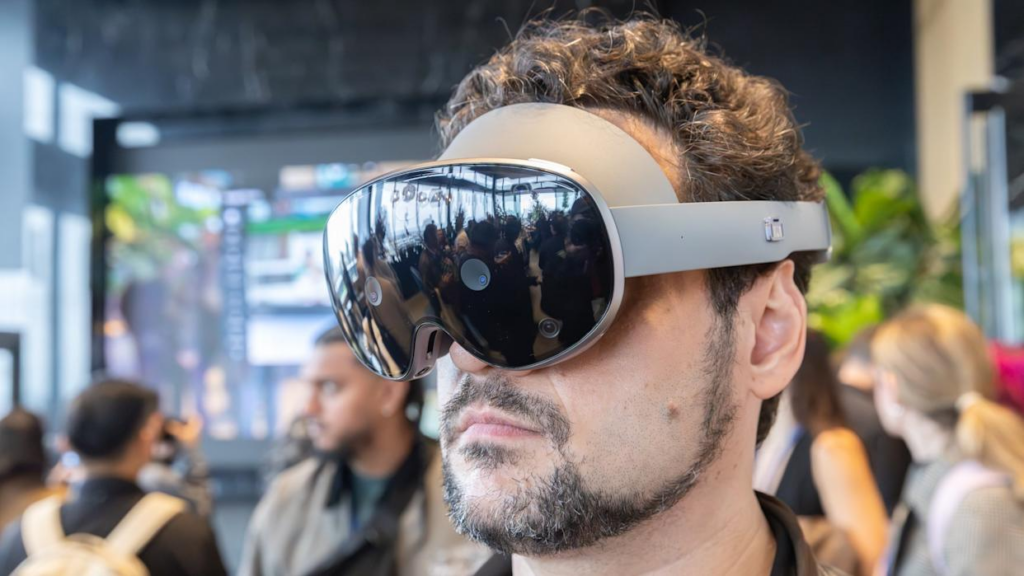
Samsung has officially declared war on the smartphone era, confirming in their Q4 2025 earnings call that their long-awaited AR glasses will drop before the end of 2026. This isn’t just another gadget; it is a polarizing play to move the entire human experience from a 6-inch screen to “multimodal AI” projected directly onto your retinas. While you were distracted by the $2,899 Galaxy Z TriFold, Samsung’s mobile head Seong Cho was quietly preparing a “next-generation” form factor designed to render Meta’s Ray-Bans and Snap’s Specs irrelevant. Armed with 12MP cameras and Google’s Android XR platform, these glasses are the first step toward a future where “looking down” at a phone is a relic of the past.
However, the “Us vs. Them” reality of this tech revolution comes with a massive price tag. Samsung has warned of “inevitable” price hikes due to industry-wide cost pressures, suggesting these glasses won’t be for the average consumer but for the elite early adopters willing to pay for “immersion.” This creates a radical divide: those living in a hyper-connected, AI-augmented reality and those left behind in the “analog” world of handheld devices. As the Galaxy S26 prepares to launch in February, the real story isn’t the phone—it’s the death of the phone. Samsung is betting that you’re tired of the “brick” and ready to wear your internet on your face, regardless of the staggering cost of entry.




Leave a Comment