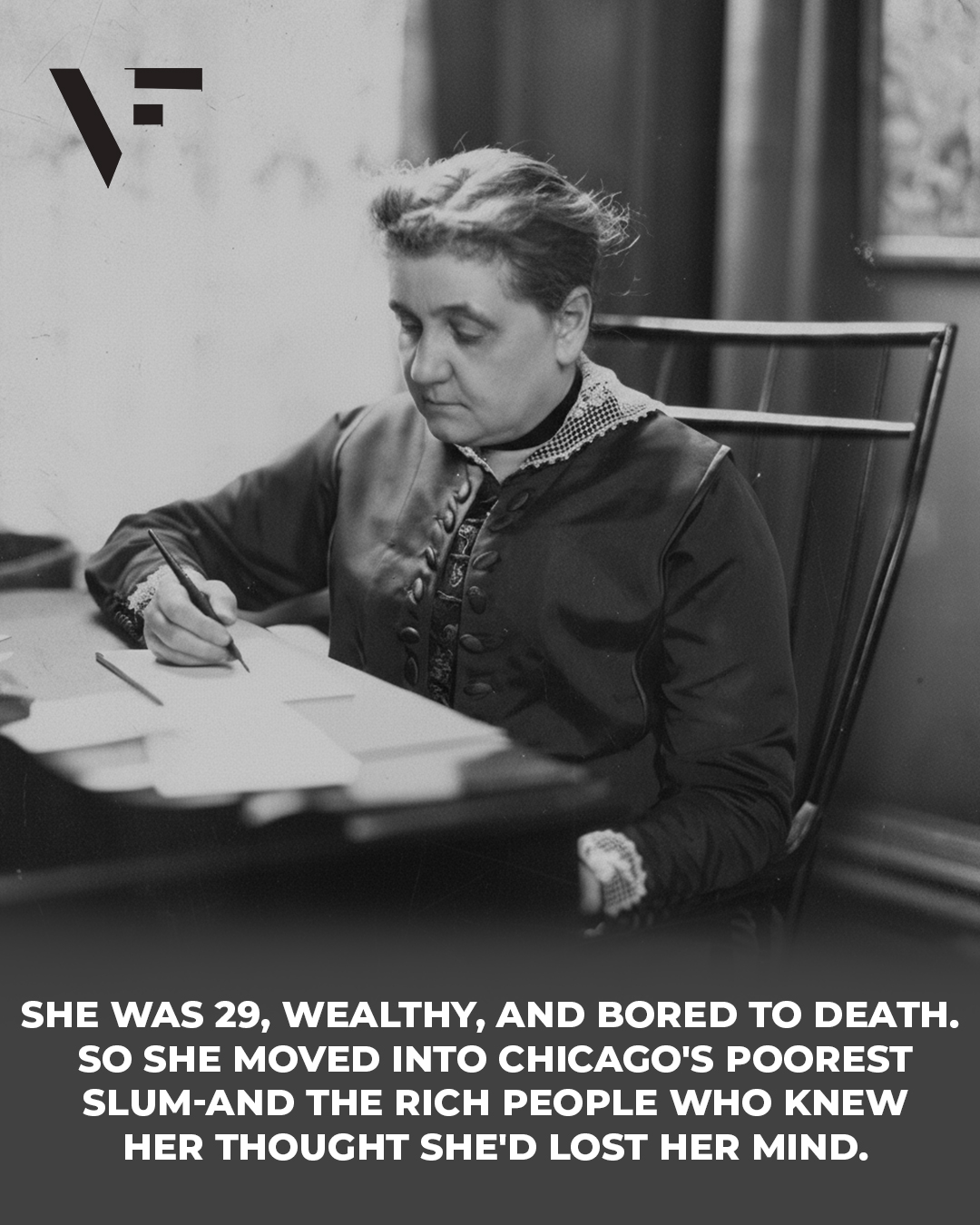

In 1889, at age 29, Jane Addams left wealth and comfort behind to move into one of Chicago’s poorest immigrant neighborhoods. From a crumbling mansion on Halsted Street, she founded Hull-House, where she lived alongside the families she served. What began with art classes and childcare grew into a national reform movement. Addams and her colleagues fought child labor, unsafe factories, and urban poverty, shaping the foundations of America’s social safety net. Condemned during World War I for her pacifism, she later became the first American woman to win the Nobel Peace Prize. Her life proved that proximity to injustice can become a force for change
desc ;
Chicago, September 1889. Smoke from nearby factories drifted over Halsted Street as a 29 year old woman stepped through the doors of a decaying mansion in the Nineteenth Ward. The neighborhood was crowded with recent immigrants, families living in tenements near stockyards and sweatshops. The woman was Jane Addams.
Addams had grown up in relative comfort in Cedarville, Illinois, the daughter of a prosperous mill owner. Educated at Rockford Female Seminary, she traveled in Europe after graduation, uncertain how to use her education in a society that offered few public roles to women of her class. In London in 1888, she visited Toynbee Hall, a settlement house where university graduates lived among the urban poor, offering education and community programs. The model convinced her that reform required proximity, not distance.
Back in Chicago, she and her colleague Ellen Gates Starr rented the former Hull mansion and opened Hull House on September 18, 1889. Rather than operate it as a charity office, Addams chose to reside there. This decision unsettled members of her social circle. Settlement workers were expected to assist the poor, not share their living conditions.
Hull House began with lectures and art displays, but neighborhood conversations quickly shaped its direction. Working mothers asked for childcare. Immigrants requested English classes. Young people needed safe recreation. Within months, the house offered a kindergarten, evening courses, clubs, and a reading room. Over time it expanded into a complex of buildings with a gymnasium, theater, art gallery, and social services.
Addams insisted that reform must rest on observation and data. Residents conducted detailed surveys of housing, wages, and working conditions in the ward. Among those who joined the project were Florence Kelley, who campaigned against child labor, and Alice Hamilton, who investigated industrial diseases. Their findings informed campaigns for factory inspection laws, workplace safety regulations, and the establishment of the first juvenile court in the United States.
By the early twentieth century, Hull House served thousands each week and inspired hundreds of similar settlements nationwide. Addams wrote extensively about democracy and social ethics, arguing that political equality required economic opportunity and community participation. Her influence reached into Progressive Era reforms that shaped labor law, public health policy, and urban planning.
Her stance during World War I proved controversial. Addams opposed American entry into the war and helped organize peace efforts. Critics labeled her unpatriotic, and her reputation suffered. Yet she continued her advocacy, and in 1931 she became the first American woman to receive the Nobel Peace Prize.
Addams lived at Hull House for more than four decades. She died in 1935. The original mansion remains preserved as a museum, though much of the surrounding complex was later demolished. Her decision in 1889 to exchange comfort for engagement altered the course of American social reform. By choosing to reside where poverty was visible and urgent, she transformed observation into policy and sympathy into structure. Her legacy persists wherever social work, labor protection, and community based services continue to operate




Leave a Comment