
The ferry from Ishinomaki takes about forty minutes, slicing through waters that have sustained this coastline for centuries. On clear days, Mount Kinka rises in the distance, a green silhouette against the pale sky. The passengers are mostly tourists now, cameras ready, anticipation visible in the way they crowd the railings as the island takes shape on the horizon. They have come for the cats. They have come to see the place where felines outnumber humans, where the animal kingdom has quietly reclaimed a corner of the human world. They have come to Tashirojima, the Cat Island, and they do not yet understand that what they are about to witness is not a novelty but an elegy.
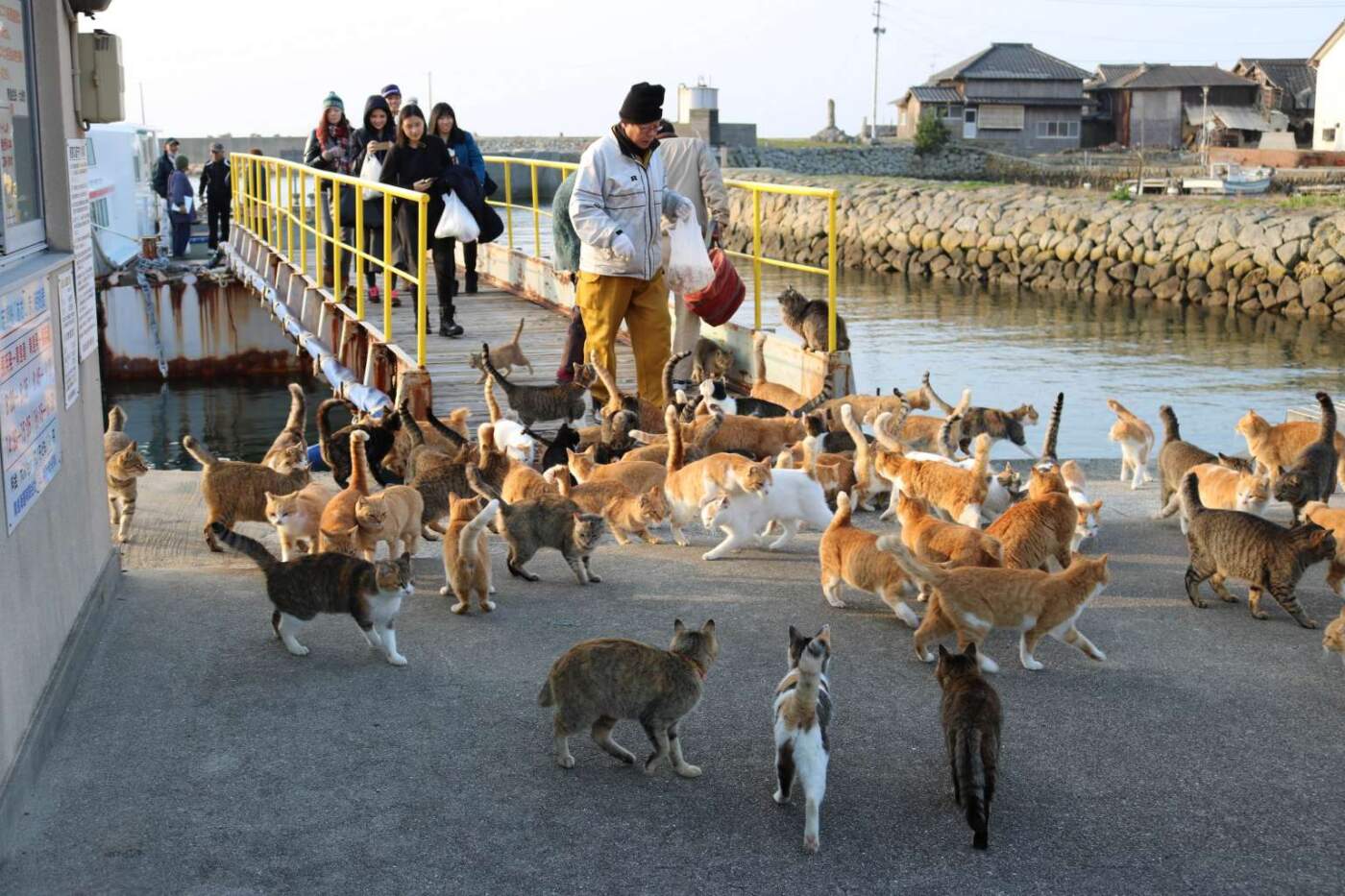
The cats are waiting on the dock. This is the first thing visitors notice: the cats are always waiting. They sit in patient clusters, tails curled around paws, eyes half-closed against the salt wind. They do not beg or scramble; they simply wait, as though they have been waiting for centuries, as though waiting is the primary occupation of cats on islands where humans have become scarce. Some are tabbies, some calico, some the solid black that Japanese folklore associates with protection and good fortune. They are neither wild nor domestic but something in between, a third category that has emerged from decades of cohabitation and decline. They are the residents now. The humans are the visitors.
There are perhaps three dozen humans left on Tashirojima, all of them elderly. The youngest are in their sixties; the oldest are in their nineties. They have lived here their entire lives, most of them, fishing the same waters and tending the same small gardens that their parents and grandparents worked before them. They remember when the island had schools and shops and a population that required both. They remember when the ferry ran multiple times a day, carrying children to school and adults to jobs and families to visit relatives on the mainland. They remember when Tashirojima was not Cat Island but simply an island, a place where people lived and worked and died, like any other place.
The cats number in the hundreds. No one knows exactly how many; a census of felines is difficult to conduct, and the cats themselves seem to regard human efforts at enumeration with polite disinterest. They roam the island freely, occupying abandoned houses and weathered shrines and the overgrown paths that once connected a thriving community. They sleep in sunbeams that fall through broken windows, chase mice through empty storehouses, raise their kittens in the sheltered corners of buildings whose human inhabitants have departed for the mainland or the cemetery or both. They have become, in the absence of their original purpose, the island’s primary residents and its primary attraction.
The cats were not always the center of attention. For centuries, Tashirojima was known for silk production, a labor-intensive industry that required silkworms, mulberry leaves, and the constant vigilance required to protect both from the rodents that would devour them. The cats were introduced as pest control, a practical solution to a practical problem. They earned their keep by patrolling the silkworm houses, and the humans who fed them and sheltered them considered this a fair exchange. No one worshipped them or photographed them or traveled across the ocean specifically to see them. They were workers, like the fishermen and farmers and silk weavers who shared their island.
The silkworms are gone now. The mulberry fields have returned to forest, and the storehouses where silk was processed and stored have fallen into various states of decay. The fishing industry that replaced silk as the island’s economic foundation has also declined, the young people departing for cities with better prospects and the old people remaining to fish alone or not at all. The cats remained through all of it, adapting to each transformation with the patient resilience that cats have perfected over millennia of cohabitation with humans. They did not mourn the silkworms or the fishermen or the children who grew up and left. They simply continued their ancient work of being cats, and the island continued its slow return to a state of nature.
The fishermen who remain tell visitors about the cats’ supernatural powers. They say that cats bring good luck to those who put to sea, that the presence of a cat on a fishing boat ensures a bountiful catch, that the spirits of departed cats watch over sailors in stormy weather. These beliefs are not held with the fervor of religious conviction but with the casual certainty of people who have spent their lives in intimate relationship with both the sea and its feline custodians. They point to the cat shrine, Neko Jinja, a small wooden structure tucked among the trees on the island’s eastern shore. It was built centuries ago, they say, by fishermen who had observed the behavior of their shipboard cats and deduced that the animals could predict weather patterns and fish migrations. The shrine is dedicated to the memory of a cat who died after being accidentally struck by a falling rock; the fishermen buried it on the spot and consecrated the ground in gratitude for its service.
The shrine is still maintained, though the fishermen who tend it are few and growing fewer. The cats gather there in greater numbers than elsewhere on the island, perhaps attracted by the scent of offerings or simply by the peaceful atmosphere of a place dedicated to their kind. Visitors leave coins and cat treats, bow respectfully, take photographs. The cats accept these tributes with the same dignified composure they bring to all human interactions. They have been worshipped for centuries, after all. They have learned to expect it.
The transformation of Tashirojima from working island to tourist destination has been gradual but accelerating. Word of the island’s unusual demographic spread slowly at first, through travel blogs and niche publications and the whispered recommendations of travelers who had stumbled upon something extraordinary. Then came social media, and with it the viral photographs that turned Tashirojima from obscure curiosity to international phenomenon. Cats sleeping in abandoned fishing boats. Cats lounging on shrine steps. Cats staring into the middle distance with the inscrutable wisdom of creatures who have witnessed the rise and fall of human enterprises without once altering their own essential nature. The photographs were shared millions of times, each share adding to the island’s reputation and drawing more visitors to its shores.
The tourists bring money, which the remaining residents use to maintain the island’s infrastructure and purchase food and medical supplies. They also bring cat food, which they distribute generously to the waiting felines, unaware that they are contributing to a population boom that the island’s ecosystem cannot sustainably support. The cats have become dependent on these handouts, their hunting instincts dulled by decades of reliable provisioning. They gather at the ferry dock each day, not because they recognize the schedule but because they have learned that humans arrive on boats and humans carry food. It is a simple equation, as old as domestication itself.
The Japanese government has designated Tashirojima as a Special Protection Area, which means that the cats are officially recognized as part of the island’s cultural heritage and cannot be removed or harmed. Volunteers from the mainland travel regularly to conduct trap-neuter-return programs, attempting to stabilize the population at a level that the island’s resources can support. They work alongside the elderly residents, who share their institutional knowledge of feline genealogy and behavior. These collaborations are among the few remaining examples of intergenerational cooperation on the island, the young and old united in their commitment to the cats who have become the island’s defining feature.
There is something melancholy about Tashirojima, though visitors rarely acknowledge it. They come for the novelty, the photo opportunities, the chance to be surrounded by hundreds of friendly cats in a picturesque setting. They do not see the abandoned houses, the shuttered shops, the cemetery where generations of islanders lie beneath weathered headstones. They do not hear the silence that descends when the last ferry departs and the cats settle into their evening routines and the elderly humans retreat to their homes for another night of solitude. They do not understand that Tashirojima is not a cat sanctuary but a human community in its final stages of decline, and that the cats who have inherited it are not beneficiaries but witnesses.
The cats do not understand this either, or perhaps they do. It is impossible to know what cats understand about human mortality and the transience of human enterprises. They have lived alongside us for ten thousand years, have watched us build cities and abandon them, have accompanied us to every continent and countless islands, have adapted to every environment we have created without once surrendering their essential wildness. They do not mourn us when we leave, or perhaps they do, in ways that are invisible to our species. They continue their ancient routines of hunting and sleeping and reproducing, indifferent to our dramas of departure and decline. They are the custodians of our abandoned places, the inheritors of our discarded structures, the survivors of our failed experiments in permanent settlement.
Tashirojima will not be abandoned entirely, at least not soon. The tourists will continue to arrive, the volunteers will continue their trap-neuter-return programs, the elderly residents will continue their daily routines of feeding cats and tending gardens and watching the ferries come and go. But the trajectory is clear, as it is clear for countless other rural communities across Japan and around the world. The young people will not return. The birth rate will not recover. The population will continue its slow decline toward zero, and at some point in the not-distant future, the last human resident will die or depart for the mainland, and the island will belong entirely to the cats.
What will happen then? Will the cats survive without the human provisioning they have come to depend on? Will their population crash, or will they rediscover the hunting skills that sustained their ancestors before humans arrived with bowls of kibble and cans of wet food? Will they continue to gather at the ferry dock, waiting for boats that no longer arrive? Will future visitors find not a cat paradise but a cat graveyard, the bleached bones of hundreds of felines scattered among the ruins of human habitation?
These questions are unanswerable, and the cats themselves offer no guidance. They continue their patient vigil at the dock, their afternoon naps in the sunbeams, their evening patrols of the abandoned buildings. They accept the offerings of tourists and the care of volunteers and the quiet companionship of the elderly humans who share their island. They do not worry about the future, or perhaps they do, in ways that are invisible to us. They simply continue being cats, as they have for ten thousand years, as they will for ten thousand more, on Tashirojima and countless other islands where humans have come and gone and left behind only their memories and their cats.
The cat shrine remains, weathered but intact, tended by hands that grow fewer with each passing year. The offerings accumulate: coins, treats, small wooden plaques inscribed with wishes for the health and happiness of beloved pets. The cats gather there in greater numbers than elsewhere, perhaps sensing that this place is consecrated to their kind. They sit in silent vigil before the tiny altar, their tails curled around their paws, their eyes half-closed against the sea wind. They have been waiting for centuries. They will wait for centuries more. Tashirojima is their island now, and they are its enduring custodians, patient and inscrutable and utterly indifferent to the human drama of departure and decline.
The ferry departs, carrying tourists back to the mainland with memory cards full of cat photographs and souvenirs purchased from the island’s small shop. The elderly residents close their doors against the evening chill and prepare their simple meals. The cats settle into their accustomed places, on warm stones and abandoned porches and the worn wooden steps of the shrine. The island grows quiet, the silence broken only by the lap of waves against the shore and the occasional mew of a kitten seeking its mother. Tashirojima has returned to its essential nature: a small island in the sea, inhabited by creatures who do not wonder about the future or mourn the past, who simply exist in the eternal present of their feline consciousness.
Tomorrow, another ferry will arrive. More tourists will disembark, cameras ready, eager to experience the famous Cat Island. More cat food will be distributed, more photographs taken, more offerings left at the shrine. The cats will wait on the dock, as they always wait, patient and expectant. The elderly humans will emerge from their homes to greet visitors and sell souvenirs and share stories of the island as it once was. The cycle will continue, as it has continued for years, as it will continue until the last human departs and the last cat follows its instincts into whatever future awaits.
Tashirojima is a unique tourist destination and a poignant example of how animals can become the enduring custodians of a place as human presence diminishes. It is also a mirror, reflecting our complicated relationship with the creatures we have domesticated and the communities we have abandoned. We see the cats and we smile at their abundance, their comfort, their obvious enjoyment of human attention. We do not see ourselves receding from the frame, becoming visitors in places we once called home. We do not see our own future in the dwindling population of elderly humans who spend their final years in the company of cats. We do not understand that Tashirojima is not a novelty but a prophecy, not an exception but an example, not a curiosity but a coming attraction.
The cats know. They have always known. They have watched us for ten thousand years, have accompanied us across continents and oceans, have adapted to every environment we have created. They have seen us arrive and depart, build and abandon, love and forget. They do not judge us for our transience; they simply accept it, as they accept the sun and the rain and the fish that gather in the waters around their island. They are the custodians of our ruins, the inheritors of our absence, the survivors of our failed attempts at permanence. They wait on the dock, patient and inscrutable, and we come to them with our cameras and our cat food and our desperate need to believe that something will remain after we are gone.
Something will. The cats will remain. They will remain on Tashirojima and on countless other islands where humans have come and gone, will continue their ancient routines of hunting and sleeping and reproducing, will adapt to whatever conditions the future brings. They do not need our worship or our provisioning or our attention. They need only the island, the sea, the small creatures that inhabit the abandoned fields and forests. They have survived without us before; they will survive without us again. We are the visitors, not they. We are the transients, the passengers, the ones who arrive on ferries and depart before evening. The cats are the residents. The cats are the custodians. The cats are the future of Tashirojima, and they are waiting.
The ferry from Ishinomaki takes about forty minutes, slicing through waters that have sustained this coastline for centuries. On clear days, Mount Kinka rises in the distance, a green silhouette against the pale sky. The passengers are mostly tourists now, cameras ready, anticipation visible in the way they crowd the railings as the island takes shape on the horizon. They have come for the cats. They have come to see the place where felines outnumber humans, where the animal kingdom has quietly reclaimed a corner of the human world. They have come to Tashirojima, the Cat Island, and they do not yet understand that what they are about to witness is not a novelty but an elegy.
The cats are waiting on the dock. This is the first thing visitors notice: the cats are always waiting. They sit in patient clusters, tails curled around paws, eyes half-closed against the salt wind. They do not beg or scramble; they simply wait, as though they have been waiting for centuries, as though waiting is the primary occupation of cats on islands where humans have become scarce. Some are tabbies, some calico, some the solid black that Japanese folklore associates with protection and good fortune. They are neither wild nor domestic but something in between, a third category that has emerged from decades of cohabitation and decline. They are the residents now. The humans are the visitors.
There are perhaps three dozen humans left on Tashirojima, all of them elderly. The youngest are in their sixties; the oldest are in their nineties. They have lived here their entire lives, most of them, fishing the same waters and tending the same small gardens that their parents and grandparents worked before them. They remember when the island had schools and shops and a population that required both. They remember when the ferry ran multiple times a day, carrying children to school and adults to jobs and families to visit relatives on the mainland. They remember when Tashirojima was not Cat Island but simply an island, a place where people lived and worked and died, like any other place.
The cats number in the hundreds. No one knows exactly how many; a census of felines is difficult to conduct, and the cats themselves seem to regard human efforts at enumeration with polite disinterest. They roam the island freely, occupying abandoned houses and weathered shrines and the overgrown paths that once connected a thriving community. They sleep in sunbeams that fall through broken windows, chase mice through empty storehouses, raise their kittens in the sheltered corners of buildings whose human inhabitants have departed for the mainland or the cemetery or both. They have become, in the absence of their original purpose, the island’s primary residents and its primary attraction.
The cats were not always the center of attention. For centuries, Tashirojima was known for silk production, a labor-intensive industry that required silkworms, mulberry leaves, and the constant vigilance required to protect both from the rodents that would devour them. The cats were introduced as pest control, a practical solution to a practical problem. They earned their keep by patrolling the silkworm houses, and the humans who fed them and sheltered them considered this a fair exchange. No one worshipped them or photographed them or traveled across the ocean specifically to see them. They were workers, like the fishermen and farmers and silk weavers who shared their island.
The silkworms are gone now. The mulberry fields have returned to forest, and the storehouses where silk was processed and stored have fallen into various states of decay. The fishing industry that replaced silk as the island’s economic foundation has also declined, the young people departing for cities with better prospects and the old people remaining to fish alone or not at all. The cats remained through all of it, adapting to each transformation with the patient resilience that cats have perfected over millennia of cohabitation with humans. They did not mourn the silkworms or the fishermen or the children who grew up and left. They simply continued their ancient work of being cats, and the island continued its slow return to a state of nature.
The fishermen who remain tell visitors about the cats’ supernatural powers. They say that cats bring good luck to those who put to sea, that the presence of a cat on a fishing boat ensures a bountiful catch, that the spirits of departed cats watch over sailors in stormy weather. These beliefs are not held with the fervor of religious conviction but with the casual certainty of people who have spent their lives in intimate relationship with both the sea and its feline custodians. They point to the cat shrine, Neko Jinja, a small wooden structure tucked among the trees on the island’s eastern shore. It was built centuries ago, they say, by fishermen who had observed the behavior of their shipboard cats and deduced that the animals could predict weather patterns and fish migrations. The shrine is dedicated to the memory of a cat who died after being accidentally struck by a falling rock; the fishermen buried it on the spot and consecrated the ground in gratitude for its service.
The shrine is still maintained, though the fishermen who tend it are few and growing fewer. The cats gather there in greater numbers than elsewhere on the island, perhaps attracted by the scent of offerings or simply by the peaceful atmosphere of a place dedicated to their kind. Visitors leave coins and cat treats, bow respectfully, take photographs. The cats accept these tributes with the same dignified composure they bring to all human interactions. They have been worshipped for centuries, after all. They have learned to expect it.
The transformation of Tashirojima from working island to tourist destination has been gradual but accelerating. Word of the island’s unusual demographic spread slowly at first, through travel blogs and niche publications and the whispered recommendations of travelers who had stumbled upon something extraordinary. Then came social media, and with it the viral photographs that turned Tashirojima from obscure curiosity to international phenomenon. Cats sleeping in abandoned fishing boats. Cats lounging on shrine steps. Cats staring into the middle distance with the inscrutable wisdom of creatures who have witnessed the rise and fall of human enterprises without once altering their own essential nature. The photographs were shared millions of times, each share adding to the island’s reputation and drawing more visitors to its shores.
The tourists bring money, which the remaining residents use to maintain the island’s infrastructure and purchase food and medical supplies. They also bring cat food, which they distribute generously to the waiting felines, unaware that they are contributing to a population boom that the island’s ecosystem cannot sustainably support. The cats have become dependent on these handouts, their hunting instincts dulled by decades of reliable provisioning. They gather at the ferry dock each day, not because they recognize the schedule but because they have learned that humans arrive on boats and humans carry food. It is a simple equation, as old as domestication itself.
The Japanese government has designated Tashirojima as a Special Protection Area, which means that the cats are officially recognized as part of the island’s cultural heritage and cannot be removed or harmed. Volunteers from the mainland travel regularly to conduct trap-neuter-return programs, attempting to stabilize the population at a level that the island’s resources can support. They work alongside the elderly residents, who share their institutional knowledge of feline genealogy and behavior. These collaborations are among the few remaining examples of intergenerational cooperation on the island, the young and old united in their commitment to the cats who have become the island’s defining feature.
There is something melancholy about Tashirojima, though visitors rarely acknowledge it. They come for the novelty, the photo opportunities, the chance to be surrounded by hundreds of friendly cats in a picturesque setting. They do not see the abandoned houses, the shuttered shops, the cemetery where generations of islanders lie beneath weathered headstones. They do not hear the silence that descends when the last ferry departs and the cats settle into their evening routines and the elderly humans retreat to their homes for another night of solitude. They do not understand that Tashirojima is not a cat sanctuary but a human community in its final stages of decline, and that the cats who have inherited it are not beneficiaries but witnesses.
The cats do not understand this either, or perhaps they do. It is impossible to know what cats understand about human mortality and the transience of human enterprises. They have lived alongside us for ten thousand years, have watched us build cities and abandon them, have accompanied us to every continent and countless islands, have adapted to every environment we have created without once surrendering their essential wildness. They do not mourn us when we leave, or perhaps they do, in ways that are invisible to our species. They continue their ancient routines of hunting and sleeping and reproducing, indifferent to our dramas of departure and decline. They are the custodians of our abandoned places, the inheritors of our discarded structures, the survivors of our failed experiments in permanent settlement.
Tashirojima will not be abandoned entirely, at least not soon. The tourists will continue to arrive, the volunteers will continue their trap-neuter-return programs, the elderly residents will continue their daily routines of feeding cats and tending gardens and watching the ferries come and go. But the trajectory is clear, as it is clear for countless other rural communities across Japan and around the world. The young people will not return. The birth rate will not recover. The population will continue its slow decline toward zero, and at some point in the not-distant future, the last human resident will die or depart for the mainland, and the island will belong entirely to the cats.
What will happen then? Will the cats survive without the human provisioning they have come to depend on? Will their population crash, or will they rediscover the hunting skills that sustained their ancestors before humans arrived with bowls of kibble and cans of wet food? Will they continue to gather at the ferry dock, waiting for boats that no longer arrive? Will future visitors find not a cat paradise but a cat graveyard, the bleached bones of hundreds of felines scattered among the ruins of human habitation?
These questions are unanswerable, and the cats themselves offer no guidance. They continue their patient vigil at the dock, their afternoon naps in the sunbeams, their evening patrols of the abandoned buildings. They accept the offerings of tourists and the care of volunteers and the quiet companionship of the elderly humans who share their island. They do not worry about the future, or perhaps they do, in ways that are invisible to us. They simply continue being cats, as they have for ten thousand years, as they will for ten thousand more, on Tashirojima and countless other islands where humans have come and gone and left behind only their memories and their cats.
The cat shrine remains, weathered but intact, tended by hands that grow fewer with each passing year. The offerings accumulate: coins, treats, small wooden plaques inscribed with wishes for the health and happiness of beloved pets. The cats gather there in greater numbers than elsewhere, perhaps sensing that this place is consecrated to their kind. They sit in silent vigil before the tiny altar, their tails curled around their paws, their eyes half-closed against the sea wind. They have been waiting for centuries. They will wait for centuries more. Tashirojima is their island now, and they are its enduring custodians, patient and inscrutable and utterly indifferent to the human drama of departure and decline.
The ferry departs, carrying tourists back to the mainland with memory cards full of cat photographs and souvenirs purchased from the island’s small shop. The elderly residents close their doors against the evening chill and prepare their simple meals. The cats settle into their accustomed places, on warm stones and abandoned porches and the worn wooden steps of the shrine. The island grows quiet, the silence broken only by the lap of waves against the shore and the occasional mew of a kitten seeking its mother. Tashirojima has returned to its essential nature: a small island in the sea, inhabited by creatures who do not wonder about the future or mourn the past, who simply exist in the eternal present of their feline consciousness.
Tomorrow, another ferry will arrive. More tourists will disembark, cameras ready, eager to experience the famous Cat Island. More cat food will be distributed, more photographs taken, more offerings left at the shrine. The cats will wait on the dock, as they always wait, patient and expectant. The elderly humans will emerge from their homes to greet visitors and sell souvenirs and share stories of the island as it once was. The cycle will continue, as it has continued for years, as it will continue until the last human departs and the last cat follows its instincts into whatever future awaits.
Tashirojima is a unique tourist destination and a poignant example of how animals can become the enduring custodians of a place as human presence diminishes. It is also a mirror, reflecting our complicated relationship with the creatures we have domesticated and the communities we have abandoned. We see the cats and we smile at their abundance, their comfort, their obvious enjoyment of human attention. We do not see ourselves receding from the frame, becoming visitors in places we once called home. We do not see our own future in the dwindling population of elderly humans who spend their final years in the company of cats. We do not understand that Tashirojima is not a novelty but a prophecy, not an exception but an example, not a curiosity but a coming attraction.
The cats know. They have always known. They have watched us for ten thousand years, have accompanied us across continents and oceans, have adapted to every environment we have created. They have seen us arrive and depart, build and abandon, love and forget. They do not judge us for our transience; they simply accept it, as they accept the sun and the rain and the fish that gather in the waters around their island. They are the custodians of our ruins, the inheritors of our absence, the survivors of our failed attempts at permanence. They wait on the dock, patient and inscrutable, and we come to them with our cameras and our cat food and our desperate need to believe that something will remain after we are gone.
Something will. The cats will remain. They will remain on Tashirojima and on countless other islands where humans have come and gone, will continue their ancient routines of hunting and sleeping and reproducing, will adapt to whatever conditions the future brings. They do not need our worship or our provisioning or our attention. They need only the island, the sea, the small creatures that inhabit the abandoned fields and forests. They have survived without us before; they will survive without us again. We are the visitors, not they. We are the transients, the passengers, the ones who arrive on ferries and depart before evening. The cats are the residents. The cats are the custodians. The cats are the future of Tashirojima, and they are waiting.
The ferry from Ishinomaki takes about forty minutes, slicing through waters that have sustained this coastline for centuries. On clear days, Mount Kinka rises in the distance, a green silhouette against the pale sky. The passengers are mostly tourists now, cameras ready, anticipation visible in the way they crowd the railings as the island takes shape on the horizon. They have come for the cats. They have come to see the place where felines outnumber humans, where the animal kingdom has quietly reclaimed a corner of the human world. They have come to Tashirojima, the Cat Island, and they do not yet understand that what they are about to witness is not a novelty but an elegy.
The cats are waiting on the dock. This is the first thing visitors notice: the cats are always waiting. They sit in patient clusters, tails curled around paws, eyes half-closed against the salt wind. They do not beg or scramble; they simply wait, as though they have been waiting for centuries, as though waiting is the primary occupation of cats on islands where humans have become scarce. Some are tabbies, some calico, some the solid black that Japanese folklore associates with protection and good fortune. They are neither wild nor domestic but something in between, a third category that has emerged from decades of cohabitation and decline. They are the residents now. The humans are the visitors.
There are perhaps three dozen humans left on Tashirojima, all of them elderly. The youngest are in their sixties; the oldest are in their nineties. They have lived here their entire lives, most of them, fishing the same waters and tending the same small gardens that their parents and grandparents worked before them. They remember when the island had schools and shops and a population that required both. They remember when the ferry ran multiple times a day, carrying children to school and adults to jobs and families to visit relatives on the mainland. They remember when Tashirojima was not Cat Island but simply an island, a place where people lived and worked and died, like any other place.
The cats number in the hundreds. No one knows exactly how many; a census of felines is difficult to conduct, and the cats themselves seem to regard human efforts at enumeration with polite disinterest. They roam the island freely, occupying abandoned houses and weathered shrines and the overgrown paths that once connected a thriving community. They sleep in sunbeams that fall through broken windows, chase mice through empty storehouses, raise their kittens in the sheltered corners of buildings whose human inhabitants have departed for the mainland or the cemetery or both. They have become, in the absence of their original purpose, the island’s primary residents and its primary attraction.
The cats were not always the center of attention. For centuries, Tashirojima was known for silk production, a labor-intensive industry that required silkworms, mulberry leaves, and the constant vigilance required to protect both from the rodents that would devour them. The cats were introduced as pest control, a practical solution to a practical problem. They earned their keep by patrolling the silkworm houses, and the humans who fed them and sheltered them considered this a fair exchange. No one worshipped them or photographed them or traveled across the ocean specifically to see them. They were workers, like the fishermen and farmers and silk weavers who shared their island.
The silkworms are gone now. The mulberry fields have returned to forest, and the storehouses where silk was processed and stored have fallen into various states of decay. The fishing industry that replaced silk as the island’s economic foundation has also declined, the young people departing for cities with better prospects and the old people remaining to fish alone or not at all. The cats remained through all of it, adapting to each transformation with the patient resilience that cats have perfected over millennia of cohabitation with humans. They did not mourn the silkworms or the fishermen or the children who grew up and left. They simply continued their ancient work of being cats, and the island continued its slow return to a state of nature.
The fishermen who remain tell visitors about the cats’ supernatural powers. They say that cats bring good luck to those who put to sea, that the presence of a cat on a fishing boat ensures a bountiful catch, that the spirits of departed cats watch over sailors in stormy weather. These beliefs are not held with the fervor of religious conviction but with the casual certainty of people who have spent their lives in intimate relationship with both the sea and its feline custodians. They point to the cat shrine, Neko Jinja, a small wooden structure tucked among the trees on the island’s eastern shore. It was built centuries ago, they say, by fishermen who had observed the behavior of their shipboard cats and deduced that the animals could predict weather patterns and fish migrations. The shrine is dedicated to the memory of a cat who died after being accidentally struck by a falling rock; the fishermen buried it on the spot and consecrated the ground in gratitude for its service.
The shrine is still maintained, though the fishermen who tend it are few and growing fewer. The cats gather there in greater numbers than elsewhere on the island, perhaps attracted by the scent of offerings or simply by the peaceful atmosphere of a place dedicated to their kind. Visitors leave coins and cat treats, bow respectfully, take photographs. The cats accept these tributes with the same dignified composure they bring to all human interactions. They have been worshipped for centuries, after all. They have learned to expect it.
The transformation of Tashirojima from working island to tourist destination has been gradual but accelerating. Word of the island’s unusual demographic spread slowly at first, through travel blogs and niche publications and the whispered recommendations of travelers who had stumbled upon something extraordinary. Then came social media, and with it the viral photographs that turned Tashirojima from obscure curiosity to international phenomenon. Cats sleeping in abandoned fishing boats. Cats lounging on shrine steps. Cats staring into the middle distance with the inscrutable wisdom of creatures who have witnessed the rise and fall of human enterprises without once altering their own essential nature. The photographs were shared millions of times, each share adding to the island’s reputation and drawing more visitors to its shores.
The tourists bring money, which the remaining residents use to maintain the island’s infrastructure and purchase food and medical supplies. They also bring cat food, which they distribute generously to the waiting felines, unaware that they are contributing to a population boom that the island’s ecosystem cannot sustainably support. The cats have become dependent on these handouts, their hunting instincts dulled by decades of reliable provisioning. They gather at the ferry dock each day, not because they recognize the schedule but because they have learned that humans arrive on boats and humans carry food. It is a simple equation, as old as domestication itself.
The Japanese government has designated Tashirojima as a Special Protection Area, which means that the cats are officially recognized as part of the island’s cultural heritage and cannot be removed or harmed. Volunteers from the mainland travel regularly to conduct trap-neuter-return programs, attempting to stabilize the population at a level that the island’s resources can support. They work alongside the elderly residents, who share their institutional knowledge of feline genealogy and behavior. These collaborations are among the few remaining examples of intergenerational cooperation on the island, the young and old united in their commitment to the cats who have become the island’s defining feature.
There is something melancholy about Tashirojima, though visitors rarely acknowledge it. They come for the novelty, the photo opportunities, the chance to be surrounded by hundreds of friendly cats in a picturesque setting. They do not see the abandoned houses, the shuttered shops, the cemetery where generations of islanders lie beneath weathered headstones. They do not hear the silence that descends when the last ferry departs and the cats settle into their evening routines and the elderly humans retreat to their homes for another night of solitude. They do not understand that Tashirojima is not a cat sanctuary but a human community in its final stages of decline, and that the cats who have inherited it are not beneficiaries but witnesses.
The cats do not understand this either, or perhaps they do. It is impossible to know what cats understand about human mortality and the transience of human enterprises. They have lived alongside us for ten thousand years, have watched us build cities and abandon them, have accompanied us to every continent and countless islands, have adapted to every environment we have created without once surrendering their essential wildness. They do not mourn us when we leave, or perhaps they do, in ways that are invisible to our species. They continue their ancient routines of hunting and sleeping and reproducing, indifferent to our dramas of departure and decline. They are the custodians of our abandoned places, the inheritors of our discarded structures, the survivors of our failed experiments in permanent settlement.
Tashirojima will not be abandoned entirely, at least not soon. The tourists will continue to arrive, the volunteers will continue their trap-neuter-return programs, the elderly residents will continue their daily routines of feeding cats and tending gardens and watching the ferries come and go. But the trajectory is clear, as it is clear for countless other rural communities across Japan and around the world. The young people will not return. The birth rate will not recover. The population will continue its slow decline toward zero, and at some point in the not-distant future, the last human resident will die or depart for the mainland, and the island will belong entirely to the cats.
What will happen then? Will the cats survive without the human provisioning they have come to depend on? Will their population crash, or will they rediscover the hunting skills that sustained their ancestors before humans arrived with bowls of kibble and cans of wet food? Will they continue to gather at the ferry dock, waiting for boats that no longer arrive? Will future visitors find not a cat paradise but a cat graveyard, the bleached bones of hundreds of felines scattered among the ruins of human habitation?
These questions are unanswerable, and the cats themselves offer no guidance. They continue their patient vigil at the dock, their afternoon naps in the sunbeams, their evening patrols of the abandoned buildings. They accept the offerings of tourists and the care of volunteers and the quiet companionship of the elderly humans who share their island. They do not worry about the future, or perhaps they do, in ways that are invisible to us. They simply continue being cats, as they have for ten thousand years, as they will for ten thousand more, on Tashirojima and countless other islands where humans have come and gone and left behind only their memories and their cats.
The cat shrine remains, weathered but intact, tended by hands that grow fewer with each passing year. The offerings accumulate: coins, treats, small wooden plaques inscribed with wishes for the health and happiness of beloved pets. The cats gather there in greater numbers than elsewhere, perhaps sensing that this place is consecrated to their kind. They sit in silent vigil before the tiny altar, their tails curled around their paws, their eyes half-closed against the sea wind. They have been waiting for centuries. They will wait for centuries more. Tashirojima is their island now, and they are its enduring custodians, patient and inscrutable and utterly indifferent to the human drama of departure and decline.
The ferry departs, carrying tourists back to the mainland with memory cards full of cat photographs and souvenirs purchased from the island’s small shop. The elderly residents close their doors against the evening chill and prepare their simple meals. The cats settle into their accustomed places, on warm stones and abandoned porches and the worn wooden steps of the shrine. The island grows quiet, the silence broken only by the lap of waves against the shore and the occasional mew of a kitten seeking its mother. Tashirojima has returned to its essential nature: a small island in the sea, inhabited by creatures who do not wonder about the future or mourn the past, who simply exist in the eternal present of their feline consciousness.
Tomorrow, another ferry will arrive. More tourists will disembark, cameras ready, eager to experience the famous Cat Island. More cat food will be distributed, more photographs taken, more offerings left at the shrine. The cats will wait on the dock, as they always wait, patient and expectant. The elderly humans will emerge from their homes to greet visitors and sell souvenirs and share stories of the island as it once was. The cycle will continue, as it has continued for years, as it will continue until the last human departs and the last cat follows its instincts into whatever future awaits.
Tashirojima is a unique tourist destination and a poignant example of how animals can become the enduring custodians of a place as human presence diminishes. It is also a mirror, reflecting our complicated relationship with the creatures we have domesticated and the communities we have abandoned. We see the cats and we smile at their abundance, their comfort, their obvious enjoyment of human attention. We do not see ourselves receding from the frame, becoming visitors in places we once called home. We do not see our own future in the dwindling population of elderly humans who spend their final years in the company of cats. We do not understand that Tashirojima is not a novelty but a prophecy, not an exception but an example, not a curiosity but a coming attraction.
The cats know. They have always known. They have watched us for ten thousand years, have accompanied us across continents and oceans, have adapted to every environment we have created. They have seen us arrive and depart, build and abandon, love and forget. They do not judge us for our transience; they simply accept it, as they accept the sun and the rain and the fish that gather in the waters around their island. They are the custodians of our ruins, the inheritors of our absence, the survivors of our failed attempts at permanence. They wait on the dock, patient and inscrutable, and we come to them with our cameras and our cat food and our desperate need to believe that something will remain after we are gone.
Something will. The cats will remain. They will remain on Tashirojima and on countless other islands where humans have come and gone, will continue their ancient routines of hunting and sleeping and reproducing, will adapt to whatever conditions the future brings. They do not need our worship or our provisioning or our attention. They need only the island, the sea, the small creatures that inhabit the abandoned fields and forests. They have survived without us before; they will survive without us again. We are the visitors, not they. We are the transients, the passengers, the ones who arrive on ferries and depart before evening. The cats are the residents. The cats are the custodians. The cats are the future of Tashirojima, and they are waiting.


Leave a Comment