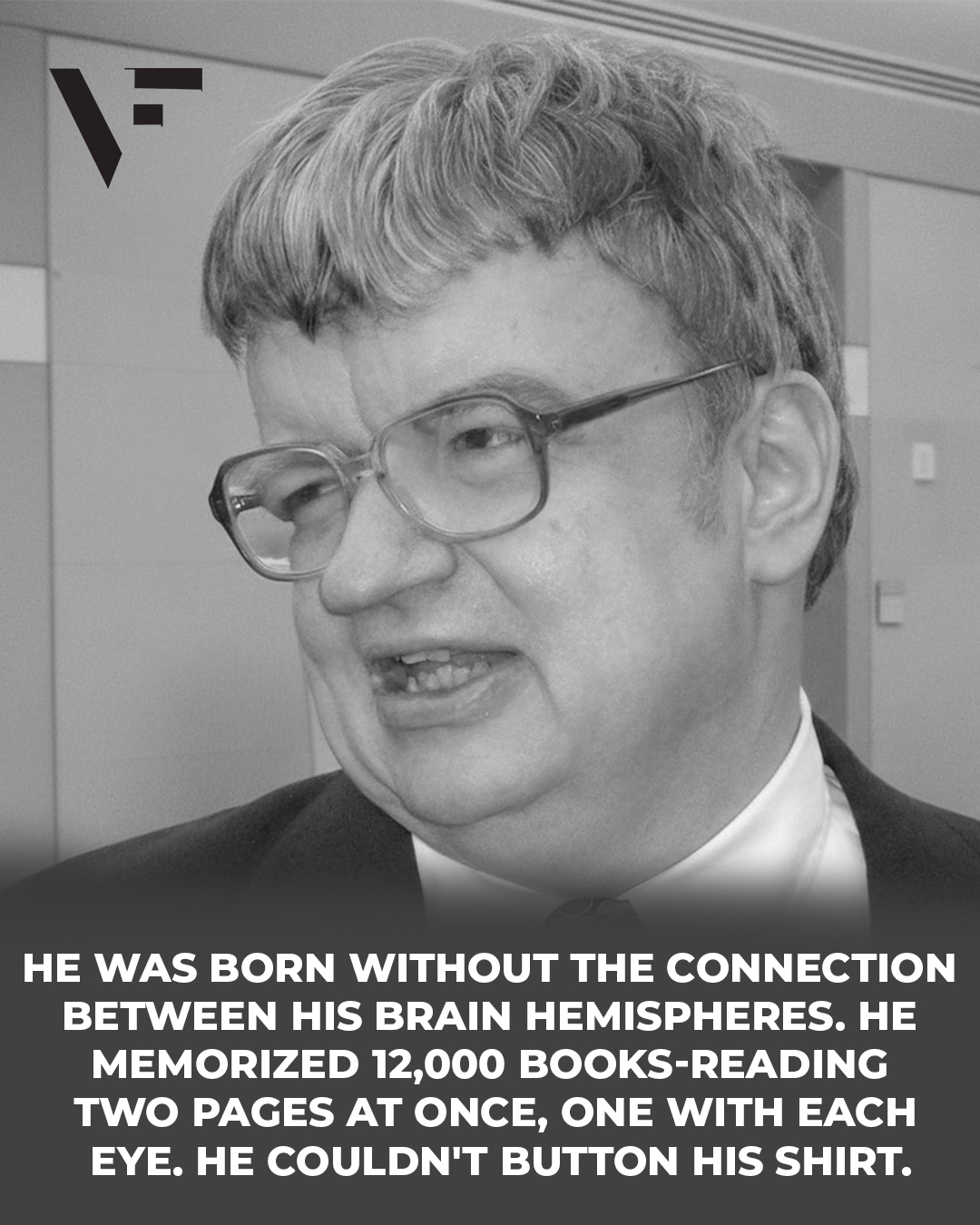

When Kim Peek was born in 1951 without a corpus callosum, doctors told his parents he would never walk or talk and advised institutionalizing him. Instead, his father brought him home. Kim grew up unable to button his shirt or live independently, yet he developed one of the most extraordinary memories ever recorded. He read two pages at once, memorized more than 12,000 books, and could recall dates, maps, music, and entire texts word for word. His life inspired the film Rain Man and reshaped how the world understands savant syndrome. Kim’s story remains a powerful reminder that profound disability and remarkable genius can exist in the same person
Desc ;
In 1951, doctors examined a newborn boy in Salt Lake City and delivered a bleak prognosis. The child’s head was unusually large, and scans revealed profound neurological abnormalities. They advised his parents to place him in an institution. The boy, they said, would likely never walk or speak.
His father refused. The child was Kim Peek.
Medical evaluations showed that Peek had been born without a corpus callosum, the thick bundle of nerve fibers that connects the brain’s two hemispheres. He also had macrocephaly and cerebellar damage. Standard developmental expectations did not apply. He would struggle with coordination, abstract reasoning, and basic self care. Throughout his life, he needed assistance dressing, cooking, and managing daily routines.
Yet alongside these limitations, something unexpected emerged. By eighteen months old, Peek was memorizing books. He did not simply recognize stories. He retained them verbatim. As he grew older, he developed a reading method that astonished researchers. He could read two pages at once, reportedly processing the left page with his left eye and the right page with his right eye, committing both to memory.
Over decades, Peek read and memorized an estimated 12,000 books. He retained dates, phone directories, classical music scores, historical events, and geographic data with extraordinary precision. He could identify the day of the week for nearly any given date and recite passages from literature without hesitation. His recall accuracy was often measured at around 98 percent.
At the same time, he could not button his own shirt.
In the early 1980s, Peek and his father met screenwriter Barry Morrow at a conference. Morrow was struck by Peek’s abilities and later drew inspiration from him while writing Rain Man. The film, starring Dustin Hoffman, introduced a wide audience to the concept of savant syndrome. Though the character was a composite, Peek’s memory and demeanor influenced the portrayal. The film won four Academy Awards and shifted public conversation about developmental disabilities.
After the film’s success, Peek and his father traveled widely, appearing at universities, libraries, and public events. Peek answered audience questions on history, geography, literature, and music, demonstrating his memory live. These appearances challenged simplistic assumptions about disability. Observers encountered a man who required constant assistance yet possessed knowledge beyond most specialists.
In 2004, scientists studied Peek’s brain using advanced imaging techniques. They confirmed the absence of a corpus callosum and found evidence of unusual neural organization. Researchers suggested that alternative pathways had formed, allowing hemispheric communication through atypical routes. His case contributed to growing scientific understanding of neuroplasticity, the brain’s capacity to reorganize itself when standard structures are absent.
Peek died of a heart attack in 2009 at the age of fifty eight. His brain was donated to research.
His life complicates common measures of independence and intelligence. Society often defines ability by self sufficiency. Peek could not manage daily living alone, yet he stored and retrieved information on a scale that defied ordinary categorization. Both realities coexisted without canceling each other.
Doctors once predicted only limitation. His father chose care over institutionalization. The result was not a cure, but a life that expanded scientific inquiry and altered public perception. Kim Peek’s memory remains extraordinary. So does the reminder that human potential cannot be reduced to a single definition




Leave a Comment