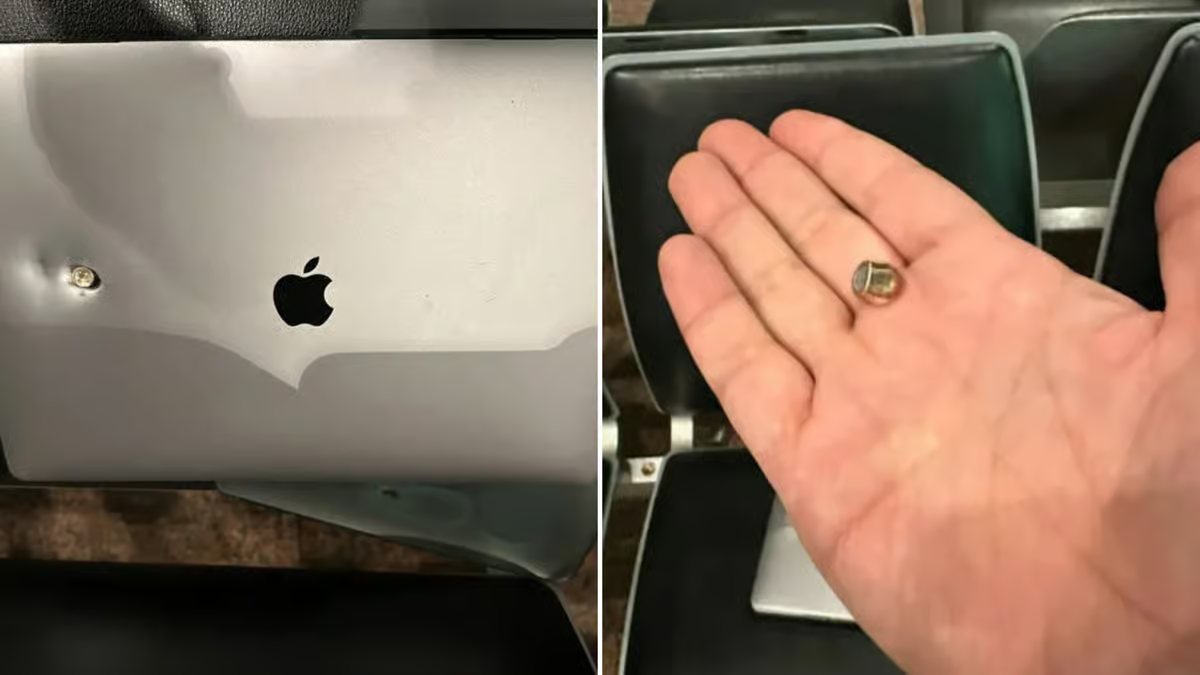

The bullet was traveling at approximately 1,200 feet per second when it left the firearm, a velocity that would typically allow it to pass through human tissue and continue through walls and windows until its kinetic energy was finally exhausted. But between the bullet and the man’s body was an object that its manufacturer never intended as armor: a MacBook Pro, packed in a backpack, its aluminum chassis and dense internal components arranged in the particular configuration that Apple’s engineers had designed for processing power and thermal management rather than ballistic protection. The bullet struck the laptop, penetrated the outer casing, encountered the logic board and battery cells and reinforced frame, and surrendered its lethal energy to the destruction of a consumer electronic device. The man walked away without physical injury, carrying a backpack that now contained thousands of dollars of ruined technology and the projectile that had been intended to end his life.
The photographs of the damaged device that circulated after the incident show the bullet embedded deep within the laptop’s interior, surrounded by the shattered remnants of components that once performed billions of calculations per second. The aluminum chassis is punctured and deformed, the distinctive Apple logo now a scarred witness to the violence it partially contained. Battery cells have been ruptured, their chemical contents leaking into the wreckage. The logic board, that dense landscape of silicon and copper, has been bisected by the projectile’s path. The computer is irreparably destroyed, its functions terminated not by obsolescence or accident but by direct ballistic intervention. It will never boot again, never display another image or process another document or connect to another network. It has become, instead, evidence of a failed murder and a successful rescue.
The victim’s identity has been protected, as is appropriate for someone who has survived an armed robbery and, presumably, is cooperating with law enforcement to identify and apprehend the assailant. He was walking somewhere, doing something ordinary, when the confrontation occurred. Perhaps he was returning from work or heading to a coffee shop or simply moving through the city on whatever errands occupied his day. He was carrying a backpack containing a laptop, as millions of people do every day, never imagining that this commonplace arrangement of technology and textiles would become the difference between life and death. The assailant demanded something, or perhaps said nothing at all, and then fired. The bullet flew. The laptop absorbed. The man survived.
The physics of this incident are straightforward in retrospect but would have been impossible to predict or engineer. The MacBook Pro’s aluminum unibody construction, developed to provide structural rigidity while minimizing weight, offered initial resistance that slowed the projectile’s velocity. The dense arrangement of internal components—battery cells containing energy-dense chemistry, logic boards layered with copper traces, cooling systems fabricated from copper and aluminum—provided additional barriers that further dissipated kinetic energy. The backpack itself, with its multiple fabric layers and the air gaps between them, contributed to the deceleration. Each obstacle was insufficient alone to stop the bullet, but their cumulative effect, combined with the specific trajectory and the particular ammunition used, was sufficient to prevent penetration into the wearer’s body. The laptop was not designed as armor, but it functioned as armor through the fortuitous coincidence of its material properties and the circumstances of the attack.
This incident joins a small but significant category of cases in which everyday objects have inadvertently functioned as ballistic protection. Bibles carried in breast pockets have stopped bullets. Smartphones have intercepted projectiles. Even coins and belt buckles and cigarette lighters have, in various documented instances, deflected or absorbed sufficient energy to save lives. These objects are not tested or certified for such purposes; their protective function is entirely coincidental, the product of chance intersections of trajectory and material properties. Their survival as artifacts, preserved with embedded bullets and deformed by impact, testifies to the randomness of violence and the equally random nature of protection. The MacBook Pro that saved its owner’s life will be examined by investigators, photographed for evidence, and eventually perhaps returned to the victim as a souvenir of his survival. It is useless as a computer but invaluable as a testament.
The technological sophistication of the device that served as this man’s shield is worth considering. The MacBook Pro represents the cumulative achievement of decades of research and development in materials science, electrical engineering, and industrial design. Its aluminum chassis is machined from a single block of metal, a manufacturing process that requires immense precision and yields exceptional structural integrity. Its battery technology stores significant energy in minimal volume, a density achieved through continuous refinement of electrochemical systems. Its logic board contains billions of transistors etched onto silicon wafers through photolithographic processes that approach the limits of physical possibility. All of this sophistication, all of this engineering excellence, was directed toward the conventional purposes of computing: processing information, connecting people, enabling productivity and creativity. None of it was intended to stop bullets. Yet when the moment came, these technologies, designed for entirely different functions, performed a function their creators never anticipated. The laptop did not compute; it protected.
The man who owned this MacBook Pro presumably purchased it for ordinary reasons: work, study, communication, entertainment. He chose this particular model based on its performance characteristics, its aesthetic qualities, its ecosystem compatibility. He paid a significant sum for the privilege of owning a device that represented the cutting edge of consumer technology. He carried it in his backpack, as he had carried countless other objects in countless other backpacks throughout his life, never imagining that this particular object on this particular day would serve a purpose that no marketing department had ever claimed. The laptop was, until the moment of impact, a tool for productivity. It became, in an instant, a tool for survival. Its value, measured in the currency of human life, exceeded any price that could be assigned to it.
The assailant who fired the bullet did not anticipate that a laptop would intervene in his attack. He chose his weapon, his ammunition, his target, and his moment with the expectation that his projectile would follow its intended trajectory and achieve its intended effect. He did not account for the MacBook Pro in the backpack, the aluminum chassis and dense internal components that would absorb the energy his firearm had released. His failure was not tactical but probabilistic; he was unlucky in the sense that his victim happened to be carrying an object that could stop a bullet, and lucky in the sense that this object was not designed for such purposes and should not have been capable of performing them. The randomness that saved the victim also frustrated the assailant, a symmetry that offers cold comfort to those who prefer to believe that the universe operates according to comprehensible rules.
The investigation into this incident will proceed along standard protocols. Law enforcement will document the scene, collect evidence, interview the victim and any witnesses. They will examine the damaged laptop, extracting the embedded bullet for ballistic analysis. They will attempt to trace the firearm through its serial number if it was recovered, or through other forensic evidence if it was not. They will develop leads and pursue suspects and eventually, perhaps, make an arrest. The laptop, its protective function fulfilled, will become evidence in a criminal case, its destroyed components testifying to the violence that occurred. It may be returned to the victim after the conclusion of legal proceedings, a battered keepsake of the day he should have died but did not.
The broader significance of this incident extends beyond its immediate circumstances. It is a reminder that the objects we carry daily, chosen for their utility and convenience, possess properties we do not consider and capabilities we do not anticipate. A laptop is a tool for work, but its aluminum chassis can stop a bullet. A smartphone is a conduit for communication, but its glass and circuitry can deflect a projectile. A book is a vessel for ideas, but its hundreds of paper pages can absorb kinetic energy. We select these objects based on criteria that have nothing to do with ballistic protection, yet under the right circumstances, with the right trajectory and the right ammunition, they can become shields. This is not a reason to purchase laptops for their protective properties; the probability of being shot while carrying a MacBook Pro is vanishingly small, and the probability that the laptop will stop the bullet is smaller still. But it is a reason to recognize that the objects we surround ourselves with are more complex, more capable, and more consequential than we typically acknowledge.
The man who survived this armed robbery will carry more than the memory of the incident. He will carry the knowledge that a consumer electronic device, purchased for ordinary purposes and carried in an ordinary backpack, preserved his life through the fortuitous coincidence of its material properties and the trajectory of a bullet. This knowledge will shape his relationship with technology, with randomness, with the fundamental unpredictability of existence. He may never look at a laptop the same way again. He may never carry a backpack without remembering the weight it bore on that particular day. He may find himself scanning crowds for potential threats, or he may find himself liberated by the recognition that survival is often a matter of luck rather than preparation. His psychological response to this trauma will be as unique as his fingerprint, shaped by factors that no investigator can quantify and no analyst can predict.
The MacBook Pro that saved his life is beyond repair. Its logic board is shattered, its battery compromised, its casing deformed beyond the possibility of restoration. It will never again display the glowing Apple logo on boot-up, never again respond to the touch of fingers on its keyboard and trackpad, never again connect to the networks that bind modern life together. It has become, in its destruction, a different kind of object: not a tool but a relic, not a consumer electronic device but a testament to survival. Its value is no longer measured in dollars or processing power but in the life it preserved and the story it now embodies. The man who owned it may keep it forever, a physical reminder of the day he should have died. He may discard it, unable to bear the weight of its significance. He may donate it to a museum or offer it to law enforcement as evidence or simply place it in a drawer and try to forget. Whatever he chooses, the laptop has completed its service to him, not as designed but as required.
The bullet that lodged in the laptop’s interior is also evidence, also a relic, also a testament to violence and survival. It traveled from the firearm through the air and into the aluminum chassis, its kinetic energy dissipated by the destruction it caused. It will be extracted, measured, analyzed, and eventually perhaps introduced as evidence in a criminal trial. Its ballistic markings will be compared to test fires from suspected weapons, its composition traced to manufacturers and distributors. It will tell the story of its own manufacture and use, a narrative encoded in rifling patterns and alloy ratios. And when its evidentiary purpose is exhausted, it will be disposed of or retained or returned, its trajectory from raw material to finished product to projectile to artifact finally complete.
The incident is over. The man survived. The laptop died. The assailant fled or was apprehended, depending on the status of the investigation, which has not been publicly detailed. The photographs of the damaged device continue to circulate, shared and reshared by people who find meaning in this convergence of technology and violence. The story becomes parable, cautionary tale, evidence of the universe’s strange capacity for justice or randomness or both. The MacBook Pro, designed in California and assembled in China and sold in retail stores around the world, performed a function its creators never imagined and will never certify. It was not engineered for ballistic protection. It was not tested against ballistic threats. It was not marketed as a safety device. But when the moment came, it did what needed to be done. It absorbed energy that would have destroyed human tissue. It stopped a bullet. It saved a life. That is enough. That is everything. That is the story of a laptop that became a shield, a computer that became a protector, an ordinary object that transcended its intended purpose and achieved something extraordinary.



Leave a Comment