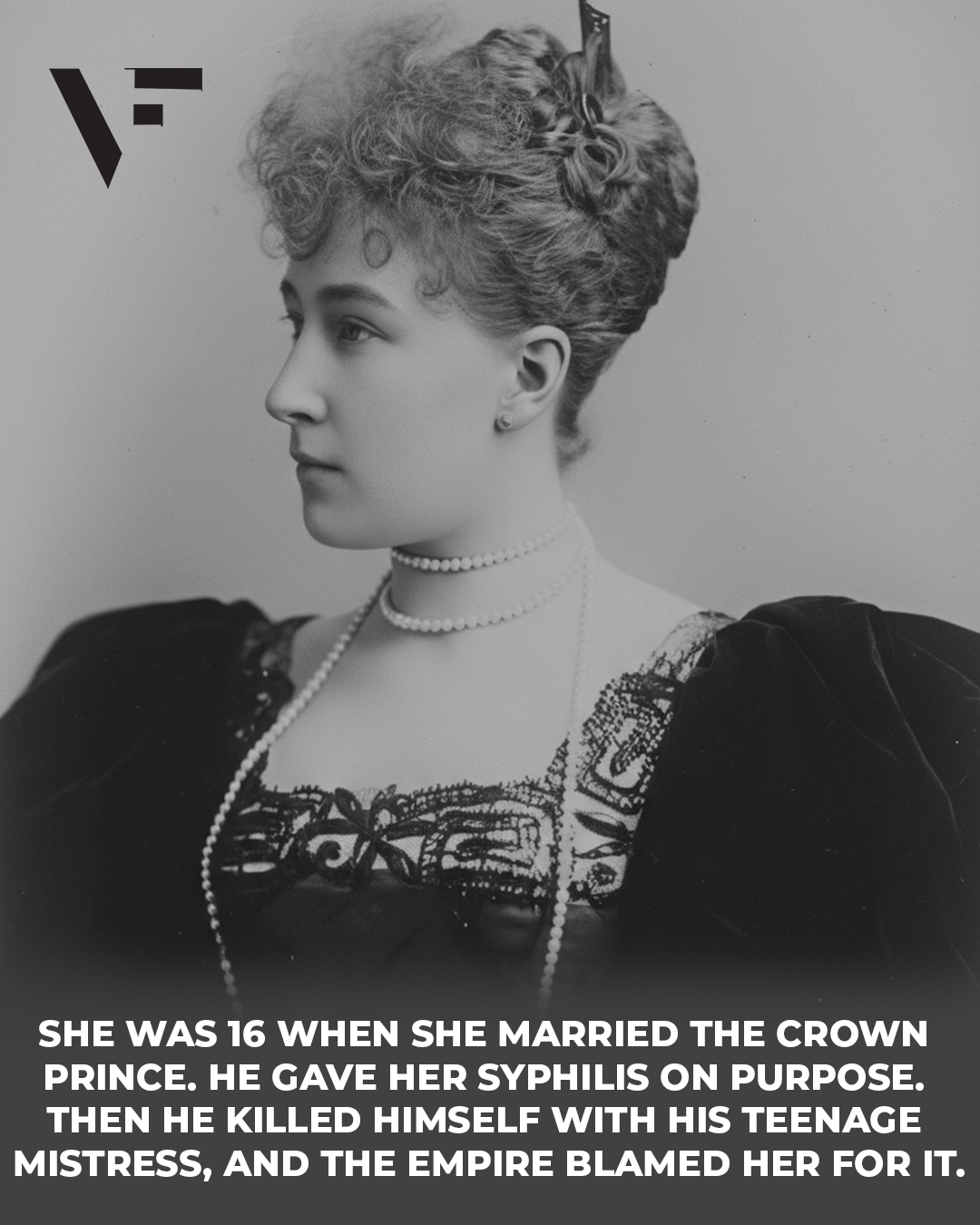

In 1881, sixteen-year-old Princess Stéphanie of Belgium stood in Vienna’s Augustinian Church to marry Crown Prince Rudolf of Austria-Hungary. The union was political, not romantic, and the marriage quickly turned cold and humiliating. Isolated at court and trapped in a troubled relationship, Stéphanie endured betrayal and illness. In 1889, Rudolf was found dead at Mayerling alongside his young mistress in a murder-suicide that shocked Europe. Though she had no role in the tragedy, suspicion and blame followed her. Cast aside by the imperial family, Stéphanie lived on in the shadow of scandal, a reminder of how royal duty often silenced the voices of young women.
desc;
In May 1881, the bells of the Augustinian Church in Vienna rang for a royal wedding. Sixteen year old Princess Stéphanie of Belgium stood beside Crown Prince Rudolf of Austria, heir to the vast Austria-Hungary. The ceremony was a dynastic arrangement, designed to strengthen ties between the Belgian and Habsburg courts. Personal happiness was not a consideration.
Stéphanie was the daughter of Leopold II of Belgium, whose reign would later become synonymous with exploitation in the Congo Free State. Her upbringing in Brussels had been formal and emotionally distant. The Viennese court, governed by rigid protocol under Empress Elisabeth of Austria, proved no warmer.
From the beginning, the marriage was strained. Rudolf, intelligent and politically liberal in outlook, was also volatile and frequently unfaithful. Stéphanie, isolated by language and custom, struggled to find acceptance in Vienna. In 1883 she gave birth to a daughter, Archduchess Elisabeth Marie of Austria. No further children followed.
Medical historians later suggested that Rudolf had contracted a venereal disease, likely syphilis, and transmitted it to his wife. The infection is believed to have left Stéphanie unable to conceive again and may have caused long term health problems. Whether intentional or reckless, the consequences shaped the remainder of their marriage. Correspondence from the period indicates emotional distance and growing despair.
By the late 1880s, Rudolf’s mental state had deteriorated. Political frustrations, personal scandals, and depression compounded his instability. In January 1889, events at the hunting lodge of Mayerling shocked Europe. Rudolf and seventeen year old Baroness Mary Vetsera were found dead. The incident, known as the Mayerling incident, was officially described as a murder suicide.
The tragedy destabilized the Habsburg succession and reverberated across the continent. Rumors circulated widely. While there is no evidence that Stéphanie bore responsibility, whispers within court society often treated her as a failed wife who had not secured an heir. Public sympathy centered largely on the deceased crown prince rather than on the young widow left behind.
At twenty four, Stéphanie became a widow in one of Europe’s most scrutinized courts. Her position grew increasingly marginal. In 1900, she remarried, choosing Elemér Lónyay, a union considered morganatic and controversial within aristocratic circles. The marriage effectively ended her formal status within the imperial hierarchy.
Stéphanie lived until 1945, witnessing the collapse of the Habsburg monarchy at the end of the First World War and the transformation of Europe’s political landscape. Her life illustrates how royal women often functioned as instruments of alliance, their personal experiences overshadowed by dynastic calculation. Married as a teenager for political purpose, widowed amid scandal, and sidelined by tradition, she occupied the center of imperial drama without controlling its course.
The story of Mayerling is often told as a romantic tragedy. For Stéphanie, it marked not romance but the unraveling of a role assigned before she reached adulthood.



Leave a Comment