
He walked in as a stray and left as management’s most beloved hire
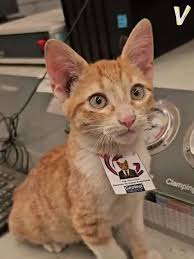
Some stories don’t begin with ambition or planning. They begin with a door left open and a small moment of curiosity. That’s exactly how a stray orange cat wandered into a factory one ordinary day, unaware that he was about to become something much bigger than a passing visitor.
At first, no one knew where he came from. He wasn’t chipped. He didn’t belong to anyone nearby. He simply appeared, padding quietly across the factory floor with the confidence of someone who felt oddly at home. Instead of darting away or hiding, he stayed. He watched. He sat beside workers during breaks. He followed people from room to room as if he had always been part of the team.
Rather than chasing him out, the staff did something unexpected. They let him stay.
Over time, the cat became a constant presence. He showed up every morning. He greeted employees as they arrived. He curled up near workstations, offering silent companionship during long shifts. When stress levels rose, he would appear, settle beside someone, and purr until the tension softened.
That’s when the joke started.
Someone suggested he needed a title. Someone else designed an ID badge. Before long, the factory had officially “hired” him. His name became Ingeniero Miauricio, and his role was declared Director of Emotional Support.
What started as humor quickly turned into something meaningful.
Workplaces are often defined by pressure, deadlines, and repetition. Morale can dip without warning. Burnout sneaks in quietly. And yet, here was a small orange cat doing something no memo or motivational poster ever could. He made people feel seen. Calm. Less alone.
Employees noticed that conversations changed when he was around. People smiled more. They took breaks they had been skipping. Arguments softened. Laughter became more common. Miauricio didn’t fix machines or attend meetings, but he improved the environment in a way no policy ever could.
He didn’t demand attention. He offered presence.
That distinction matters. Animals have a way of grounding people without asking anything in return. They don’t care about job titles, productivity metrics, or performance reviews. They respond only to tone, energy, and kindness. In return, they give something rare in adult life: uncomplicated comfort.
The factory embraced him fully. He received food, regular checkups, and a safe place to sleep. In exchange, he continued doing what he did best: existing nearby, reminding people to breathe, to pause, to pet a cat before returning to their tasks.
Ingeniero Miauricio became part of the company culture. New hires were introduced to him. Visitors asked about him. Photos circulated. His ID badge became a symbol not of gimmickry, but of values. This was a place that understood that emotional well-being matters just as much as output.
And for Miauricio, the transformation was just as profound. A stray animal lives with constant uncertainty. Food is never guaranteed. Safety is fragile. Trust is risky. By choosing him, the factory gave him stability. Warmth. Belonging.
It’s easy to dismiss stories like this as cute or lighthearted, but there’s something deeper underneath. It challenges the way we define worth. Miauricio doesn’t generate revenue. He doesn’t clock hours. Yet his contribution is real. Measurable in mood. In morale. In the small daily interactions that make work more humane.
There’s also a quiet lesson about inclusion. He wasn’t invited. He wasn’t selected through a process. He simply arrived, and instead of being treated as a nuisance, he was welcomed. Sometimes the best additions to our lives are the ones we didn’t plan for.
Ingeniero Miauricio reminds people that productivity doesn’t have to come at the cost of warmth. That professionalism doesn’t require emotional distance. That care can exist even in industrial spaces where it’s least expected.
In a world obsessed with optimization, this orange cat optimized something far more important than efficiency. He optimized humanity.
He shows up every day without knowing his title. He wears his badge without understanding its meaning. He just knows that this is where he belongs, and that the people here are his people.
And maybe that’s why the story resonates so widely.
Because deep down, everyone wants what Ingeniero Miauricio found by accident: a place to belong, a role that matters, and the freedom to simply be themselves.
Sometimes the best coworkers don’t talk, don’t type, and don’t attend meetings. Sometimes they just curl up beside you, purr softly, and remind you that work is better when there’s room for kindness.
Ingeniero Miauricio didn’t apply for the job. He earned it by being exactly who he is.
After seven silent months, a bear steps back into the world
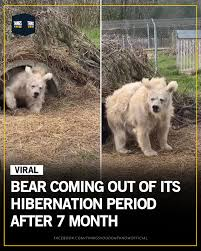
The moment is quiet, almost fragile. After seven months of hibernation, Chada, a Himalayan brown bear living in a sanctuary in Ukraine, slowly emerges from her den. There is no dramatic burst of energy, no triumphant return. Instead, there is hesitation. A pause. A careful placing of paws, as if the world itself needs to be re-learned.
The footage captured of her awakening feels intimate, not because it was meant to be watched, but because it shows something rarely noticed: recovery. Hibernation is not simply sleep. It is a profound physiological shutdown, a survival strategy honed over thousands of years. And waking up from it is not a switch being flipped. It is a process.
During hibernation, bears dramatically slow their metabolism. Heart rates drop. Body temperature decreases. They survive entirely on stored fat, without eating, drinking, or moving for months at a time. Muscles weaken. Balance fades. Sensory awareness dulls. The body protects itself, but at a cost.
So when Chada steps out of her den, she is not returning refreshed. She is returning vulnerable.
Her movements reflect that reality. Each step looks measured, almost cautious, as if she is testing the ground beneath her. Her body is awake, but not yet confident. The world has continued without her, and she must slowly reorient herself within it.
This gradual re-entry is essential. Rushing it could cause injury. Muscles need time to regain strength. Joints need movement to restore flexibility. The nervous system needs gentle stimulation to fully recalibrate. Nature understands patience better than most human systems ever have.
What makes this moment especially poignant is where it happens. Chada lives in a sanctuary, a protected space where her needs are respected rather than exploited. For bears like her, sanctuaries offer something rare: safety without confinement, care without interference.
In the wild, emerging from hibernation is risky. Food is scarce. Energy reserves are low. Threats are immediate. In a sanctuary, that pressure is eased. Chada can take her time. She can move slowly. She can rest again if needed. That freedom is not indulgence. It is recovery.
The footage resonates because it mirrors something deeply human. Many people know what it feels like to emerge from a long period of isolation, illness, or emotional shutdown. The world may look the same, but the body and mind feel different. Movements are slower. Confidence is tentative. Awareness comes back in layers.
Watching Chada reminds us that rest is not weakness, and recovery is not instant.
Hibernation is often romanticized as deep, peaceful sleep. In reality, it is survival under constraint. The bear’s body does extraordinary work to prevent muscle loss, bone deterioration, and organ damage during months of inactivity. Even so, the toll is real. Waking up is work.
That work deserves gentleness.
The sanctuary staff understand this. They do not rush Chada. They observe. They allow her space. They let her body dictate the pace. This approach reflects a broader philosophy of wildlife care rooted in respect rather than control.
In a time when animals are often treated as attractions, commodities, or content, moments like this matter. They reframe our relationship with wildlife. They show animals not as symbols or spectacles, but as living beings navigating complex physical realities.
Chada’s uncertain steps are not weakness. They are evidence of resilience. Her body has endured months of metabolic suspension and is now reactivating systems one by one. That process is remarkable, even if it looks slow.
There is also something quietly hopeful about the timing. Ukraine has endured immense disruption and hardship. In the midst of that, this sanctuary continues its work. Life continues its cycles. Care persists. A bear wakes up.
Nature does not pause for human conflict, but it also does not ignore the need for protection. Sanctuaries become anchors of stability, places where life can continue healing even when the world outside feels uncertain.
Chada’s emergence is not a grand event. It is not loud. It does not demand attention. And yet, it lingers.
Because it reminds us that returning to the world after a long absence is allowed to be slow. That strength does not always look powerful. Sometimes it looks like a bear standing still, breathing, feeling the ground, and taking one careful step forward.
In a culture obsessed with speed and productivity, this moment offers a different lesson. Healing happens at its own pace. Awareness returns gradually. Balance is rebuilt through patience.
Chada does not rush. She does not perform. She simply re-enters the world when her body is ready.
And in watching her do so, we are reminded that waking up — truly waking up — is an act of courage in itself.
He faced a cobra alone so a sleeping child would live
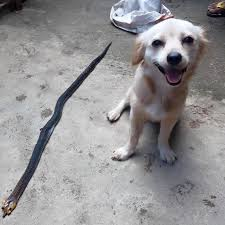
It happened quietly, the way most acts of real courage do. No warning. No audience. Just instinct, loyalty, and a split-second choice that would change everything.
In a home in the Philippines, while a child slept peacefully inside, a deadly cobra attempted to enter. Cobras do not wander harmlessly. Their venom is fast, potent, and often fatal, especially to children. One bite can be enough. The danger was real, immediate, and unforgiving.
Before any human could react, the family dog did.
He didn’t bark for help. He didn’t retreat. He charged.
What followed was a violent, desperate fight between a dog and one of nature’s most lethal predators. The dog attacked the cobra with everything he had, using his body as a shield between the snake and the house. He succeeded. The cobra was killed before it could reach the child.
But victory came at a cost.
During the fight, the dog was bitten multiple times. Cobra venom does not give second chances. After ensuring the threat was gone, the dog collapsed. Despite efforts to help him, the venom had already spread through his body. He died later from the effects of the bites.
When people saw him one last time, something struck them deeply.
His face looked calm. Peaceful. Almost… content.
Some say it was simply the way his muscles relaxed after death. Others believe it was something more — a quiet expression of fulfillment, as if he knew exactly what he had done, and why.
Whether it was a trick of the eyes or a reflection of the heart, the image stayed with everyone who heard the story.
Because this dog didn’t act out of training or command. He acted out of instinctive love and protection. Dogs do not calculate odds. They do not weigh consequences. They respond to threat with devotion that often defies logic.
To him, there was no question of survival versus sacrifice. There was only one truth: danger was approaching his family, and it had to be stopped.
Stories like this resonate because they expose a raw truth about loyalty. This dog was not obligated to protect the home. He could have run. He could have hidden. Many animals would have. Instead, he chose confrontation against an enemy far more dangerous than himself.
And in doing so, he saved a life.
The child inside the house never woke up during the incident. They slept through the chaos, unaware that their life had been protected by a four-legged guardian who would never see another sunrise.
That contrast is heartbreaking and powerful. One life continues because another ended.
Across cultures and histories, dogs have stood guard beside humans — as protectors, companions, and silent sentinels. But moments like this strip away romantic ideas and reveal the truth. Loyalty, at its purest, is not about reward or recognition. It is about instinctively placing another’s life above your own.
This dog did not know the word “hero.” He did not understand legacy. But his actions defined both.
Some people debate whether animals feel pride. Science may never fully answer that question. But anyone who has lived alongside a dog understands something deeper. They feel purpose. They feel belonging. And they feel love in a way that does not hesitate when danger arrives.
That is why the image of his peaceful face matters so much. It feels like closure. Like a silent message that his task was complete.
In a world where heroism is often associated with spectacle, uniforms, or recognition, this story reminds us that the most profound bravery often happens unseen, in ordinary places, by beings who expect nothing in return.
There was no cape. No applause. No monument.
Just a dog, a cobra, and a sleeping child.
And a choice that mattered.
The family will remember him not just as a pet, but as a protector who gave everything. The child will grow up because of him, even if they never fully understand why. And the story will continue to be shared, not because it is tragic, but because it is true.
Heroes don’t always survive their battles.
Heroes don’t always get credit.
Heroes don’t always walk on two legs.
Sometimes, they stand guard in silence.
Sometimes, they choose danger so others don’t have to.
And sometimes, they leave the world knowing they did exactly what they were meant to do.
He didn’t run.
He didn’t hesitate.
He protected.
And that is what makes him a hero.
Towering over his herd, King Kong redefines what “larger than life” truly means
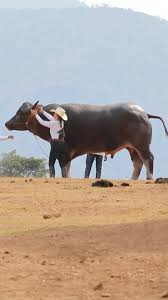
Some animals stop you in your tracks not because they are aggressive or rare, but because their sheer presence feels unreal. King Kong, officially recognized as the world’s tallest living water buffalo, is one of those animals. Standing an astonishing 50 centimetres taller than the average water buffalo, he doesn’t just stand out — he towers.
At first glance, it’s hard to believe the scale. When people stand beside him, they don’t look like caretakers or handlers. They look like reference points. His shoulders rise far above what most expect from a species already known for its size and strength. Yet despite his intimidating stature, those who know King Kong describe him as calm, gentle, and remarkably composed.
Water buffalo are typically associated with endurance and power. For centuries, they’ve been relied upon in agriculture, particularly in wetland farming, where their strength and patience make them invaluable. King Kong embodies all of that — just magnified. His height alone sets him apart, but it’s the balance between his physical dominance and his temperament that truly fascinates people.
To understand just how exceptional he is, it helps to know what “average” looks like. A typical water buffalo stands around 130 to 140 centimetres at the shoulder. King Kong surpasses that by half a metre. That difference may sound abstract on paper, but in person, it’s staggering. It changes proportions. It alters expectations. It makes even seasoned farmers pause.
What’s remarkable is that his size is not the result of artificial enhancement or forced breeding. King Kong’s height is a natural genetic anomaly — rare, but entirely organic. In a world where extremes are often manufactured, his existence is a reminder that nature still surprises us on its own terms.
Despite the attention, King Kong’s daily life remains grounded and routine. He eats, rests, and moves like any other water buffalo, though everything he does feels scaled up. His footsteps are heavier. His presence fills space. But his behavior is unhurried, almost meditative.
Caretakers report that he is easy to manage, responsive, and surprisingly affectionate. This contrast between appearance and personality is part of why he has captured so much global attention. People expect a creature of his size to be difficult or unpredictable. Instead, they find a giant who seems content simply being.
Animals like King Kong challenge how we think about dominance and power. Size alone does not dictate aggression. Strength does not automatically lead to threat. In many cases, the largest animals are also the most controlled, because survival at that scale often requires efficiency rather than excess energy.
His recognition as the world’s tallest living water buffalo has brought renewed interest to the species itself. Water buffalo are often overlooked, seen as utilitarian animals rather than extraordinary ones. King Kong forces a second look. He reframes the species as something awe-inspiring, not just practical.
There’s also something quietly humbling about seeing an animal like this up close. Humans are used to being the tallest figures in most environments. Standing next to King Kong flips that dynamic instantly. You are reminded that the world does not revolve around human proportions. Nature operates on a much broader spectrum.
Photographs of King Kong have gone viral for this reason. They don’t need embellishment. The scale tells the story. A person standing beside him looks smaller, not just physically, but in perspective. It’s a visual reminder of how vast and varied life on this planet truly is.
Importantly, King Kong’s care emphasizes responsible stewardship. Animals of extraordinary size require attentive handling, proper nutrition, and space suited to their needs. His well-being highlights what’s possible when animals are respected rather than exploited.
There is no spectacle in how he is presented. No tricks. No forced performances. His recognition comes simply from existing as he is. That authenticity is rare, and people respond to it instinctively.
In an age where attention is often driven by novelty or shock, King Kong stands out for a different reason. He doesn’t demand attention. He earns it by reminding us that nature still creates wonders beyond expectation.
He is not a myth. Not an exaggeration. Not a nickname stretched too far.
He is a living, breathing water buffalo whose height alone rewrites the mental image most of us carry.
And when you see him, whether in person or through a photograph, one thing becomes very clear: some giants don’t need to roar to be unforgettable.
A lifeline opens for rescues overwhelmed by cruelty, cost, and forgotten animals
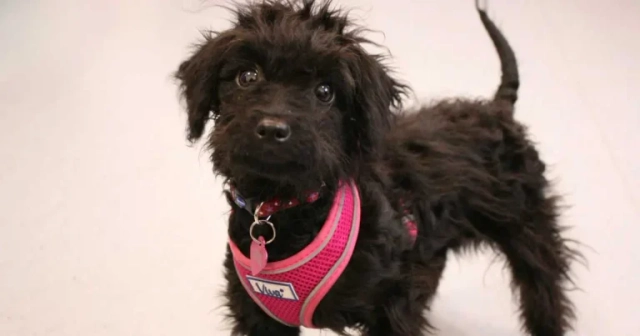
At a time when animal rescue centres across the UK are stretched to breaking point, a timely opportunity has opened that could make a real difference for some of the most vulnerable animals in the system. The Naturewatch Foundation has officially opened applications for its annual Pet Rescue Grant, offering crucial financial support to organisations caring for animals harmed by the low-welfare and illegal pet trade.
The grant, now in its third year, is designed to help rescues meet the rising and often overwhelming costs associated with rehabilitation. Registered UK charities and community interest companies can apply for funding of up to £10,000, while smaller grants of £1,000 are available to unregistered charities and community-based organisations working on the front lines of animal welfare.
This funding comes at a critical moment.
Rescue centres are reporting a surge in animals arriving with complex medical and behavioural needs. Many of these dogs, cats, and rabbits have been bred irresponsibly, traded illegally, or treated as disposable commodities rather than living beings. The consequences of that exploitation do not disappear once the animals are rescued. They arrive carrying trauma, illness, injury, and long-term welfare challenges that require time, expertise, and significant financial investment.
The Pet Rescue Grant can be used to fund veterinary care, behavioural support, specialist equipment, training, or other essential costs directly related to the rescue and rehabilitation process. In practical terms, this might mean emergency surgery for a neglected dog, long-term behavioural therapy for an animal traumatised by abuse, or specialist housing for rabbits rescued from overcrowded or unsanitary conditions.
According to Naturewatch Foundation campaign manager Natalie Harney, the need for this support has never been greater.
“The Pet Rescue Grant is needed now more than ever,” she said. “We’re hearing from animal rescues that costs are spiralling while animals arrive with increasingly complex welfare issues and often require extensive veterinary care and behavioural support.”
Her words reflect a growing crisis in the rescue sector. Inflation, rising veterinary fees, and increased demand have created a perfect storm. At the same time, the low-welfare pet trade continues to operate at scale, fuelled by online sales, impulse purchases, and weak enforcement. Animals are bred and sold quickly for profit, with little regard for their long-term health or wellbeing.
When those animals are abandoned, seized, or surrendered, it is rescues who absorb the cost.
Naturewatch Foundation’s grant is not positioned as a solution to the entire system, but as a meaningful intervention. A way to help rescues continue their work without compromising care or turning animals away due to lack of funds.
“At the same time, animals continue to be exploited for profit,” Harney added, “trapping many dogs, cats and rabbits in a cycle of suffering where they’re treated like commodities. This grant is our small way of helping rescues give those animals the care they desperately need.”
That framing is important. The grant is not charity for charity’s sake. It is targeted support aimed at breaking a cycle — one that begins with exploitation and often ends with animals paying the price.
Previous recipients illustrate the impact such funding can have. Last year, the Bunnyjackpot Foundation and Hope Rescue each received £5,000, while Second Chance Spaniel Rescue and Cat Supports South Wales were awarded £1,000 mini grants. For these organisations, the funding helped cover vital care that might otherwise have been delayed, reduced, or made impossible.
Behind every grant is a quieter story: an animal receiving treatment sooner, a rescue avoiding burnout, a volunteer not having to choose between two urgent cases because resources ran out.
Grants like this also acknowledge a reality often overlooked. Rescue work is not just about compassion. It is skilled labour. It involves medical knowledge, behavioural expertise, legal compliance, and emotional resilience. Supporting rescues financially is a way of valuing that work, not just praising it.
The application process is open to UK-based organisations actively involved in rescuing and rehabilitating dogs, cats, or rabbits impacted by the low-welfare pet trade. The funding must be used for direct welfare-related costs, ensuring that money goes where it matters most: to the animals themselves.
For smaller, community-led groups that may not have formal charity status, the £1,000 mini grant offers recognition and support that can be transformative. These groups are often closest to the problem, operating locally with limited resources but deep commitment.
In a sector where need consistently outpaces funding, even modest financial support can have an outsized effect.
The opening of the Pet Rescue Grant applications is a reminder that while the low-welfare pet trade remains a serious and ongoing issue, there are also people and organisations actively working to counter its damage. It is a reminder that intervention matters — and that targeted support can help sustain the rescues standing between exploitation and recovery.
For organisations on the front lines, this grant represents more than money. It represents acknowledgement, solidarity, and the chance to keep going.
And for the animals affected by cruelty and neglect, it represents something even more important: care, time, and the possibility of a future shaped by compassion rather than profit.
Oregon may become the first place where animal freedom is put to vote
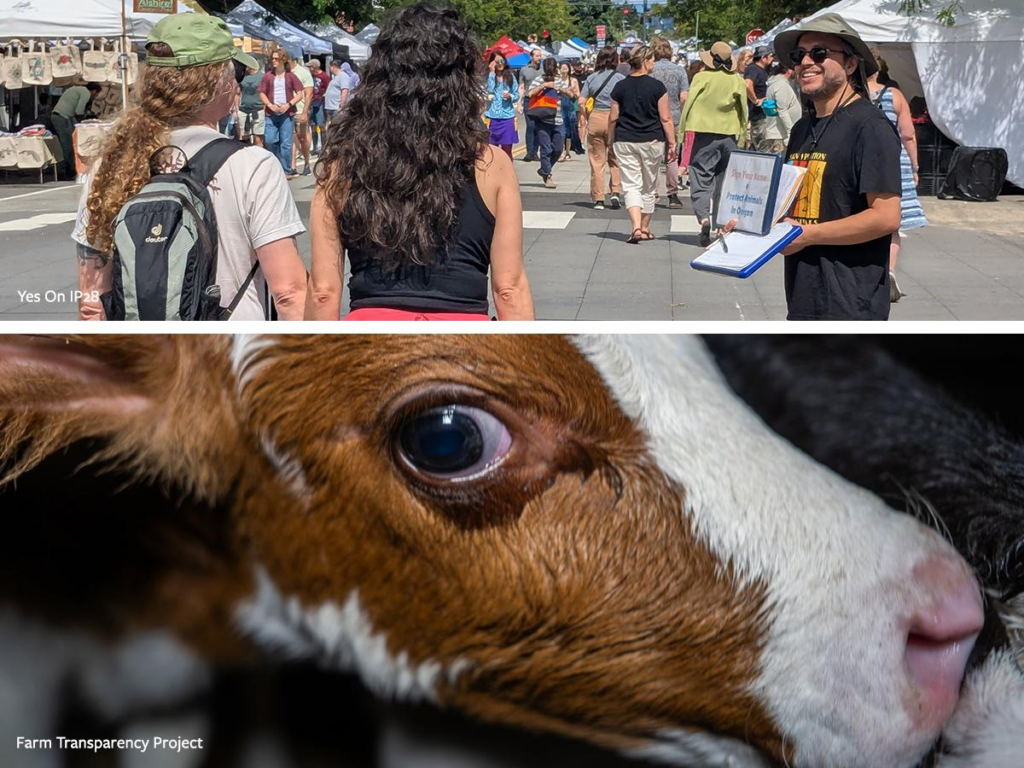
In a political landscape often shaped by incremental reform, Initiative Petition 28 (IP28) stands out as something radically different. Filed in Oregon, this ballot initiative dares to challenge the legal foundation that allows widespread animal cruelty to exist in plain sight. Known formally as the People for the Elimination of Animal Cruelty Exemptions (PEACE) Act, IP28 does not aim to regulate cruelty more gently. It aims to end the legal permission for it altogether.
At the core of IP28 is a simple but disruptive idea: if animal cruelty is illegal, then no industry should be exempt from that definition.
Under current Oregon law, animal abuse is defined as intentionally, knowingly, or recklessly causing injury to an animal. Yet entire categories of harm — including slaughter, forced breeding, animal experimentation, hunting, fishing, rodeos, exhibitions, and standard “animal husbandry” practices — are carved out as legal exceptions. These exemptions mean that most animals, despite being capable of pain, fear, and distress, are effectively excluded from protection under the law.
IP28 seeks to remove those exemptions.
If passed, the initiative would ensure that animals can no longer be intentionally injured or killed, forcibly impregnated, deprived of adequate food, water, shelter, or subjected to violence — regardless of whether that harm occurs on farms, in laboratories, during transport, at exhibitions, or in the wild. The shift is profound. It reframes animals not as property whose suffering is negotiable, but as individuals entitled to basic legal protection.
Critics often assume such proposals are symbolic or unrealistic. But the architects of IP28 are explicit about their long-term strategy. They do not expect the initiative to pass in 2026. Instead, the campaign is focused on building infrastructure, public awareness, and cultural momentum — returning to the ballot repeatedly until change becomes inevitable.
History supports this approach.
The women’s suffrage movement followed a similar path, bringing voting rights to the ballot in more than 30 states over a decade before success. In Oregon itself, women only secured the right to vote on their sixth attempt. Each “failed” effort educated the public, shifted attitudes, and laid the groundwork for the next push. IP28’s campaign draws directly from that lesson: durable change often begins long before victory.
Importantly, IP28 is not only about prohibition. It includes a rehabilitation-based alternative to criminal penalties, focused on rebuilding empathy rather than relying solely on punishment. This reflects a belief that cruelty is not just a legal issue, but a cultural one — and that lasting change requires addressing how people are conditioned to view animals.
The initiative also establishes a Humane Transition Fund, designed to support workers and communities affected by the shift away from animal exploitation. This fund would help provide job retraining, income assistance, animal care, conservation efforts, rewilding projects, and broader community transitions. By acknowledging economic realities, IP28 attempts to remove one of the most common barriers to ethical reform: fear of disruption without support.
Central to the campaign is the assertion that most humans can survive — and thrive — without harming animals. Modern societies already possess the knowledge, technology, and resources to meet nutritional, medical, and economic needs without relying on systemic animal exploitation. IP28 envisions a future where compassion is not treated as a luxury, but as a governing principle.
The initiative also forces a difficult ethical question into the public sphere. Why are dogs and cats legally protected, while pigs, cows, chickens, fish, and lab animals — who exhibit comparable emotional complexity and capacity for suffering — are excluded? IP28 exposes this contradiction and challenges voters to confront it directly.
Small welfare reforms have improved conditions at the margins, but they often leave the underlying system intact. IP28 deliberately plays a longer game. It invites people to ask not how to make exploitation slightly less brutal, but whether it should exist at all. That framing is why the initiative is celebrated each February during Animal Activist Appreciation Month — not as a finished solution, but as a catalyst for deeper cultural change.
As of now, nearly two-thirds of the required signatures have already been collected to qualify IP28 for the ballot. The campaign has until July 2, 2026, to reach its goal. Volunteers, organizers, and supporters are working to ensure Oregon becomes the first place where voters are asked to decide whether animal freedom deserves legal recognition.
Regardless of the outcome in 2026, IP28 has already achieved something significant. It has moved the conversation from welfare to rights, from regulation to liberation. It has placed animal exploitation under a moral spotlight that is difficult to ignore once seen.
IP28 embodies persistence, courage, and a willingness to confront injustice at its root. By honoring animals’ right to their own bodies and lives, it asks society to imagine a world that extends empathy beyond species lines — a world that may be difficult to reach, but impossible to unsee once envisioned.
Help Oregon become the first state to vote on animal freedom.
The question is no longer whether the conversation will happen — but how ready we are to face it.
Poland bans fur farming, ending its reign as the EU’s largest producer
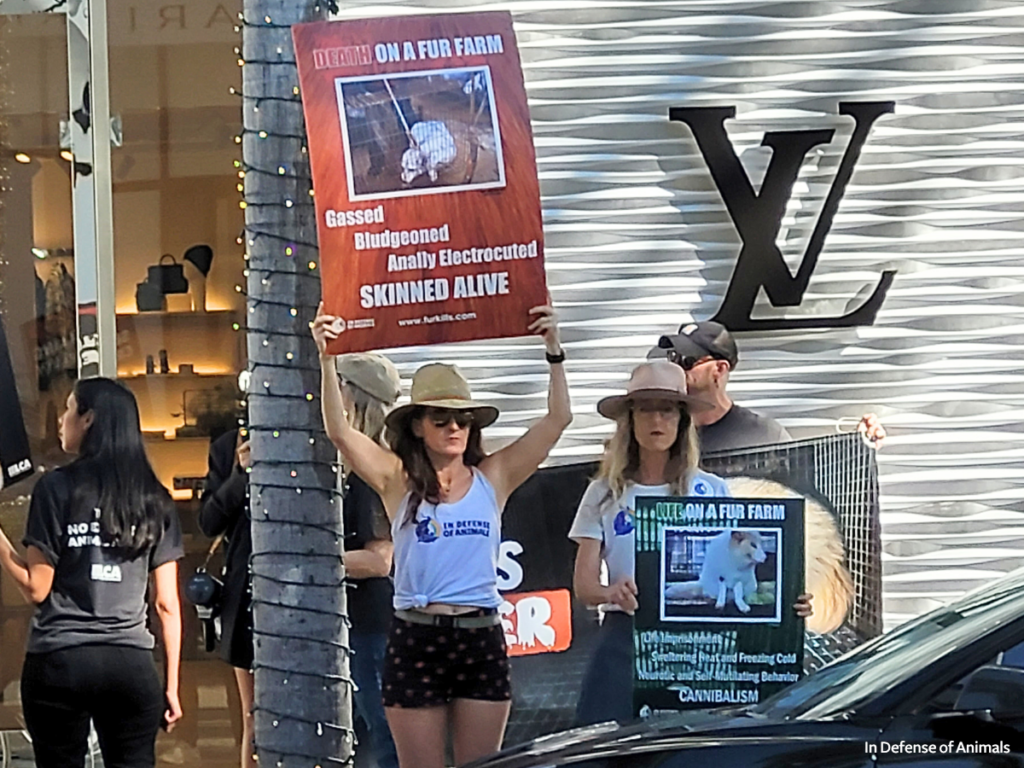
In a landmark decision for animal protection and ethical reform, Poland has officially signed a nationwide ban on fur farming, bringing an end to its status as the European Union’s largest remaining producer of animal fur. The legislation, enacted on December 4, 2025, marks a historic turning point not only for Poland, but for the global fur trade as a whole.
The law was signed by President Karol Nawrocki, following months of intense public scrutiny, international advocacy, and mounting pressure from animal welfare organizations and citizens around the world. Early signals suggested the bill might stall or be blocked at the highest levels of government, but a wave of global activism helped ensure its passage.
One of the most prominent forces behind that pressure was In Defense of Animals, which mobilized supporters internationally to write thousands of letters to Polish leadership, including the Marshal of the Senate, urging swift action. That collective effort proved decisive, demonstrating the growing influence of transnational animal rights advocacy.
The timing of the ban sent a powerful message. It came just days after Fur Free Friday demonstrations across the United States and amid a visible shift within the fashion industry itself. Major fashion platforms, including Vogue, have increasingly turned their attention toward ethical, cruelty-free alternatives, reflecting a broader cultural reckoning with the true cost of fur.
“This is a watershed moment in the history of animal protection,” said Katie Nolan, Wild Animals Campaign Specialist for In Defense of Animals. “By dismantling the fur industry in its largest European stronghold, Poland has dealt a devastating blow to the global fur trade. The message is unmistakable: the future of fashion is fur-free.”
Poland’s role in the industry made this decision especially significant. As the EU’s largest fur producer, the country supplied vast quantities of mink, fox, and raccoon dog pelts to international markets, including the United States. With Poland’s exit, the global supply chain faces a major disruption — one expected to accelerate the industry’s decline far beyond Europe.
The implications extend beyond economics. Fur farms in Poland have been identified as serious public health risks, with documented outbreaks of COVID-19 and avian influenza. These facilities, often operating with dense animal populations and minimal biosecurity, have raised alarms among scientists and public health experts. By phasing out fur farming, the new law also reduces the risk of zoonotic disease transmission with global consequences.
From an ethical standpoint, the ban brings relief to millions of animals who have long endured severe confinement and suffering. Semi-aquatic mink, in particular, were kept in barren wire cages that denied them water, space, and the ability to express natural behaviors. Death methods commonly used in the industry — including gassing and electrocution — have been widely condemned by veterinarians and welfare experts as inhumane.
The legislation mandates a structured phase-out, ensuring that fur farming operations are dismantled and that the cycle of breeding, confinement, and killing comes to an end. For animal advocates, this represents the culmination of decades of campaigning, research, and public education.
Poland’s decision also aligns it with a growing list of regions rejecting the fur trade. In the United States, California has already enacted a statewide fur ban, while major fashion cities have followed suit. Each new ban further isolates the remaining defenders of the industry, making continued operation socially, politically, and economically untenable.
Importantly, this victory was not inevitable. It was the result of sustained pressure, coalition-building, and refusal by activists and supporters to accept delay as defeat. When the bill appeared at risk of dying in the Senate, campaigners doubled down — proving that persistence, even in the face of political uncertainty, can yield transformative results.
For the global movement against fur, Poland’s ban is more than a national policy change. It is a signal. A signal that public values are shifting, that cruelty is no longer easily hidden behind tradition or profit, and that industries built on animal suffering are increasingly incompatible with modern ethical standards.
As the fur trade loses one of its last major strongholds, the momentum toward a fur-free future grows stronger. Poland’s decision underscores a simple truth that activists have long championed: progress may be slow, but it is cumulative — and when it comes, it can change everything.
This moment belongs to the animals who will never know a wire cage, and to the global community that refused to look away.
First responders brave icy waters to rescue trapped dog in Cherokee County
An ordinary winter day in Cherokee County turned into a tense rescue operation when a dog became trapped in a frozen pond, unable to find its way back to safety. As temperatures dropped and the ice posed increasing danger, first responders moved quickly, knowing every minute mattered.
Officers from the Cherokee Marshal’s Office arrived at the scene to find the dog stranded on unstable ice, frightened and surrounded by freezing water. Walking onto the pond was not an option — the ice could easily give way under a person’s weight, putting both the animal and rescuers at risk.
Instead, responders made a careful plan. Using a canoe, they slowly pushed out onto the frozen surface, distributing weight evenly to avoid breaking through. The operation required patience and precision, with officers inching forward while keeping their balance and maintaining calm to avoid startling the dog.
Witnesses described the moment as quiet but intense. The dog, visibly cold and exhausted, stayed still as the canoe approached — a small but crucial detail that made the rescue possible. Once close enough, responders gently guided the dog into the canoe, shielding it from the icy water.
Within moments, the canoe was turned back toward shore. The dog was safely brought onto dry land, wrapped up, and checked for injuries. Remarkably, despite the frightening ordeal, the dog was alert and responsive.
Soon after, the dog was reunited with its family — a simple ending, but one that carried immense relief. What could have ended in tragedy instead became a reminder of how quickly things can turn around when people are willing to act.
Officials later confirmed that no responders were injured during the rescue and praised the teamwork involved. Using the canoe not only protected the officers, but also prevented further stress or harm to the animal.
Incidents like this highlight the hidden dangers winter brings, especially for pets who may wander onto frozen ponds without understanding the risk. Ice that appears solid can be dangerously thin, and rescue officials urge pet owners to keep animals away from frozen bodies of water whenever possible.
At the same time, the story underscores something else just as important: compassion. The decision to launch a careful, time-consuming rescue for one stranded dog reflects a broader truth about emergency services — their work isn’t only about big headlines or human emergencies. Sometimes, it’s about doing everything possible for a life that can’t ask for help.
Thanks to quick thinking, calm execution, and a canoe gliding over fragile ice, one family got their dog back — cold, shaken, but alive.
And on a freezing day in Cherokee County, that was more than enough.


Leave a Comment