

THE ROCK TRAP: THE UNFILTERED REALITY OF THE MOUNTAIN DISAPPEARANCE THAT DEFIED TIME!

The foundation of a cold case shifted on January 30, 2026, as the terrifying survival story of Rachel Morrison resurfaced in the public eye. By late January 2026, her case has become a benchmark of human resilience and the dark side of remote wilderness safety. Rachel was just 19 when she vanished during a group hike near Cascade Falls on July 14, 1990. Despite being with four friends and carrying a camera that documented her final moments of freedom, she disappeared in an instant. For over a decade, her family lived in a high-stakes limbo, assuming she had succumbed to the rugged Colorado elements or a tragic accident.
The reality of Rachel’s disappearance was far more sinister than anyone imagined, ending 16 years later when she was discovered alive, having been held in a state of unimaginable isolation. Found physically restrained in a remote rocky outcrop, her survival challenged every structural theory held by investigators during the initial search. Her discovery forced a total reset of local safety protocols and sparked a high-stakes hunt for the individual responsible for her captivity. The 2026 takeaway is clear: this story is about the horrifying vulnerability of the backcountry and the strength of a woman who refused to break. Whether new technology can help prevent similar tragedies in the deep Rockies remains the most important question for hikers this season.
The “dead” planet Mercury is screaming with energy experts tried to hide.
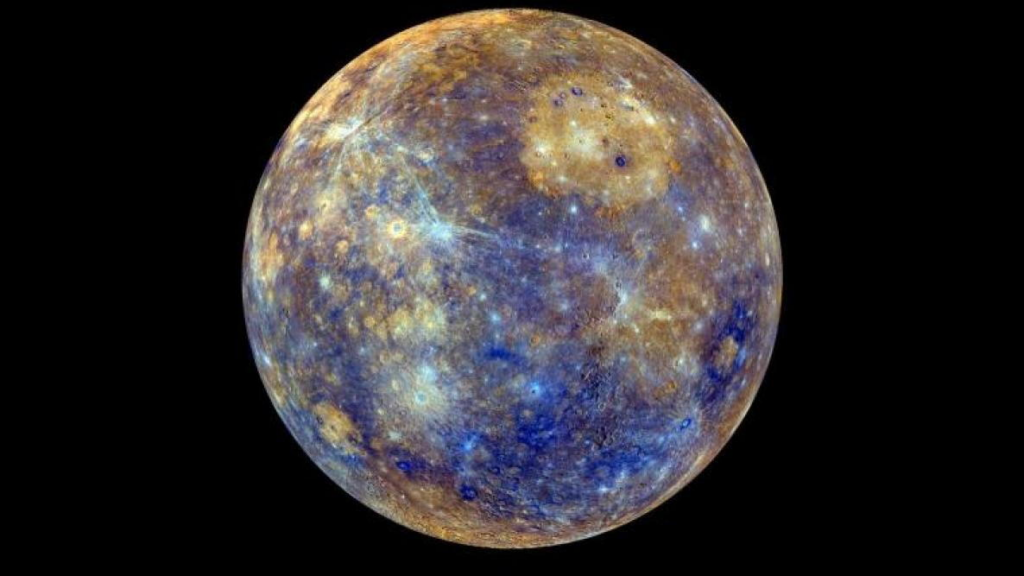
The smallest planet in our solar system, Mercury, is currently shattering everything we thought we knew about planetary death and geological stagnation. While experts previously dismissed this scorched rock as a cold, inactive relic that finished its evolution billions of years ago, new high-resolution data has revealed mysterious bright streaks across its surface that suggest it is still very much alive. These “lineae” are not ancient scars but are likely the result of active outgassing where volatile materials like sulfur are being forced up through cracks in the crust right now. Machine learning analysis of over 100,000 images shows these features cluster on sun-facing slopes, indicating a volatile heat-driven process that mimics a planetary pulse. This discovery proves that Mercury is hiding a hot, turbulent interior that continues to reshape its hellish landscape despite having no atmosphere to protect it. It is a total reversal of the “dead rock” narrative that has been taught in schools for decades, proving that the scientific establishment is often just guessing until new evidence hits them in the face.
If a tiny planet can stay this active for eons, it challenges our entire timeline of how planets lose their internal energy and eventually die. We are witnessing real-time geological evolution on a neighbor we once called a graveyard, proving that the universe still holds massive secrets right in our own backyard. This isn’t just space dust; it is a sign of a planet that refuses to go quiet into the night. Scientific models are being rewritten as we realize that the cooling process we assumed was universal might be a complete fabrication or at least a massive misunderstanding of how sulfur and heat interact under pressure. As missions from Europe and Japan head toward the planet, the old theories are being buried under evidence of a geologically violent present that mirrors a beating heart. The implications for our understanding of the solar system are massive, suggesting that other “dead” moons and planets might be harboring secret lives we never bothered to look for.
Your brain is officially too slow to see what AI just found.
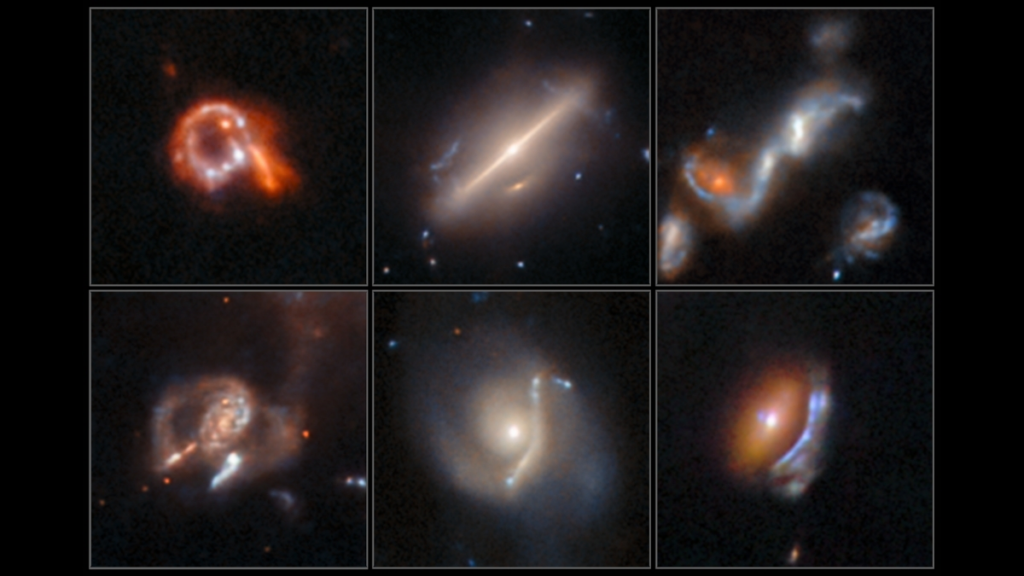
Astronomers have just unleashed a powerful AI tool called AnomalyMatch to sift through 35 years of NASA’s Hubble data, uncovering over 1,300 cosmic anomalies that humans completely missed. While organic brains are overwhelmed by the sheer deluge of data from modern telescopes, this neural network processed nearly 100 million images in just three days, identifying 800 entirely new objects that defy our current understanding of physics. We are entering an era where our technology has outpaced the capacity of human scientists to even look at the stars, leaving us dependent on machines to tell us what is actually out there in the dark. These anomalies are not just glitches; they are rare, scientifically valuable phenomena like collisional ring galaxies and bizarre gravitational outliers that present a different, hidden side of nature.
The massive data output from the JWST and the upcoming Vera Rubin Observatory means that the secrets of the universe are buried under terabytes of raw information that no human will ever see. This AI intervention is a direct challenge to the traditional “scientist at a telescope” image, proving that we are now secondary to the algorithms we built to explore the cosmos. As we rely more on machine learning to categorize the “weirdness” of space, we have to ask if we are actually discovering the universe or if we are simply letting an AI decide what is worth our attention. This isn’t just an upgrade in efficiency; it’s a fundamental shift in how humanity interacts with the unknown, where the most fascinating parts of our galaxy are being hand-picked by a computer while we struggle to keep up.
A massive “Snowball Earth” was found hiding 150 light-years away from us.
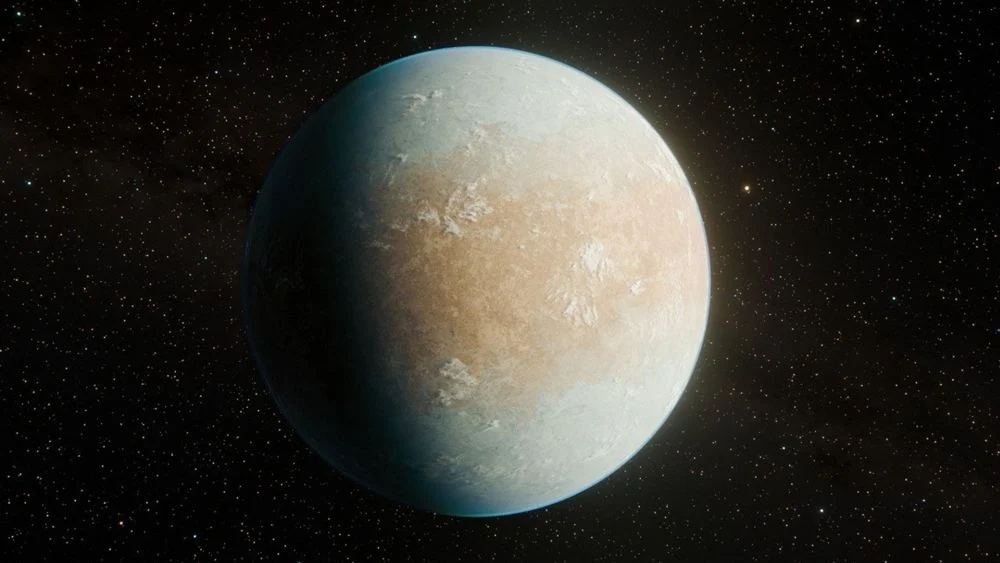
Astronomers have just identified a potential “Cold Earth” named HD 137010 b, a planet only slightly larger than our own, orbiting a Sun-like star 150 light-years away. This world is a haunting mirror of our own, possessing an orbit nearly identical in length to a terrestrial year, yet it remains trapped in a perpetual deep freeze. Because its host star is a smaller K-dwarf, the planet receives only a third of the light and heat we enjoy, leaving it significantly colder than Mars with temperatures plummeting as low as -85C. This discovery is a technical miracle, representing the first time scientists may have detected an Earth-like world using only a single transit through a massive dataset from the retired Kepler telescope. While the scientific establishment debates whether it is a habitable oasis or a barren snowball, the data proves that Earth-sized worlds are likely common, even if they are currently frozen solid.
The detection of HD 137010 b challenges the “Goldilocks” narrative by sitting right on the razor-thin edge of the habitable zone, where a thick CO2 atmosphere is the only thing that could prevent it from being a total graveyard. Because the planet takes a full year to orbit, we are forced into a agonizing waiting game for a second transit to confirm its existence officially. This find highlights the terrifying reality that even in “habitable” zones, life-supporting warmth is a rare privilege, not a guarantee for Earth-like rocks. If this planet is confirmed, it opens the door for AI and new algorithms to find hundreds of other “twins” that were previously ignored because they didn’t fit the standard model of repetitive signals. We are finally looking at the quiet, lonely outliers of the galaxy that resemble our home more than anything we have seen before.
The government is finally firing up nuclear engines to escape this planet’s limits.
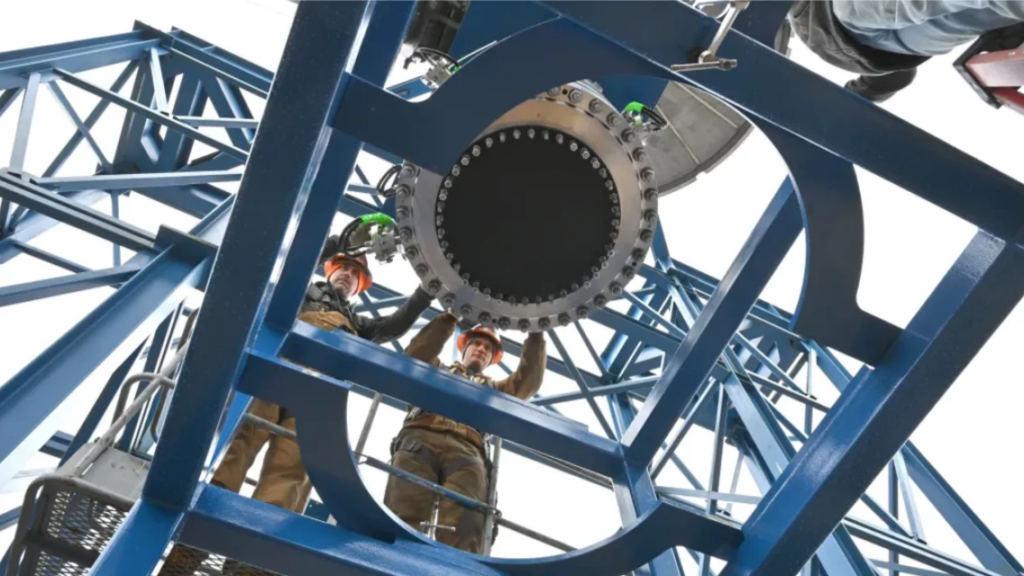
NASA has officially revived its nuclear ambitions at the Marshall Space Flight Center, completing over 100 tests on flight-scale reactor hardware that could render traditional chemical rockets obsolete. This isn’t just a minor upgrade; it is a fundamental shift from “rowing boat” chemical engines to high-efficiency nuclear thermal propulsion that heats liquid hydrogen to extreme temperatures for massive thrust. Engineers have spent months performing “cold-flow” testing on a full-scale unit built by BWX Technologies to ensure the reactor won’t vibrate itself to pieces during deep-space maneuvers. By ditching combustion for nuclear fission, NASA can finally achieve the exhaust velocities needed to cut months off a trip to Mars, which is the only way to save astronauts from being fried by cosmic radiation during long transits. This technology isn’t just about speed; it’s about the raw power required to carry heavy life-support systems and massive scientific payloads that current rockets simply cannot lift.
While the “experts” in the 1960s let this tech sit on a shelf, the current push confirms that we cannot reach the outer solar system using 20th-century fuel. The recent data provides the first high-fidelity flow response metrics for a flight-ready design, proving that the fluid dynamics of liquid hydrogen inside a nuclear core are finally manageable. This marks a turning point where space travel stops being a suicide mission and starts becoming a practical reality for human expansion. Shorter travel times mean fresher crews, less food waste, and a dramatically reduced risk of equipment failure in the vacuum of space. We are no longer just dreaming of the stars; we are building the literal engines of the future that will carry humanity past the moon and into the deep dark of the solar system. The era of slow, limited chemical propulsion is dying, and the nuclear future is officially here to take its place.
A giant star was caught cheating death because of a secret companion.
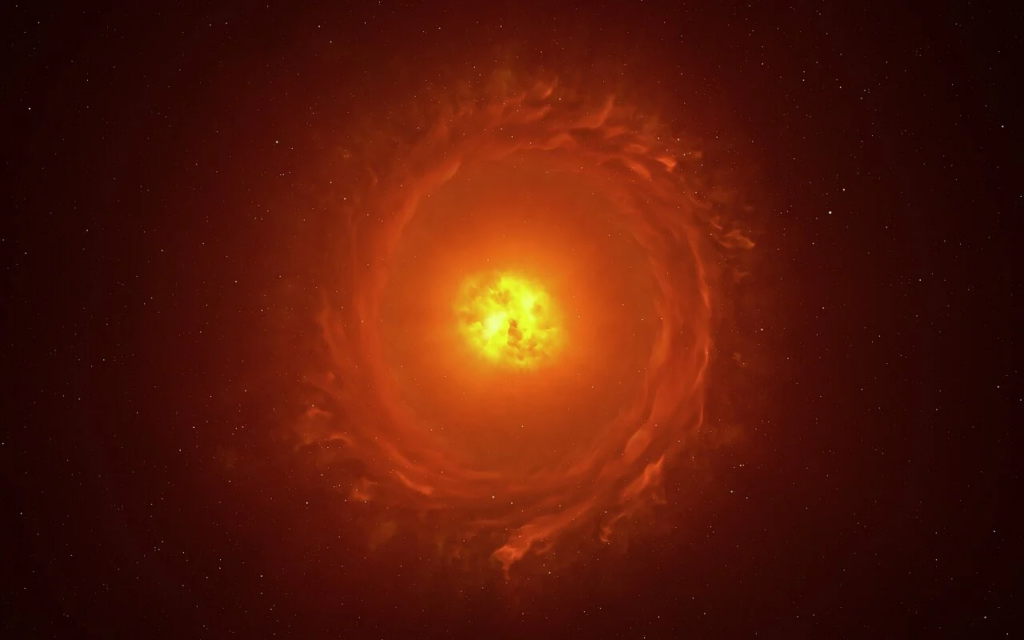
WOH G64, the most luminous and dusty red supergiant in the Large Magellanic Cloud, has officially pranked the entire astronomical community by faking its transition toward a supernova. For years, “experts” watched the star fade and its spectrum shift, convinced they were witnessing a rare leap into the yellow hypergiant phase—the final unstable gasp before a catastrophic explosion. Many believed we were about to see a star die in real-time, but new optical spectra from the Southern African Large Telescope have exposed the truth. The detection of titanium oxide molecules proves the star is still cool and stable, meaning the dramatic changes weren’t a sign of death, but rather the result of a hidden, smaller companion star lurking in the shadows. This companion is literally stretching the supergiant’s atmosphere and creating a massive dust cloud that acted as a smokescreen for the star’s “faked” demise.
This revelation proves that even the most advanced models of stellar evolution can be completely derailed by a single binary partner. As the hotter companion star orbits WOH G64, it pulls stellar material away to form a disc, generating the ionized gas that confused scientists into thinking the star was overheating and dying. It is a classic case of the scientific establishment jumping to the most “exciting” conclusion before seeing the full picture. Instead of a once-in-a-lifetime supernova preview, we are seeing a violent gravitational tug-of-war that has been happening right under our noses. This discovery forces a total rewrite of how we interpret fading stars in distant galaxies, as many “dying” stars might just be in complicated relationships. We aren’t watching a funeral; we are watching a cosmic robbery where a small star is stripping its giant neighbor of its dignity and its atmosphere.
The Moon is about to get nuked by an asteroid in 2032.
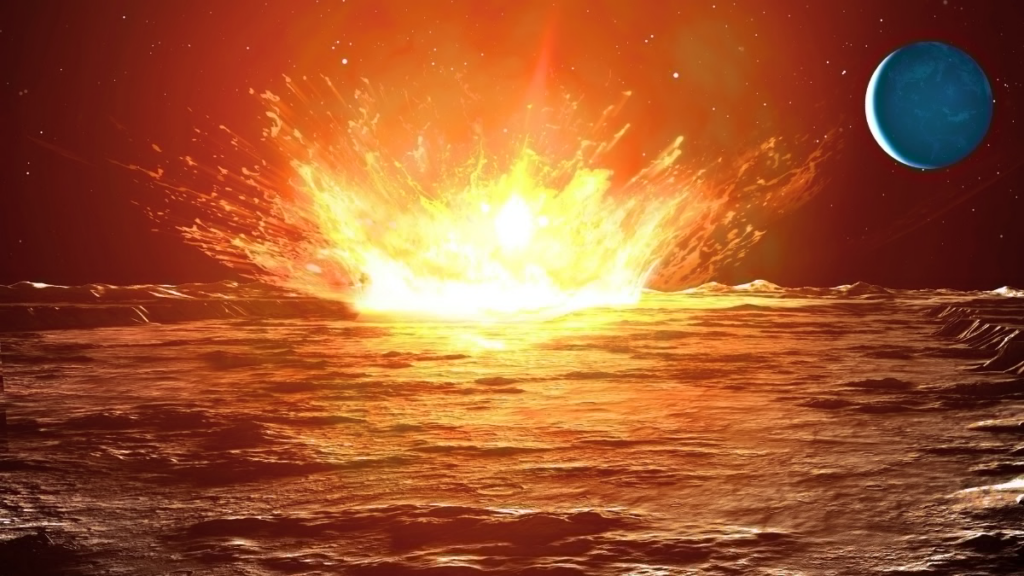
On December 22, 2032, a 60-meter-wide asteroid named 2024 YR4 has a terrifying 4 percent chance of slamming into the Moon with the force of a thermonuclear weapon. This isn’t just a distant spark in the sky; the impact will be six orders of magnitude more powerful than anything we’ve ever recorded, creating a molten crater a kilometer wide and triggering a massive 5.0 magnitude moonquake. The sheer violence of the collision will vaporize solid rock into plasma, visible to the naked eye from Earth’s Pacific region. While scientists are salivating over the chance to study the Moon’s interior through these shockwaves, the immediate reality for us is a chaotic debris field that will scream toward our atmosphere. We are looking at a potential “city-killer” event that could wipe out our satellite networks and change the night sky forever during the Christmas season of 2032.
This celestial car crash will turn our atmosphere into a shooting gallery, with simulations predicting a staggering 20 million meteors per hour hitting Earth’s orbit. Up to 400 fireballs per hour will light up the darkness, some carrying charred lunar fragments that will survive reentry and crash into the ground. This “free” lunar sample return mission comes at the cost of massive risk to our modern infrastructure, as the debris field threatens to shred the very satellites we rely on for communication and navigation. The scientific establishment is trying to spin this as a “bright side” opportunity to study crater formation, but for the average person, it’s a high-stakes lottery where the Moon’s guts are spilled across our orbit. We are witnessing the first major planetary defense warning of our time, where a neighbor’s bad day becomes a global spectacle of falling fire and potential technological collapse.
Falling space debris is now screaming so loud that earthquake sensors are triggered.
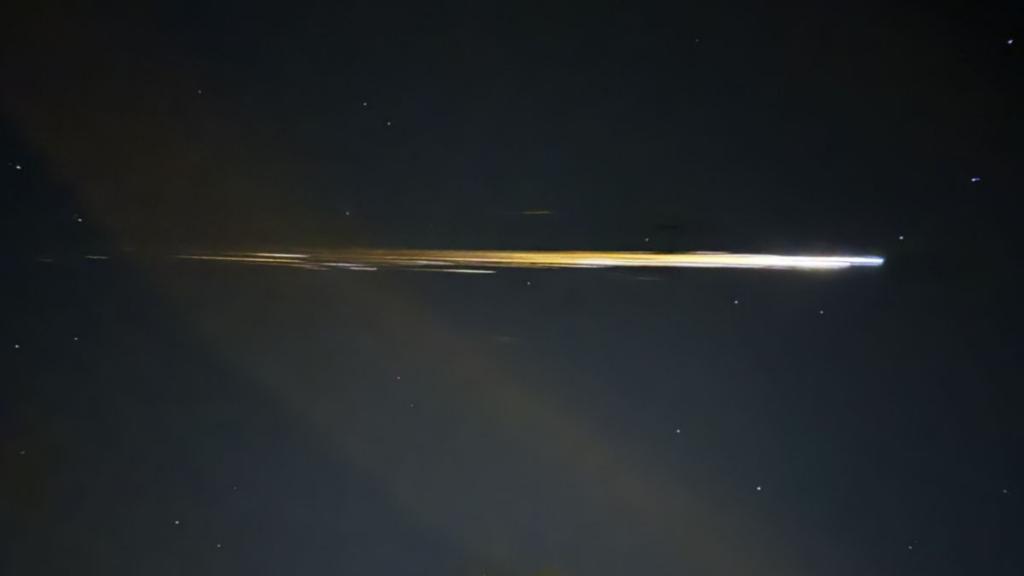
Scientists have just discovered that the 1.2 million pieces of hazardous space junk orbiting Earth are creating sonic booms so powerful they are being tracked by earthquake sensors. As massive chunks of “dead” spacecraft like the Shenzhou-15 orbital module plummet toward Earth at speeds up to Mach 30, they generate a cone of acoustic energy that slams into the ground, mimicking seismic rumbles. Planetary scientists from Johns Hopkins and Imperial College London proved that these ground-based sensors can pinpoint the exact altitude, speed, and fragmentation point of falling debris in real time. This is a game-changer for space situational awareness because it uses existing, publicly available earthquake networks to monitor the “uncontrolled” reentries that NASA and other agencies often struggle to track. Instead of just hoping for the best, we can now hear the precise moment a 1.5-metric-ton satellite begins to shatter over our heads.
This discovery highlights a terrifying reality: our atmosphere is becoming a graveyard that regularly rains supersonic metal down on the planet. When these objects break apart, they don’t just disappear; they release complex trains of multiple sonic booms and potentially hazardous aerosol-sized particulates into the air we breathe. Because these fragments travel faster than sound, the largest pieces will actually hit the ground before you even hear the boom, making rapid tracking a matter of life and death for ground-based infrastructure. While the scientific community is celebrating this new “seismoacoustic” method, it serves as a stark reminder that the debris hazard is escalating and our best defense is currently listening to the sky scream. As more satellites reach their end-of-life, the frequency of these “sky-quakes” will only increase, turning our earthquake sensors into early-warning systems for a mess we created in orbit.




Leave a Comment