
The Night Before the Cup: Tommy Woodcock and Reckless

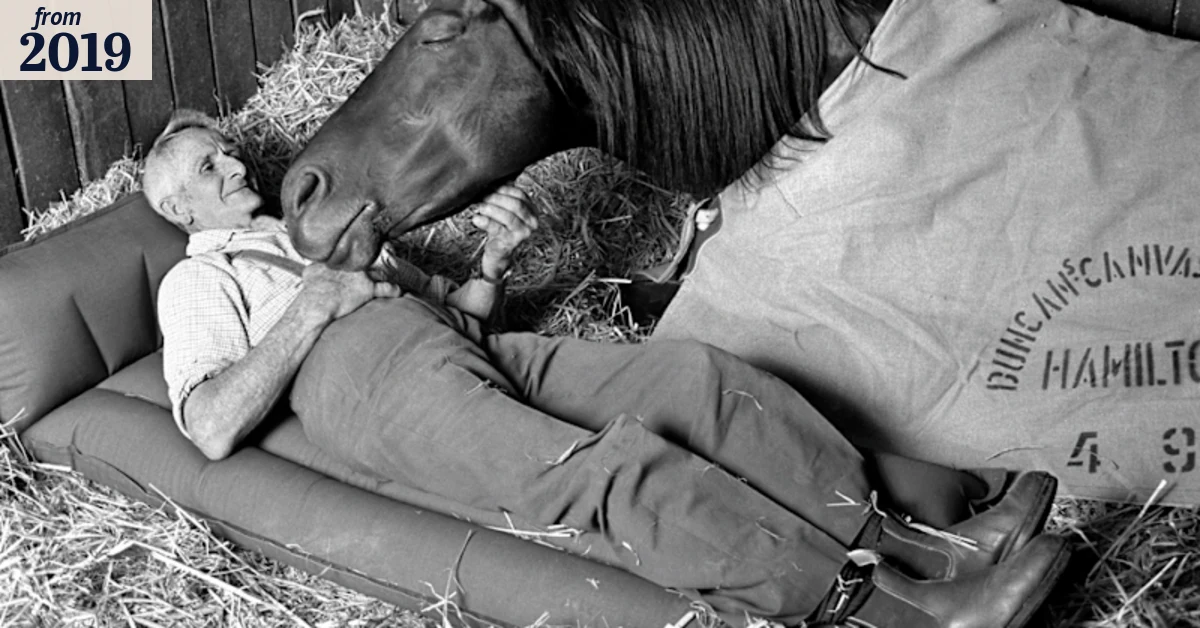
The stables were silent on the eve of the Melbourne Cup when photographer Bruce Postle noticed an old horseman standing beside his champion. Tommy Woodcock said nothing as Reckless, one of the race favorites, stepped forward and gently rested his head against his trainer’s chest. It was a simple gesture, almost human in its tenderness. Postle raised his camera and took just two photographs. In that stillness, before the thunder of hooves and the roar of the crowd, man and horse shared a quiet promise. The image endures as a reminder that sport is not only about victory, but about trust built in silence.

description

The stables were quiet on the eve of the Melbourne Cup. In the dim light, rows of horses shifted in their stalls, the usual noise of the track replaced by stillness. Photographer Bruce Postle moved carefully between the shadows, searching for a moment that did not involve crowds or trophies.

He found it in a simple exchange between a veteran horseman and his horse.

Tommy Woodcock stood beside Reckless, one of the leading contenders for the Melbourne Cup. Woodcock had spent decades in racing. He had worked as a strapper, trainer, and caretaker, most famously alongside the champion Phar Lap in the early 1930s. His career had been shaped by long hours before dawn, by feeding, brushing, and watching over animals whose careers were often brief.

Reckless was among the strongest horses in the field that year. Expectations were high. The Melbourne Cup was not simply another race. Since the nineteenth century, it had been promoted as the event that stopped a nation. Owners invested fortunes. Trainers measured reputations in seconds and lengths.

In the stable that night, there were no reporters or bookmakers. Woodcock stood close to Reckless, his hand resting against the horse’s neck. According to accounts later shared, the horse shifted forward and lowered his head against Woodcock’s chest. It was an ordinary gesture in one sense. Horses lean into handlers they trust. Yet the timing, on the night before the country’s most famous race, gave it weight.

Postle raised his camera and pressed the shutter twice.

The resulting images captured neither victory nor defeat. They showed no starting gates or finishing lines. Instead, they recorded a private connection between caretaker and animal. Woodcock’s posture was steady. Reckless’s eyes were closed. The scene suggested familiarity built through routine, patience, and physical proximity.

Australian racing has often celebrated spectacle. The Melbourne Cup draws massive crowds and national attention. Horses become household names. Yet the labor behind those moments remains largely unseen. Strappers and trainers spend years tending to animals whose success depends as much on daily care as on breeding or speed.

Woodcock understood that rhythm. His earlier association with Phar Lap, who won the Melbourne Cup in 1930, had already placed him in racing history. Decades later, standing beside Reckless, he was no longer the young handler who had traveled overseas with a champion. He was an older man beside another thoroughbred, preparing for another uncertain morning.

The photograph endures because it shifts attention away from the roar of the crowd and toward the quiet before it. It does not promise triumph. It records companionship. In racing, as in many competitive pursuits, public memory focuses on results. Postle’s images suggest that the deeper story often unfolds in the hours when no one is watching.

On that still night, before the gates opened and the nation paused, a man and a horse stood together in silence. The camera captured what statistics cannot measure. Trust, built over time, expressed without words.


Leave a Comment