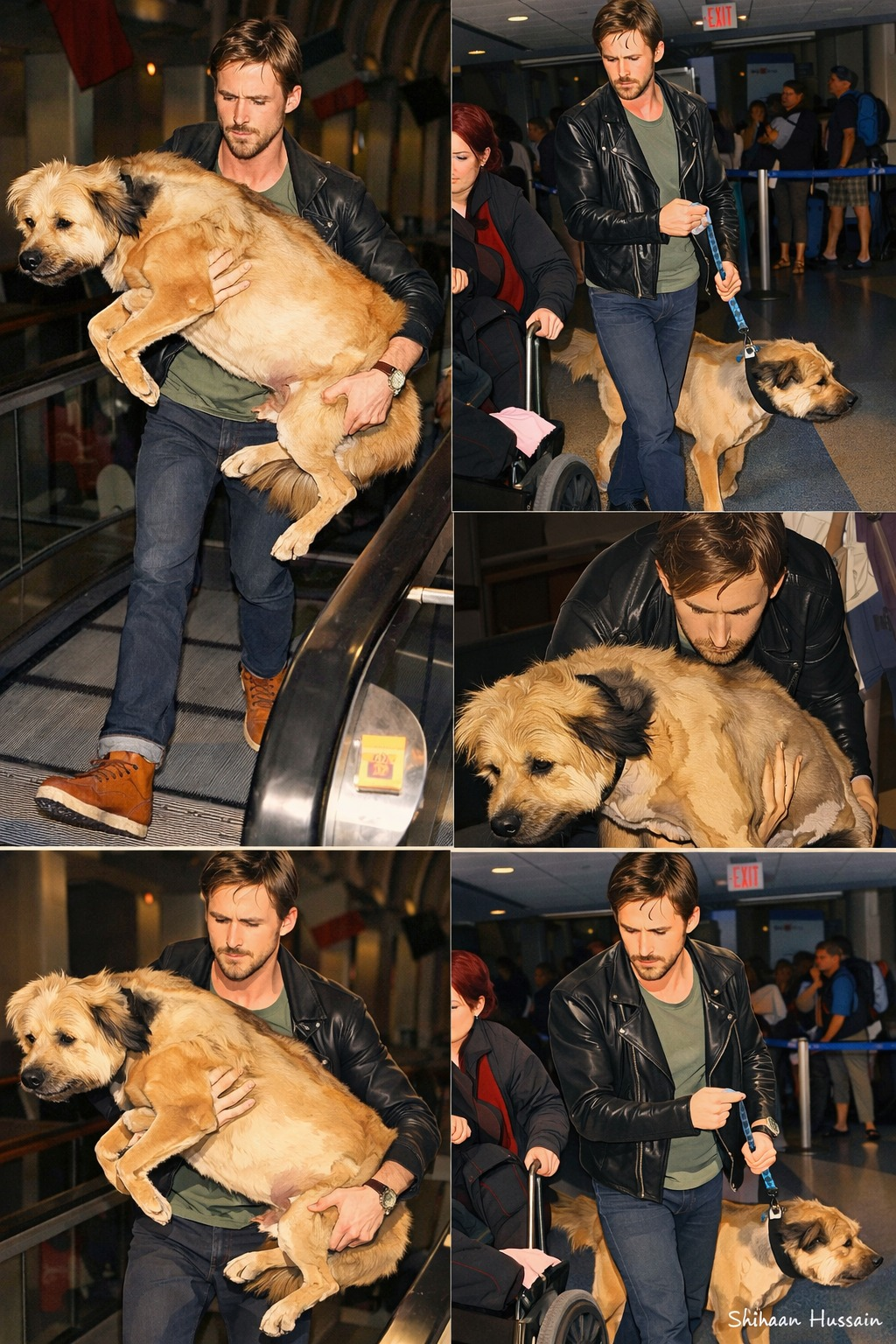

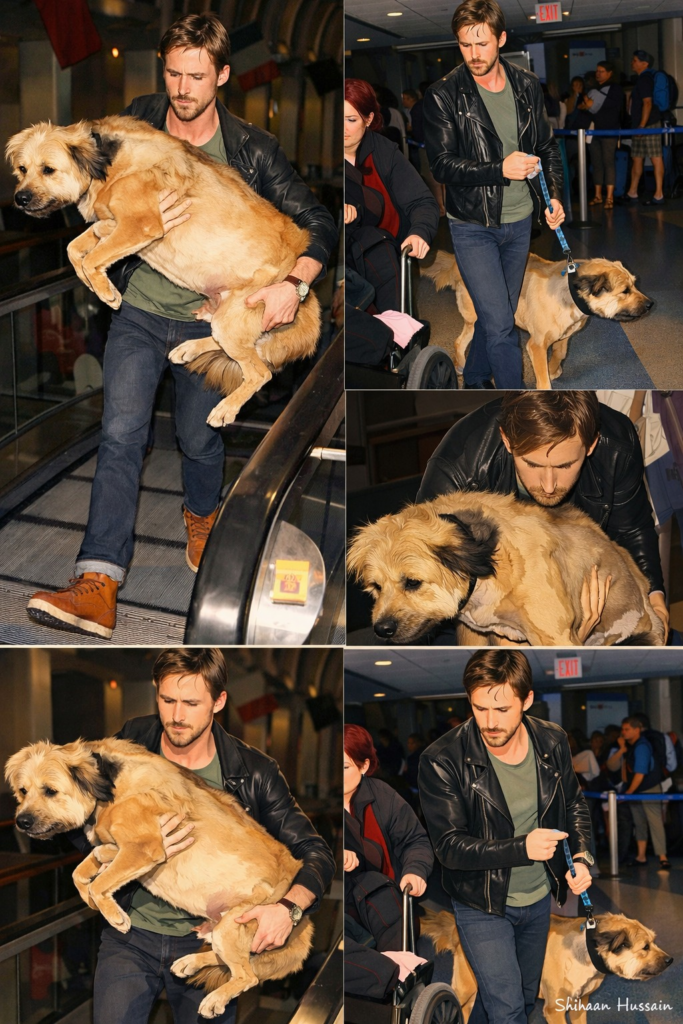
Before Ryan Gosling was famous, before the red carpets and movie posters, he walked into an animal shelter in Los Angeles and made a choice that would stay with him for the rest of his life.
The shelter was loud. Dogs barked, jumped, pressed themselves against the gates, desperate to be noticed.
One dog didn’t.
He was older. Worn down. Tired eyes that had clearly learned not to expect much anymore. He didn’t wag his tail. He didn’t rush forward. He just sat there quietly, as if he had already accepted being overlooked.
His name was George.
Most people walked right past him.
Ryan didn’t.
He didn’t see an “old dog.” He saw a presence. A calm soul that didn’t need to perform to be worthy of love. Ryan adopted George that day, and from that moment on, they were inseparable.
George wasn’t just a pet. He was family.
He went everywhere with Ryan — neighborhood walks, movie sets, interviews, even red carpets. Ryan once joked on The Ellen Show that George didn’t think he was a dog at all. He thought he was a rockstar.
And maybe he was.
Ryan wore George’s tag on a chain around his neck. He printed George’s face on t-shirts. He spoke about him with the kind of tenderness reserved for someone who truly changes you. Because George did. He gave Ryan a love that asked for nothing and gave everything.
When George passed away, Ryan didn’t just lose a dog.
He lost his best friend.
Years later, that love showed itself again. While driving with Eva Mendes, Ryan spotted a dog running loose in traffic. No cameras. No attention. Just instinct. He pulled over, got out, and rescued the dog without hesitation.
Because once you’ve been chosen by a dog like George, you never stop seeing them.
Ryan has quietly supported animal adoption ever since. Not for praise. Not for headlines. But because he understands something simple and true:
The dogs people overlook are often the ones who love us the most.
George wasn’t just a rescue.
He was a reminder — of every quiet soul still waiting behind shelter bars, hoping someone will stop long enough to really see them
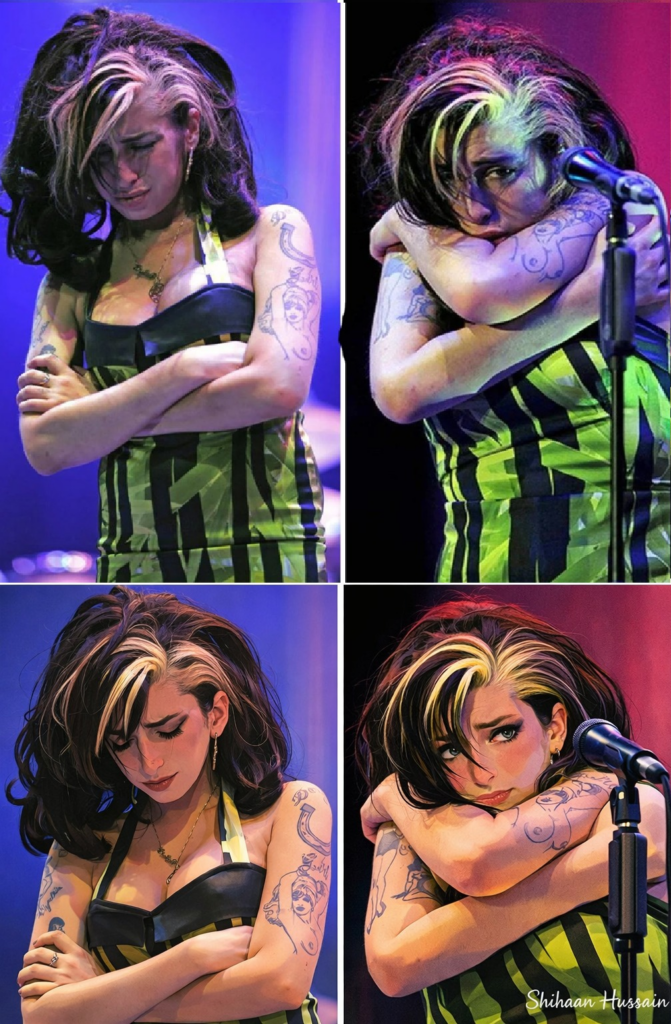
The crowd was screaming. She was falling apart.
In 2011, Amy Winehouse walked onto a stage in Belgrade and something was clearly wrong.
She hugged herself like she was trying to stay together. She forgot lyrics she once knew by heart. She sang off key. She looked lost. As the crowd grew louder, some booed. Others didn’t know what to do.
It would be her final live performance.
What many people called a bad show was actually something much harder to watch. A human being unraveling in public. Fame didn’t shield her. Applause didn’t save her. The stage lights didn’t hide the pain.
They exposed it.
Weeks later, Amy Winehouse was gone.
This image isn’t about music.
It’s about pressure.
About what happens when vulnerability is put on display and the world keeps clapping anyway.
Sometimes the saddest endings don’t happen in silence.
They happen under bright lights, with thousands watching, and no one knowing how to help.
And long after the music stops, that moment stays with us.
I’m 78 years old, and I adopted a dog no one else wanted alive.
My son told me about Hunter after a young couple brought him to the shelter and asked for him to be put down. Not because he was sick. Not because he was dangerous. But because they were moving and decided he was “too big” to take with them.
They had raised him from a puppy.
And then they left him.
The shelter refused, of course. They gave him a kennel, food, and time. But I couldn’t stop thinking about what that kind of abandonment does to a dog who has only ever loved.
So I told my son, “I want to meet him.”
He worried. Said Hunter was strong. Said I should think carefully. But I’ve lived long enough to know the difference between strength and gentleness.
When I met Hunter, I saw no aggression. No chaos.
Just a quiet dog with eyes that looked tired from asking the same question too many times.
“Why wasn’t I enough?”
I brought him home that day.
Now he follows me everywhere. He settles at my feet like he’s guarding a treasure. He rests his head on my lap as if it’s the safest place he’s ever known. Sometimes he looks at me with a kind of disbelief, like he’s still waiting for the other shoe to drop.
But it never does.
Because he’s home.
I don’t see a Pitbull.
I see loyalty. I see gratitude. I see family.
For more than 40 years, doctors told patients the same quiet truth.
This cancer cannot be stopped.
In 1982, a scientist named Mariano Barbacid discovered something no one had seen before. He proved that a single mutation in a human gene could turn a healthy cell into cancer. That discovery didn’t just earn attention. It gave birth to modern cancer genetics.
One of the most ruthless cancers on Earth is pancreatic cancer. Nearly 90 percent of cases are driven by mutations in a gene called KRAS. For decades, KRAS was labeled “undruggable.” There was nowhere for medicine to attach. No switch to turn off. Patients were left with months, not years.
Barbacid refused to accept that.
For over a decade, he worked quietly, building genetically engineered mice and dismantling cancer piece by piece. He didn’t look for a miracle drug. He looked for weaknesses. Every backup plan. Every escape route. Every survival mechanism cancer used to stay alive.
Then the pattern emerged.
Instead of attacking cancer once, he attacked it three times at the same time.
One treatment shut down the main growth signal.
Another blocked the detours cancer uses to escape.
A third disabled the emergency stress response that keeps tumors alive under pressure.
The result was something scientists almost never see.
The tumors vanished in mice.
Not slowed.
Not reduced.
Gone.
And even more shocking, they did not return for more than 200 days after treatment stopped.
This matters because pancreatic cancer has a five-year survival rate of just 13 percent. For its most common form, closer to 8 percent. Most patients are given about a year to live.
There is a catch.
This work is still preclinical. Human trials are years away. One drug in the combination may reach approval soon, but the full therapy faces long regulatory hurdles.
Still, pause for a moment.
The same scientist who proved genes can cause cancer in 1982 may have just shown how to eliminate the cancer those genes create.
That is not a breakthrough built overnight.
That is a 43-year pursuit from first discovery to real hope.
Science rarely rewards patience like this.
But sometimes, persistence changes everything.
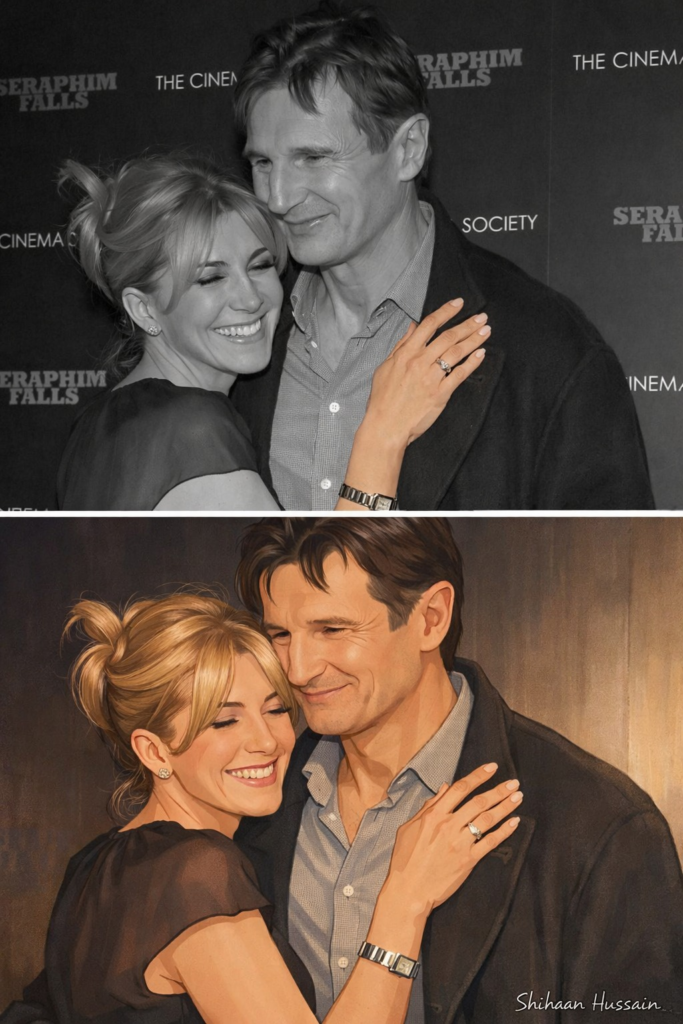
She fell. She laughed. Two days later, she was gone.
In March 2009, Natasha Richardson was taking a beginner ski lesson at Mont-Tremblant in Quebec. She fell on a gentle slope, stood up, laughed it off, and said she felt fine. There was no visible injury. No panic. No reason to worry.
Hours later, she developed a severe headache.
By the next day, she was brain-dead.
The cause was an epidural hematoma, a rare and devastating injury known for its “lucid interval.” A person appears normal, even happy, while bleeding silently builds inside the skull. By the time symptoms become obvious, it is often too late.
Her husband, Liam Neeson, rushed to her side and faced the unimaginable. Natasha was an organ donor and had made her wishes clear. In the midst of unbearable grief, Liam made the hardest decision of his life and authorized the removal of life support so others could live.
Natasha was 45 years old. They had been married for 15 years. Their two sons were brought in to say goodbye.
Her organs saved multiple lives.
After that day, Liam stepped away from public life and focused entirely on raising his children. Years later, he would describe grief as coming in waves, saying some losses never truly leave. He never remarried. Friends say he still wears his wedding ring.
Natasha Richardson fell on a gentle slope and laughed.
Forty-eight hours later, she was gone.
Liam Neeson has played heroes on screen his entire career. But the real courage was waking up every day after losing the person who anchored his life, and choosing to keep going.
This is not a movie scene.
It is life. Fragile. Sudden. Unforgiving.
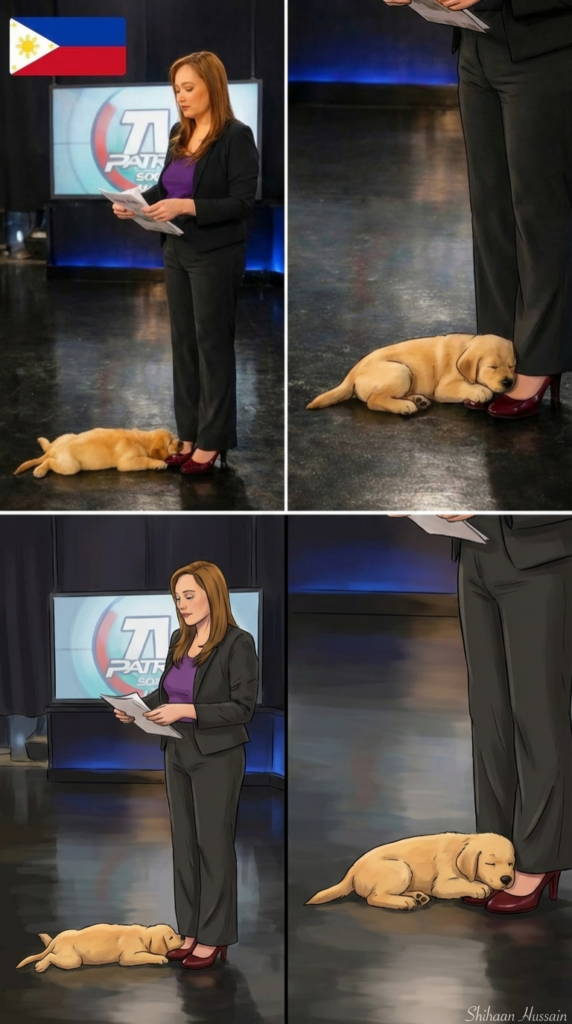
A TV reporter in the Philippines showed up to work with her puppy because she had no one at home to watch it.
During the live broadcast, the camera framed only her upper body. Viewers had no idea that just out of sight, a tiny puppy was tucked safely with her, quietly keeping her company while she delivered the news.
She stayed professional.
The puppy stayed calm.
The world stayed unaware.
Until someone caught the moment off-camera.
When the clip was shared later, it melted hearts everywhere. Not because it was flashy or planned, but because it was real. A reminder that behind the headlines and studio lights are humans doing their best to balance work, responsibility, and love.
Sometimes the most heartwarming stories aren’t reported.
From Booze to Black Belts: The Rise of Virginia’s Drunk Raccoon Crime Boss
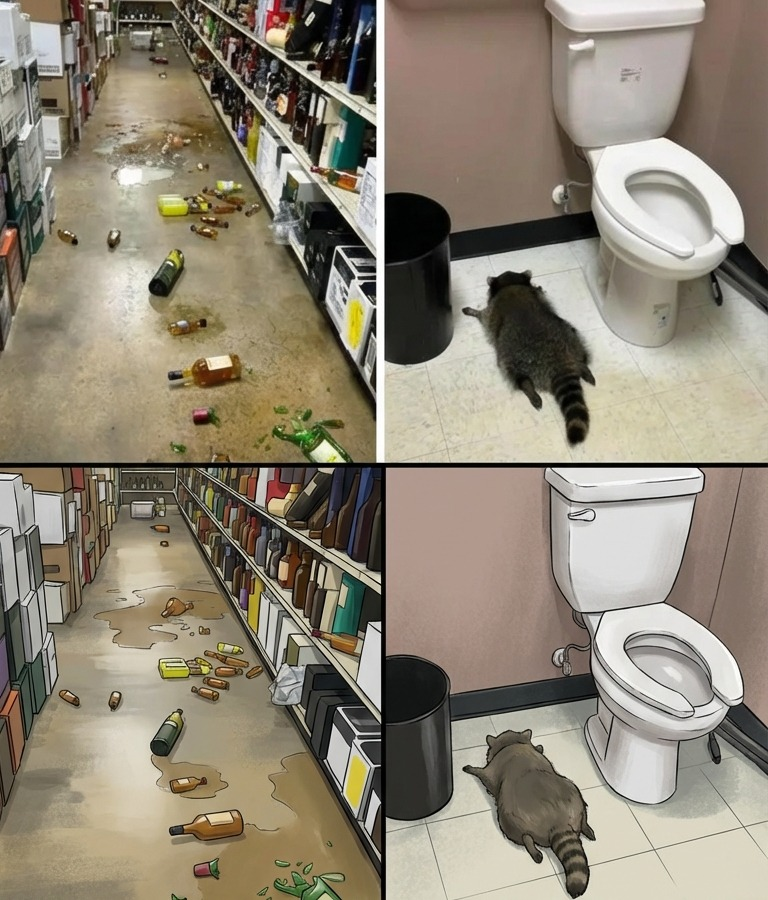
A quiet rural town in Virginia woke up this week to a crime spree so bizarre that police are still trying to explain it with a straight face.
It started when a raccoon broke into a local liquor store, drank its way through the aisle, and was later found passed out in the bathroom like it had just survived Thanksgiving dinner.
But that wasn’t the end.
According to animal control, the same raccoon is now suspected of breaking into a nearby karate studio… and then the Department of Motor Vehicles.
Yes. The DMV.
Authorities believe the masked suspect helped himself to snacks, left no fingerprints, and vanished without a trace. Officials have nicknamed him the “trashed panda,” and say he may be evolving beyond trash cans and into organized crime.
“He’s been in multiple buildings,” one officer said. “We’re not saying it was definitely him… but we’re not saying it wasn’t.”
After sobering up, the raccoon was released back into the wild about a mile from the shopping center. Police admit this may have been a mistake.
“He’ll be back,” officials said. “He’s not a dummy.”
The town has since embraced their unlikely outlaw, selling “Trashed Panda” merchandise and raising over $200,000 for the local animal shelter.
No arrests have been made.
The raccoon remains at large.
Authorities advise locking doors, guarding snacks, and avoiding eye contact with any animal wearing confidence.
Moment of the day
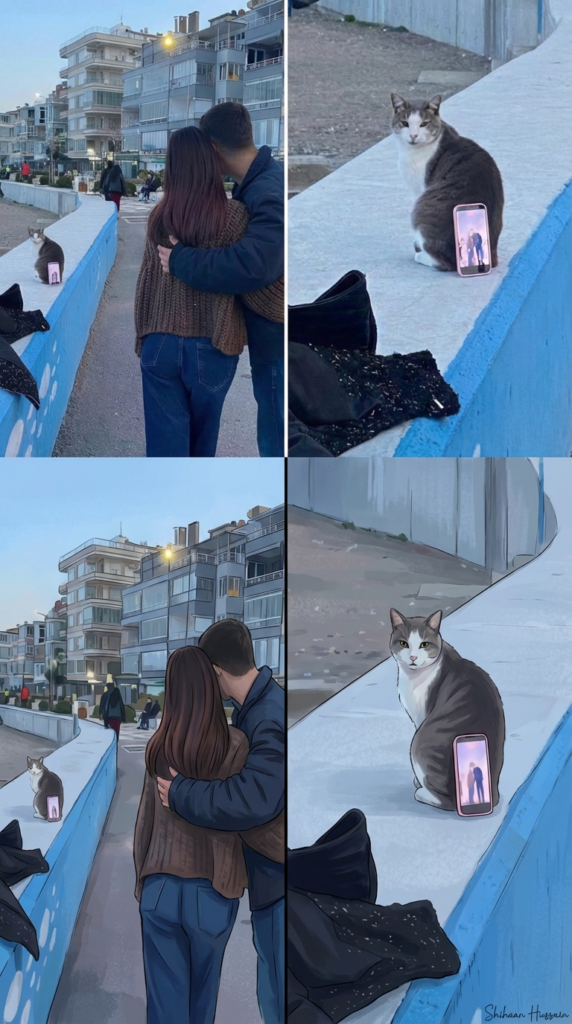
A couple takes a selfie by leaving the phone on the back of a cat in Türkiye
Leave a Comment