
Tree bark sunscreen, ox carts, and fish you catch before breakfast. Welcome to Nosy Ve.
Tree bark sunscreen, ox carts, and fish you catch before breakfast. Welcome to Nosy Ve. On this small island off Madagascar’s southwest coast, the Vezo people have lived for countless generations by understanding what the ocean provides and how to use it. Every aspect of daily existence flows from the sea, from the morning catch to the evening meal, from the traditional sunblock protecting fishers’ skin to the slow carts carrying surplus to market.
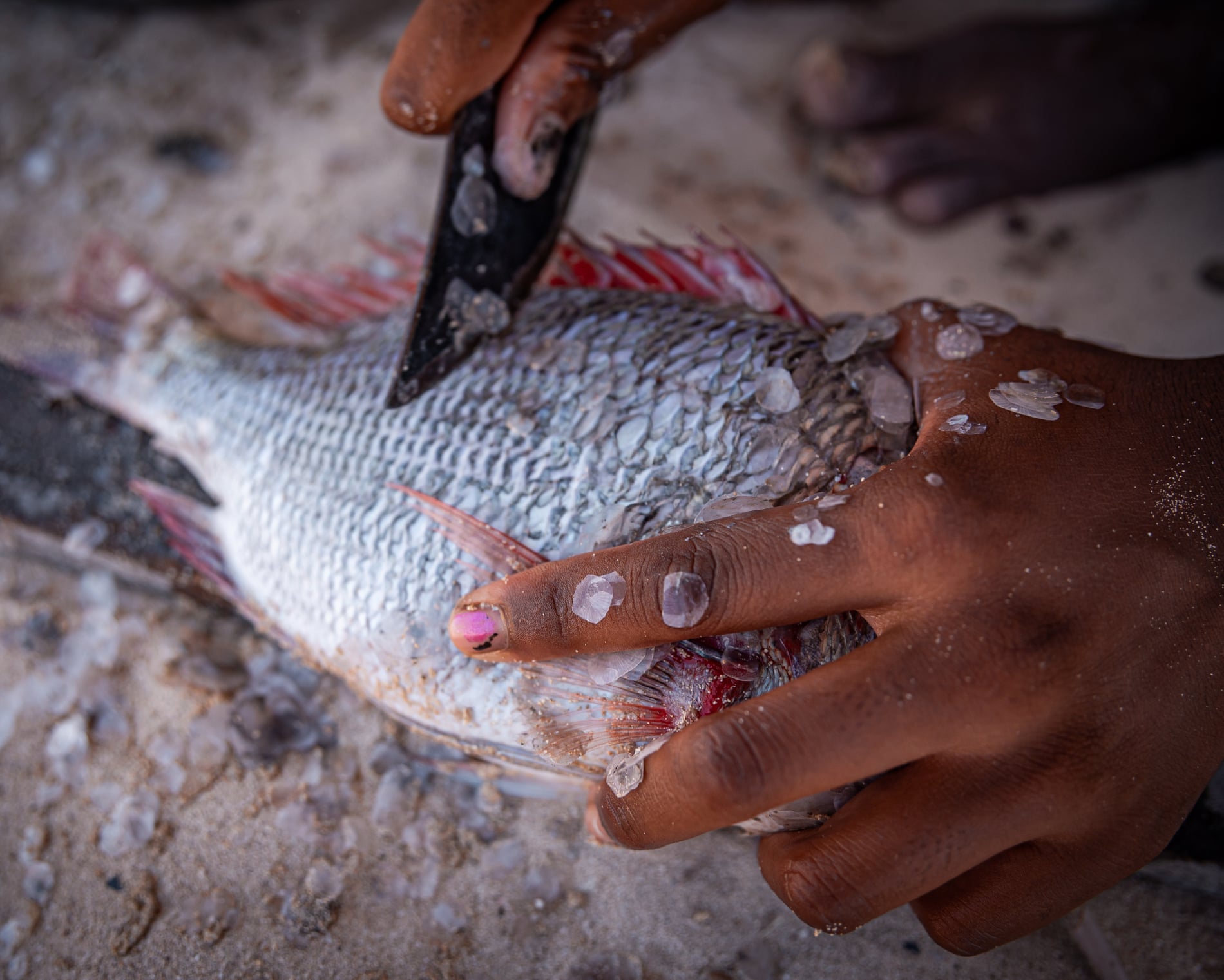
The connection between ocean and table is immediate and undeniable. The fish that swim in the morning become the meal that sustains families by evening, prepared simply with tomato, onion, and garlic, ingredients that complement rather than overwhelm the fresh catch. Tomatoes and onions, brought from the mainland, add acidity and depth to grilled fish. Garlic provides aromatic warmth. The combination transforms a basic protein into something worth gathering around, a small celebration of survival in a place where survival is never guaranteed.
Salted sardines tell a different story. These smaller fish, too numerous to eat fresh, are preserved through salting and drying, laid out on racks under the tropical sun until they transform into shelf-stable provisions. From Andavadoaka, the nearest mainland settlement, they enter a trade network that connects this remote coast to markets further inland. The sardines represent foresight, planning for days when the catch might be smaller, when weather might keep boats ashore.
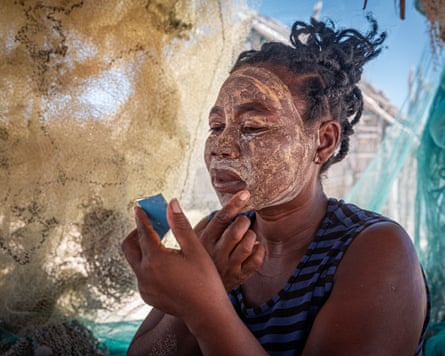
Soa Nomeny, a resident of Nosy Ve, applies tabake to her face, a traditional sunblock made from ground taolo bark. The fragrant paste protects against the relentless tropical sun that beats down on fishers spending hours on open water. This isn’t manufactured sunscreen shipped from afar; it’s local knowledge passed down, understanding of what the environment provides and how to use it. The bark, ground fine and mixed with water, creates a barrier that reflects sunlight while allowing skin to breathe. In a place where sun exposure is constant and medical care distant, such knowledge isn’t quaint tradition—it’s essential survival technology.
In Bevohitse village, the catch begins its journey to market not by truck or van, but by zebu-drawn cart. These humped cattle, with their distinctive horns and gentle demeanor, provide the main form of transport in remote areas where sandy tracks defeat wheeled vehicles. The carts creak along at walking pace, carrying fish to buyers who will distribute them to towns and cities. It’s transportation that hasn’t changed in centuries, reliable precisely because it’s simple.
These daily practices reveal a culture built on intimate knowledge of place. The Vezo know which fish run when, where to find them, how to preserve them. They know which bark protects from sun, which plants flavor food, which routes lead to market. This knowledge, accumulated over generations, represents a form of wealth that doesn’t appear on any balance sheet but is essential to survival.
Yet this knowledge faces unprecedented challenges. Fish populations decline as waters warm and industrial trawlers encroach. Traditional practices adapt, but adaptation takes time, and time is something the Vezo may not have in abundance. The sardines drying on racks, the fish cooking with tomatoes, the zebu carts heading to market, the tabake protecting faces, all of it depends on the ocean continuing to provide.
For now, life continues as it has for centuries. Boats launch at dawn. Fish are caught, cooked, eaten. Surplus travels to market by slow cart. Women protect their skin with bark paste. Children learn to read the water, to spot where fish might be, to understand the rhythm of tides and seasons. It’s a life of profound connection to place, beautiful in its simplicity, fragile in its dependence.
The question hanging over Nosy Ve and communities like it is whether this way of life can survive the changes sweeping the planet. Can traditional knowledge adapt fast enough? Can fish populations recover? Can a culture built on the sea’s abundance find new ways to thrive when that abundance falters? The answers aren’t clear yet. But for now, the fish still come, the carts still roll, the tabake still protects, and the Vezo still live as they always have: connected to the ocean, dependent on its gifts, determined to endure.


Leave a Comment