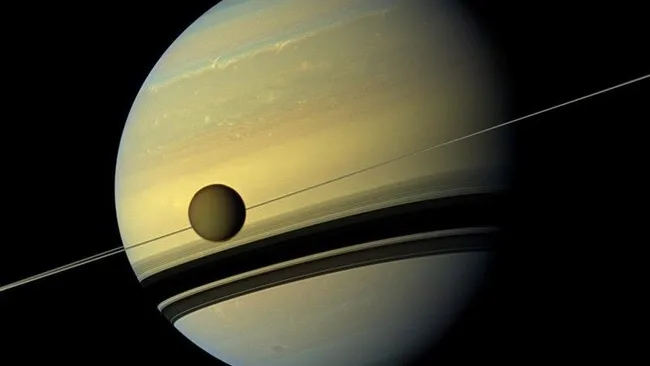

New research from astronomers at the SETI Institute suggests Saturn’s iconic rings and many of its moons’ peculiar features could trace back to a single catastrophic event: a collision between two ancient moons roughly 100-200 million years ago. The study, accepted for publication in the Planetary Science Journal, proposes that a lost moon named Chrysalis collided with proto-Titan, reshaping both bodies. The merger would have wiped Titan’s surface clean, explaining its few craters, created its thick atmosphere, and altered Titan’s orbit. That orbital change would have destabilized other moons, triggering collisions whose debris eventually formed Saturn’s rings.
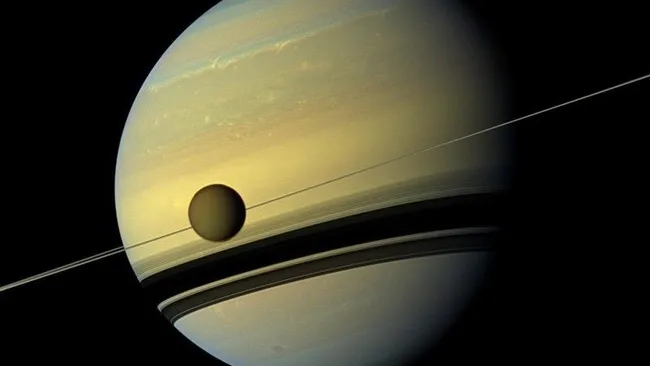
What if Saturn’s rings formed from a moon that crashed into Titan? New research from astronomers at the SETI Institute suggests exactly that, proposing a dramatic chain reaction that could explain nearly all of Saturn’s peculiar features in one sweeping theory. The study, accepted for publication in the Planetary Science Journal, traces the origins of the ringed planet’s iconic rings, its tilted axis, and several of its strangest moons back to a single catastrophic event roughly 100 to 200 million years ago.
The story begins with data from the Cassini-Huygens mission, which arrived at Saturn in 2004 and spent over a decade studying the system. Cassini’s measurements of Saturn’s “moment of inertia,” the distribution of mass inside the planet itself, revealed something surprising. More of Saturn’s mass was concentrated in its center than previously thought, changing how the planet wobbles on its axis. This slight difference meant Saturn was slightly out of sync with Neptune’s gravitational influence, something that needed explaining.
Scientists had previously theorized that Saturn once had another icy moon, which they named Chrysalis. The idea was that Chrysalis got too close to Saturn and was ripped apart by tidal forces about 100 million years ago, with most debris falling into the planet and some remaining to form the rings. The interaction would have altered Titan’s orbit, which in turn would have affected Saturn’s tilt.
But when the SETI team ran simulations testing this theory, they got a different result. Most of the time, Chrysalis didn’t get torn apart by Saturn. It collided with Titan instead. Rather than disproving the idea, this opened a new possibility. What if the collision itself was the key event?
The simulations suggest that Chrysalis was real and did indeed merge with proto-Titan 100 to 200 million years ago. Before the collision, Titan may have resembled Jupiter’s moon Callisto, an icy, airless world with an ancient, battered surface. The impact would have wiped Titan’s surface clean, explaining why today’s Titan has remarkably few craters beneath its thick atmosphere. That atmosphere itself would have leaked out from Titan’s interior during the collision.
The merger would have knocked Titan’s orbit sideways, making it wider and more elongated. It’s only now beginning to gradually circularize again. This change in Titan’s orbit would have sent tidal forces rippling through Saturn’s inner system, destabilizing the mid-sized moons and triggering more collisions. While most of those moons reformed from the debris, some icy particles settled around Saturn to form the ring systems we see today.
The theory also addresses Hyperion, Saturn’s bizarre, sponge-like moon that tumbles chaotically in its orbit. Hyperion and Titan are locked in a gravitational resonance: for every four orbits Titan makes, Hyperion makes exactly three. The simulations found that this resonance is relatively young, only a few hundred million years old, dating to about the same period when Chrysalis disappeared. “Perhaps Hyperion did not survive this upheaval, but resulted from it,” said lead researcher Matija Ćuk. “If the extra moon merged with Titan, it would produce fragments near Titan’s orbit. That is exactly where Hyperion would have formed.”
Iapetus, the two-toned moon with the most inclined orbit of any of Saturn’s main satellites, also fits into the picture. Chrysalis’s gravitational influence would have perturbed Iapetus’s orbit, leading to its extreme 15.5-degree tilt.
It’s a remarkably neat hypothesis that ties together dozens of loose ends in a single elegant story. But currently, that’s all it is: a hypothesis. Direct evidence remains elusive. NASA’s Dragonfly mission to Titan, scheduled to launch in 2028, could change that. By exploring Titan’s surface, Dragonfly may find further signs that the moon’s surface is young, indicating the upheaval that followed the collision with Chrysalis over 100 million years ago.
Until then, the idea that Saturn’s rings formed from a moon that crashed into Titan remains one of the most compelling explanations for the solar system’s most beautiful feature. A collision, a merger, a cascade of debris, and rings that have dazzled astronomers for centuries. All from one moon that got too close to another.


Leave a Comment