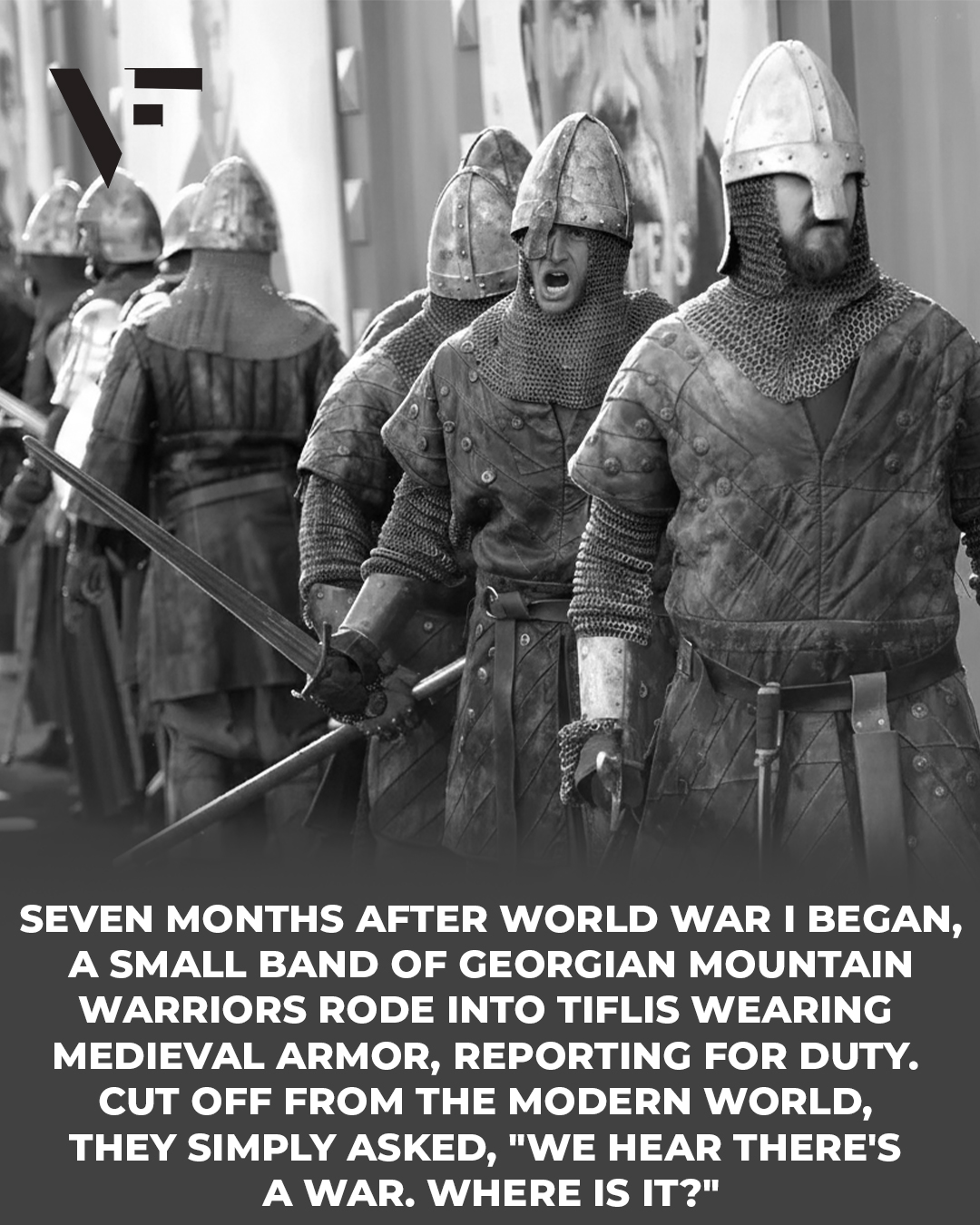

In 1914, as World War I reshaped empires with railways and machine guns, life in Georgia’s remote mountain regions moved at an older pace. Months after the Russian Empire entered the war, a group of highland warriors reportedly rode into Tiflis wearing chainmail, helmets, and carrying swords and shields. They had heard there was a war and had come to serve. Likely from isolated communities such as Khevsureti, where medieval traditions endured, their arrival revealed a striking contrast: industrial warfare meeting a culture that still preserved the armor and codes of centuries past.
desc :
In the winter of 1915, months after Europe had descended into mechanized slaughter, a small mounted group entered Tiflis, the administrative center of the Caucasus within the Russian Empire. They wore chainmail shirts, conical helmets, and carried swords and shields that appeared to belong to another century. According to contemporary reports, they announced that they had heard there was a war and had come to fight.
The empire had entered World War I in August 1914. On the Western Front, artillery and machine guns were already redefining combat. Rail networks and telegraph lines spread news rapidly across much of Europe. Yet the Caucasus Mountains remained difficult terrain, where communication moved more slowly and traditions endured with less interruption.
The riders were likely from Khevsureti, an isolated highland area whose inhabitants maintained distinctive dress and martial customs. For centuries, communities in these mountains had defended narrow passes and village territories against raiders and rival groups. Their equipment, including chainmail and swords, was not theatrical costume but inherited gear maintained for ceremonial and defensive purposes.
Anthropologists and travelers of the nineteenth and early twentieth centuries recorded the persistence of medieval style armor among Khevsur men. While firearms were known and used in the region, older weapons retained symbolic and practical value. The mountainous landscape fostered autonomy and preserved social structures that differed from those in lowland urban centers.
By 1915, the war facing the Russian Empire was being fought primarily against the Ottoman Empire and the Central Powers, involving trenches, heavy artillery, and modern rifles. The sight of armored horsemen arriving in Tiflis underscored the uneven pace of modernization across imperial territory. Industrial warfare depended on rail mobilization, factory production, and centralized command. Highland communities relied on oral networks and seasonal travel.
Their reported statement that they had come to serve illustrates a continuity of warrior identity rather than ignorance of modern arms. Participation in imperial campaigns had precedent. Highland units from the Caucasus had served in earlier Russian conflicts. The difference in 1915 lay in the scale and technology of the war they were volunteering to join.
Accounts of the episode circulated in regional newspapers and later memoirs, often emphasizing the contrast between chainmail and machine guns. The story resonated because it dramatized a meeting between two eras. On one side stood an industrial conflict stretching from the Western Front to the Middle East. On the other stood a mountain culture whose martial symbols had changed little in appearance over centuries.
The riders’ arrival did not alter the strategic course of the war. It did reveal how empires contained multiple temporalities at once. In the Caucasus, medieval forms of dress and honor codes coexisted with railways and telegraph offices. When the horsemen entered Tiflis, they bridged that divide briefly, carrying with them a reminder that modernization was not uniform.
The moment endures because it captures a rare visual collision between chainmail and the twentieth century. It shows that even in an age defined by factories and artillery, pockets of older worlds persisted, ready to step into modern conflict on their own terms.


Leave a Comment