
A Partner’s Peaceful Farewell
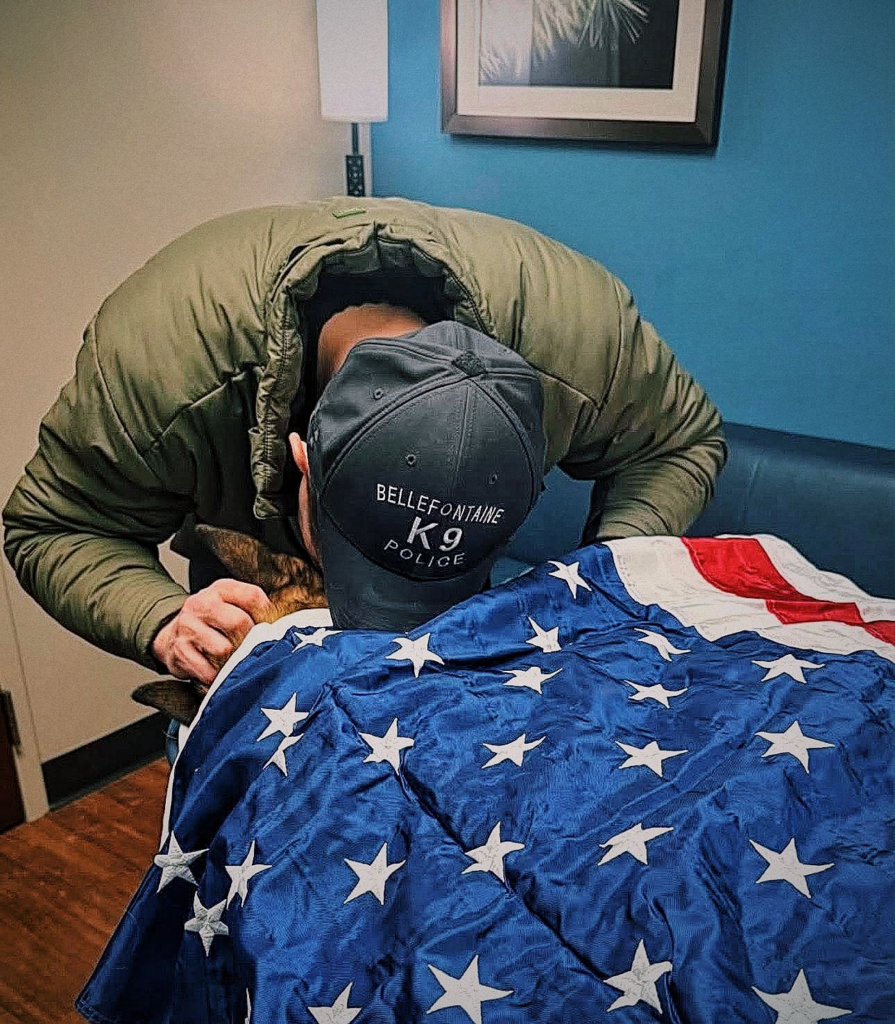
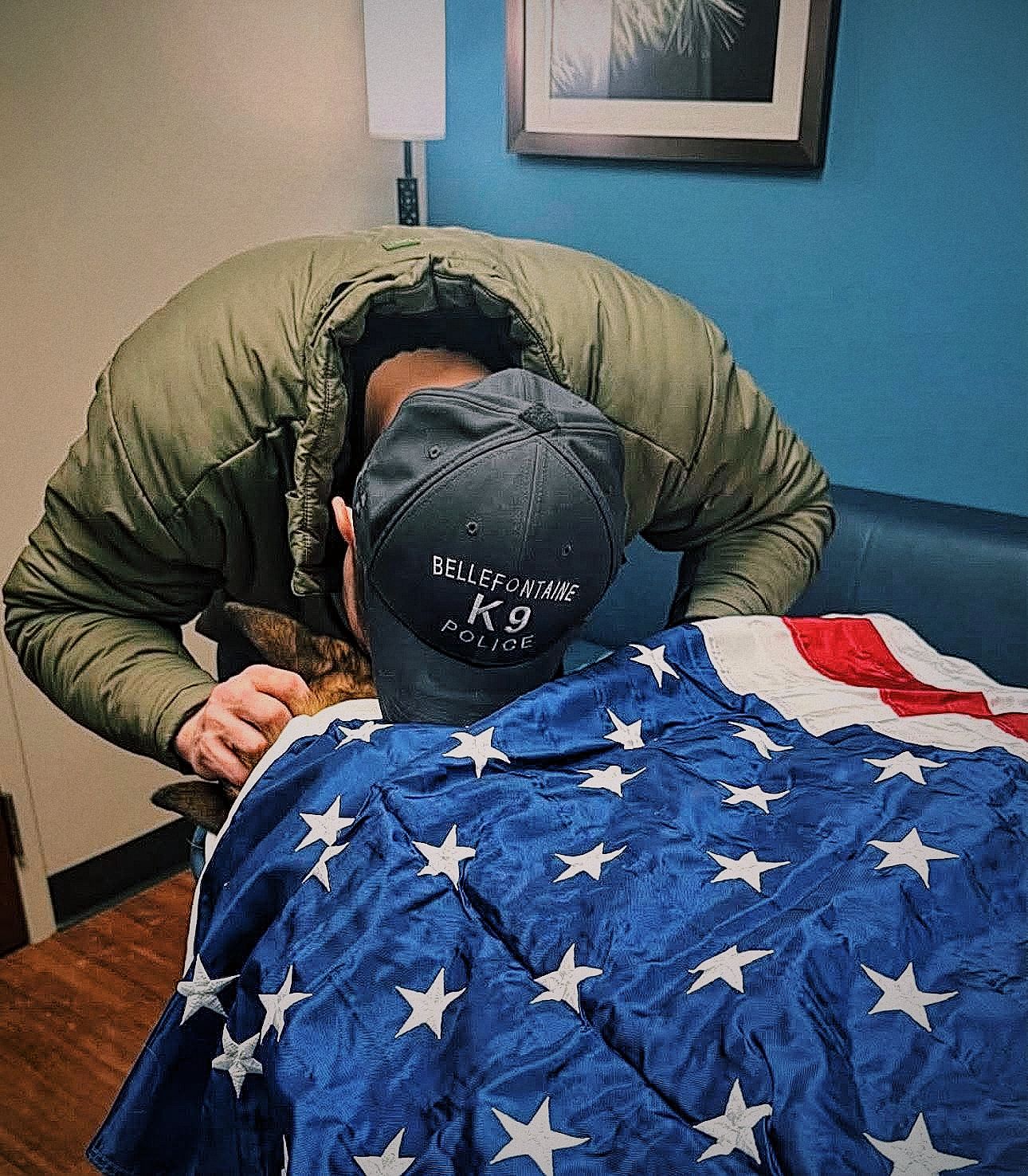
The Bellefontaine Police Department in Ohio has announced the peaceful passing of retired K-9 officer Boodik, who died on January 26, 2026, following a brief battle with cancer. The loyal German Shepherd spent his final moments in the arms of his devoted handler, Officer Hostetler, surrounded by a circle of fellow K-9 handlers, department personnel, and friends—a testament to the deep bond he shared with his human partners and the law enforcement family.
Boodik served the community with dedication, his keen senses and training contributing to public safety through narcotics detection, suspect tracking, and community outreach. His retirement marked the beginning of a well-earned life of rest and companionship, a time cut short by illness.
The department’s tribute highlights not just Boodik’s service, but the profound, unique relationship between a K-9 and his handler—a partnership built on trust, communication, and mutual respect that extends far beyond the job. For Officer Hostetler and the entire department, Boodik was not just a tool of the trade, but a beloved colleague, protector, and friend.
His passing is a somber reminder of the shorter lifespans of these working heroes and the emotional toll their loss takes on the officers who serve alongside them. The Bellefontaine community and the wider law enforcement family now join in mourning, honoring a life dedicated to service, loyalty, and courage.
Rest easy, K-9 Boodik. Your watch has ended, but your legacy of devotion and bravery will continue to inspire and guard the hearts of those you served.
A Crown Shared, Not Kept

In 2019, at S&S Consolidated High School in Sadler, Texas, a homecoming queen’s crowning became a lesson in selfless friendship. Seniors Trinity Arrington and Emily Petty, who has Down syndrome, were both nominated. Trinity spent the week campaigning for Emily, telling classmates to vote for her friend because she “always wanted to be a princess.”
When Trinity’s name was announced as queen, she accepted the sash and crown with a quiet plan in her heart. Instead of keeping the honor, she immediately turned to Emily and gently placed the crown on her head. The two friends then walked hand-in-hand around the field, waving and blowing kisses to a cheering, tearful crowd.
The gesture was not an impulsive act, but the culmination of a genuine, supportive bond. Trinity, who had spent lunch periods in the special education classroom getting to know Emily, saw the moment as a way to affirm her friend’s worth and make a childhood dream come true. In that instant, the crown transformed from a symbol of individual popularity into a gift of visibility, inclusion, and love.
Emily, overjoyed, hugged her friend and said, “I love her every day.” When Trinity became emotional, Emily tenderly reminded her, “You can’t cry.”
The moment, captured on video and shared worldwide, resonated far beyond the football field. It became a powerful example of how kindness can rewrite the script of a traditional ceremony, turning competition into compassion. Trinity’s choice reminded everyone that true leadership isn’t about holding a title—it’s about knowing when to pass it to someone whose smile will shine just a little brighter. In a world often focused on winning, two friends from Texas showed that the greatest victory is often found in lifting someone else up.
A Journey Interrupted, A Dream Continued
On May 1, 2013, Richard Swanson of Seattle, Washington, embarked on an extraordinary journey. The 42-year-old set out to dribble a soccer ball 10,000 miles from his home to São Paulo, Brazil, in time for the 2014 World Cup. His mission, called “Breakaway Brazil,” was to raise awareness and funds for the One World Futbol Project, a nonprofit that distributes durable, never-need-to-be-inflated soccer balls to children in disadvantaged communities worldwide.
With his life simplified and his sons grown, Swanson took to the road with unwavering optimism. For nearly two weeks, he dribbled south along the Pacific Coast, sharing his progress online, sleeping where kindness allowed, and keeping the ball constantly at his feet—a rolling symbol of joy and resilience.
Tragically, on May 14, 2013, just 250 miles into his journey near Lincoln City, Oregon, Swanson was struck and killed by a pickup truck while walking along US Highway 101. His soccer ball was recovered from the roadside.
Though his physical journey ended far too soon, the spirit of his mission endured. The story of his attempt galvanized support for the One World Futbol Project, leading to an outpouring of donations in his memory. The organization noted that his dream lived on through thousands of indestructible balls sent to children playing on rough terrain across the globe.
Richard Swanson’s walk was cut short, but his legacy became one of inspired action. He reminded the world that a single, seemingly improbable idea—fueled by passion and a desire to help others—can create ripples of impact far beyond one’s own path. Today, children in distant places kick balls that carry a piece of his hope, playing on in joyful ignorance of the man who dreamed of bringing the game to them, one step at a time.
From Flight Attendant to Captain, With Her Daughter Alongside
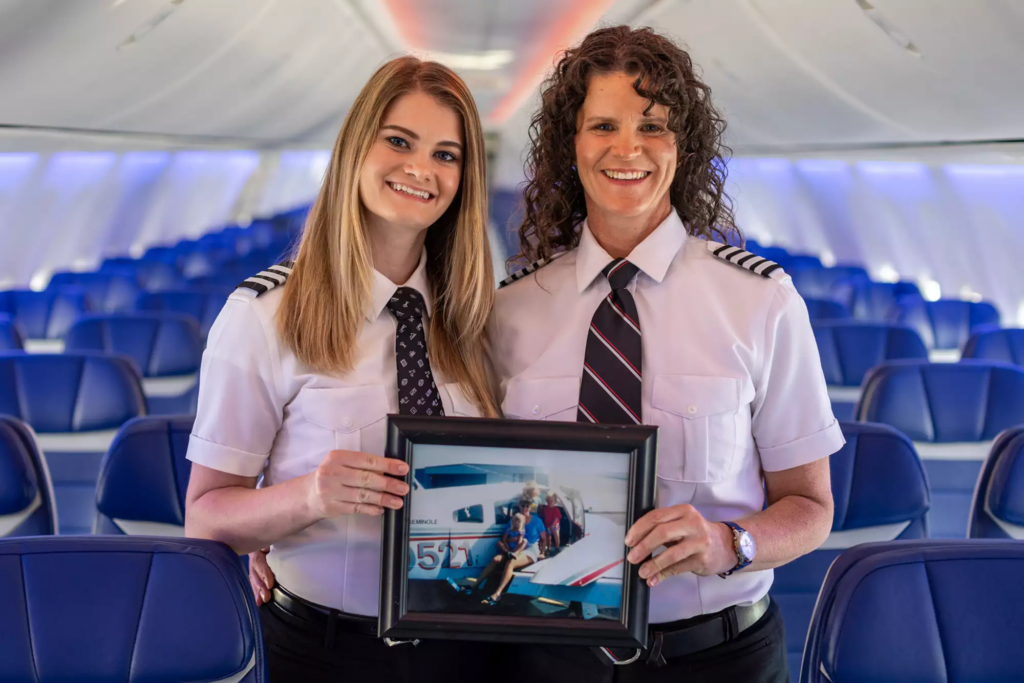
Southwest Airlines marked a historic moment on July 23, 2022, when Captain Holly Petitt and First Officer Keely Petitt piloted Flight 3658 from Denver to St. Louis, becoming the airline’s first mother-daughter pilot duo in its 55-year history.
Holly’s aviation journey began unconventionally. After college, she worked as a flight attendant. Inspired during a flight, she decided to pursue the cockpit. While raising three children, she diligently earned her pilot licenses, eventually joining Southwest 18 years ago. “It was the most amazing interview of my life,” Holly recalled. “Eighteen years later and I’m still giddy to do my job.”
Her daughter, Keely, discovered her own passion at age 14 during a discovery flight. She methodically followed her mother’s path, earning her licenses and securing a Southwest internship in 2017 before being hired as a first officer in May 2022. “Southwest was always the end goal for me,” Keely said. “There was really never any other option.”
Their shared flight was deeply emotional. “One moment you are holding this tiny little premature baby in your arms and in a blink of an eye she is sitting next to you on the flight deck of a Boeing 737 jet!” Holly wrote in a Facebook post.
The milestone is significant in an industry where only about 6% of pilots are women. Their story is not just a family triumph but a powerful symbol of mentorship, perseverance, and expanding representation in aviation. It demonstrates that career dreams can be both personally fulfilling and generationally inspiring, proving that with support and determination, the sky is truly no limit—especially when you get to share the cockpit with someone you love.
A Mother’s Scream, A Stranger’s Hands
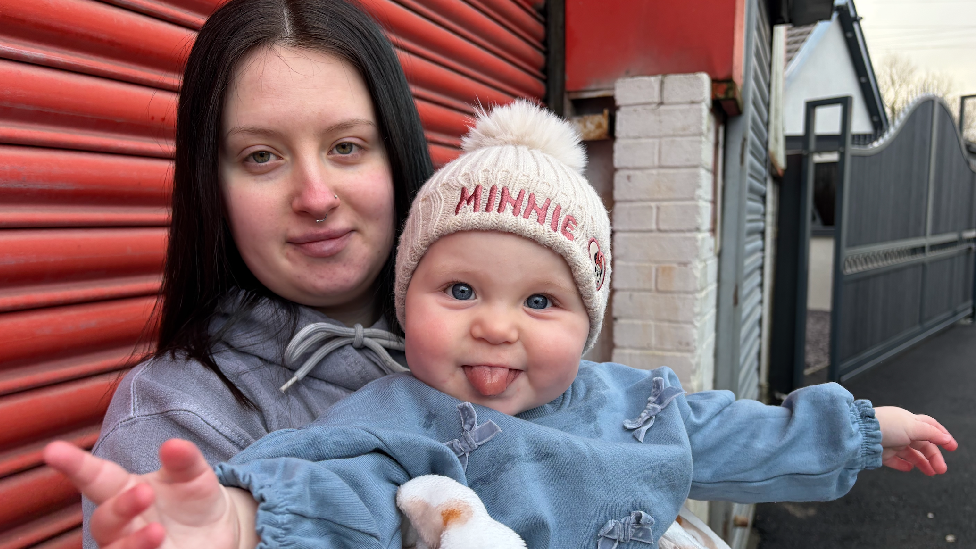
On January 14, 2026, a routine drive turned into a nightmare for 21-year-old mother Alex McClean. Traveling with her nine-month-old daughter, Lilah, along the A465 in Wales, her car suddenly lost power, filled with smoke, and warning lights flashed. She managed to pull into a lay-by, but when she exited, the passenger doors locked automatically, trapping Lilah inside as smoke turned to visible heat under the hood.
In sheer panic, Alex screamed and beat the window with her keys as traffic sped past. Within moments, welder Wesley Beynon, 39, and his uncle, Marc Willding, 58, pulled over. Without hesitation, Wesley forced open the driver’s door, leaned across the seat, and unclipped Lilah from her car seat. Marc immediately took the infant and sprinted to safety.
Approximately 30 to 60 seconds later, the vehicle was fully engulfed in flames, becoming what witnesses described as a “fireball.” Thanks to the pair’s swift, decisive actions, Lilah was completely unharmed.
Alex later called the men “real lifesavers,” emphasizing that they stopped and acted when others did not. The incident underscores the terrifying speed at which a mechanical failure can escalate and the vital importance of remaining calm in an emergency. It also highlights the profound impact of bystander intervention—the split-second decision to stop and help transformed a potential tragedy into a story of survival and human connection.
Wesley and Marc’s courage serves as a powerful reminder that heroes often appear in ordinary moments, armed not with special equipment, but with willingness, clarity, and action. Their quick thinking under pressure saved a young life, proving that sometimes the most important journey is the few steps taken toward someone in need.
A Promise Made at Fifteen

At age 15, Georgia received a life-altering diagnosis: Mayer-Rokitansky-Küster-Hauser (MRKH) syndrome, a rare condition meaning she was born without a uterus. In that small doctor’s office, her best friend Daisy squeezed her hand and made an extraordinary vow: “It’s okay, I’ll have your baby one day.” What could have been a fleeting comfort became a covenant that defined the next decade of their lives.
Georgia became a midwife, guiding countless families through birth, including Daisy’s own daughter in 2022. After that delivery, Daisy renewed her promise, and together with Georgia’s partner, Lloyd, they embarked on a surrogate journey using Georgia’s eggs and Lloyd’s sperm.
The path was fraught with emotion, including a devastating miscarriage in 2024. Yet, they persisted. In early 2025, a second embryo transfer succeeded. On an October day that year, Daisy went into labor, and in a moment of profound, full-circle grace, Georgia—the midwife who had dedicated her career to catching babies—guided her own daughter, Ottilie, into the world, her hands the first to hold her child.
This story transcends a medical narrative. It is a testament to a friendship of unparalleled depth, a promise that refused to be forgotten, and the convergence of love, science, and sheer will. It challenges the finality of a diagnosis, illustrating that family is not bound by biology alone but can be built through unwavering loyalty and shared sacrifice. From a teenager’s aching silence to a delivery room filled with triumphant tears, Georgia and Daisy’s journey reminds us that sometimes the most impossible dreams are realized through the love of someone who simply refused to let them go.
The Family I Built
Jack Lawson’s life took a profound turn when he learned that after his U.S. Army service, he would be unable to have biological children. The news struck a deep chord in a man who had grown up without parents himself and understood the void of not having someone to rely on. Instead of allowing that loss to define him, he channeled it into purpose.
Visiting a group home, he met Malik, Eli, and Aaron—three brothers with a powerful bond. The youngest, Aaron, has Down syndrome; Eli was his protector; and Malik was the quiet anchor. Jack saw not three separate stories of need, but a family waiting to be claimed. He made the decision to adopt them all.
For twenty years, Jack has walked the challenging and rewarding path of fatherhood. He provided stability, guidance, and unconditional love, while his sons gave him a sense of belonging and purpose he’d never known. Today, Malik, Eli, and Aaron are kind, grounded adults—a testament to the resilience a family can foster.
When people remark how lucky the boys are to have been adopted, Jack is quick to correct them: he is the lucky one. In choosing to become a father to three brothers, he didn’t just change their lives—they transformed his. Their journey together is a powerful reminder that family isn’t always born; it’s often built through choice, courage, and an open heart. For Jack, fatherhood wasn’t a road he missed—it was the one he paved himself, one day at a time, with the sons who made him whole.
When Ordinary People Do Extraordinary Things
From Mizoram, a story emerged in 2019 that continues to resonate as a perfect portrait of innate compassion. Six-year-old Derek C Lalchhanhima, after accidentally running over a neighbor’s chick with his bicycle, made a decision that would touch millions. He did not hide or panic. Instead, he gently cradled the injured chick, clutched his entire life savings of ten rupees, and rushed to the hospital, earnestly believing the doctors could help and his money would be enough to pay for it.
A photograph of him at the hospital, visibly anxious with the chick in one hand and the crumpled note in the other, was shared online by Sanga Says. It went viral, flooding social media with an outpouring of emotion. Users celebrated his “angel’s heart” and credited his parents, seeing in him a hopeful beacon for the future. As his father later explained, Derek did not understand the concept of death; he only understood that something was hurt and needed to be fixed, leading him to beg his parents to take it to the hospital.
The story transcends a mere viral moment. It highlights the uncorrupted moral framework of a child, where responsibility and empathy are instinctive, uncomplicated by the knowledge of futility or financial cost. In a world often hardened by cynicism, Derek’s simple act—a ten-rupee plea for a life—became a powerful mirror. It asked a silent, profound question of every adult who saw it: when did we lose the instinct to try, against all odds, to mend what we have broken? His journey to the hospital wasn’t a failure; it was a masterclass in humanity.
Leave a Comment